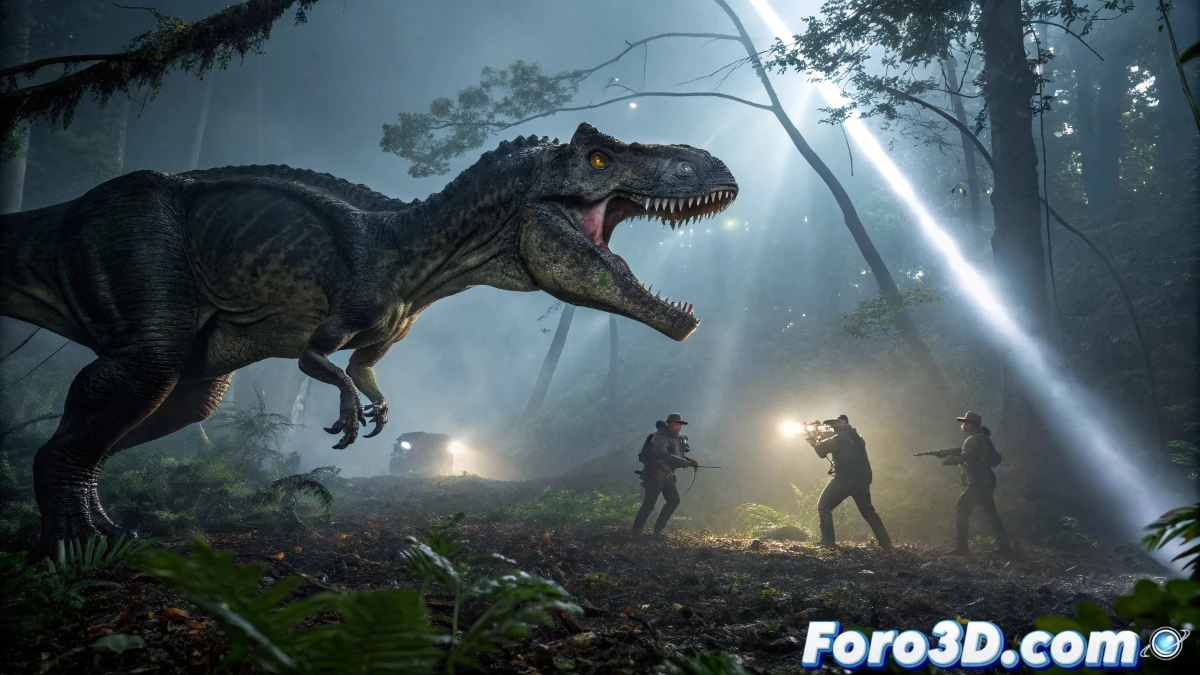
The Rebirth of Jurassic World marks a milestone in the evolution of visual effects within the franchise. Under the direction of Gareth Edwards, known for his work on Rogue One: A Star Wars Story, the film seeks to intensify the fear factor through a new vision that combines traditional and modern techniques. Producer Frank Marshall and Steven Spielberg, responsible for the innovative visual effects of the original 1993 film, felt that this installment should lean towards horror, emphasizing authenticity and danger in every scene.
Filming in real locations for greater realism
To achieve a more immersive experience, the production opted to film in real locations in Thailand and Malta. This decision allowed capturing primitive and authentic landscapes, moving away from computer-generated environments. Gareth Edwards highlighted that the original Jurassic Park had only a few dozen shots with special effects and yet remains one of the most impactful films in cinema. Therefore, they focused on returning to practical techniques to achieve a greater connection with the audience.
Combination of animatronics and CGI for more terrifying creatures
In The Rebirth of Jurassic World, the dinosaurs and other prehistoric creatures were created through a combination of animatronics and CGI. This blend allowed bringing to life more realistic and terrifying creatures, based on scientific research on dinosaurs, but with a design adapted to enhance the terror on screen. Gareth Edwards drew inspiration from horror film classics to design the new creatures, creating a visually impactful experience.
Use of cameras and anamorphic lenses for a classic aesthetic
To evoke the look of the original 1993 film, director Gareth Edwards decided, for the first time in his career, to shoot The Rebirth of Jurassic World using 35 mm film. Panavision anamorphic cameras and lenses were employed, giving the film a classic aesthetic and a visual depth that pays homage to the franchise's legacy.
Technical challenges in aquatic and action scenes
The filming of The Rebirth of Jurassic World presented significant technical challenges, especially in aquatic and action scenes. The sequences shot in the Mediterranean Sea required meticulous planning and the use of advanced visual effects to ensure the safety of the cast and the authenticity of the scenes. These difficulties highlight the production team's commitment to a realistic and thrilling cinematic experience.
Collaboration between departments for seamless VFX integration
The creation of the visual effects in The Rebirth of Jurassic World was the result of close collaboration between the production, special effects, and post-production departments. This synergy ensured that computer-generated elements integrated seamlessly with real location shots and practical effects, offering the audience a coherent and immersive visual experience. The focus on interdisciplinary collaboration highlights the team's dedication to maintaining quality and visual continuity throughout the film.