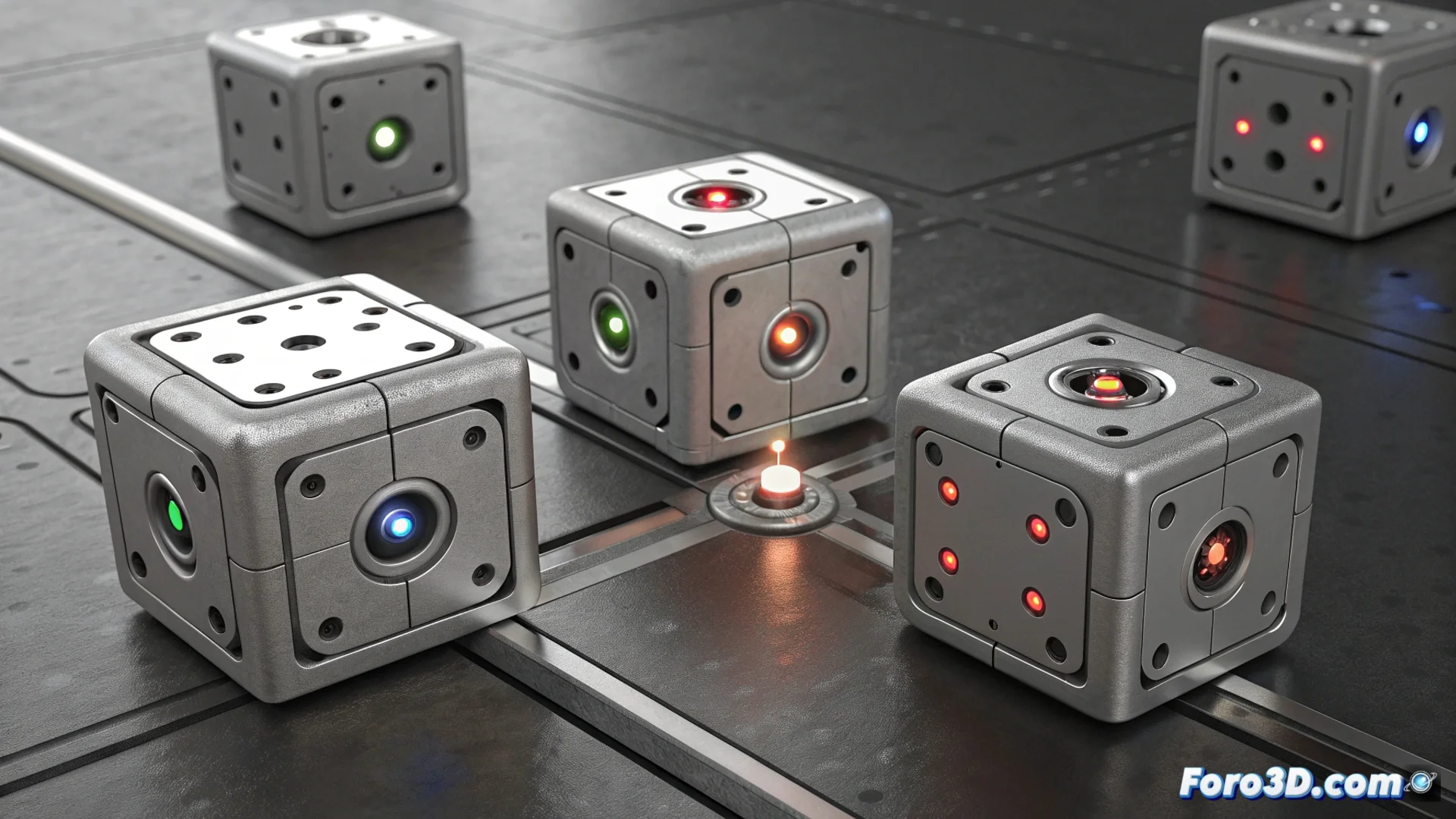
M-Block 2.0 Robotic Cubes Evolve to Coordinate
The MIT Computer Science and Artificial Intelligence Laboratory has unveiled the second iteration of its fascinating M-Blocks. These autonomous cubes, which stand out for having no arms, wheels, or any visible appendages, have taken a crucial leap: they can now interact and coordinate with each other to create shapes and collective behaviors. 🤖
The Heart of Movement: An Internal Flywheel
The secret to their movement lies in an internal flywheel system. This component spins at extremely high speeds, up to 20,000 RPM. By braking it abruptly, the cube transfers its angular momentum and generates a precise impulse. This mechanism gives them surprisingly agile mobility to roll, jump, and even attach to other cubes using permanent magnets on their faces.
Key Advantages of This Design:- Robustness: Lacking fragile external moving parts, they are more resistant and suitable for complex environments.
- Mechanical Simplicity: Their construction is more straightforward, favoring scalability and reducing failures.
- Movement Versatility: A single internal mechanism enables multiple types of locomotion.
"The absence of external moving components radically simplifies their design and makes them remarkably robust," highlight the developers.
Collective Intelligence via Infrared
The major novelty of this 2.0 generation is an infrared communication system. Each of the cube's six faces integrates a sensor and an emitter, creating a local data network with its immediate neighbors. This allows the cubes to share information in real time about their identity, position, and internal state.
New Enabled Capabilities:- Preprogrammed Group Behaviors: The cubes can execute instructions to follow a specific path or assemble a figure.
- Temporary Structures: They have the ability to join together to create a shape and later disassemble it to form another.
- Decentralized Coordination: Each cube makes decisions based on information from its neighbors, without needing central control.
A Future of Transformation (Still Paused)
Although the vision of self-assembling cube swarms recalls science fiction, the researchers are pragmatic. Currently, their movement and reorganization speed is deliberate, like a puzzle that thinks through each move, far from the fast transformations in movies. This project explores the foundations of distributed modular robotics, laying the groundwork for future applications in logistics, emergency response, or even space exploration, where adaptability and redundancy are crucial. 🧩