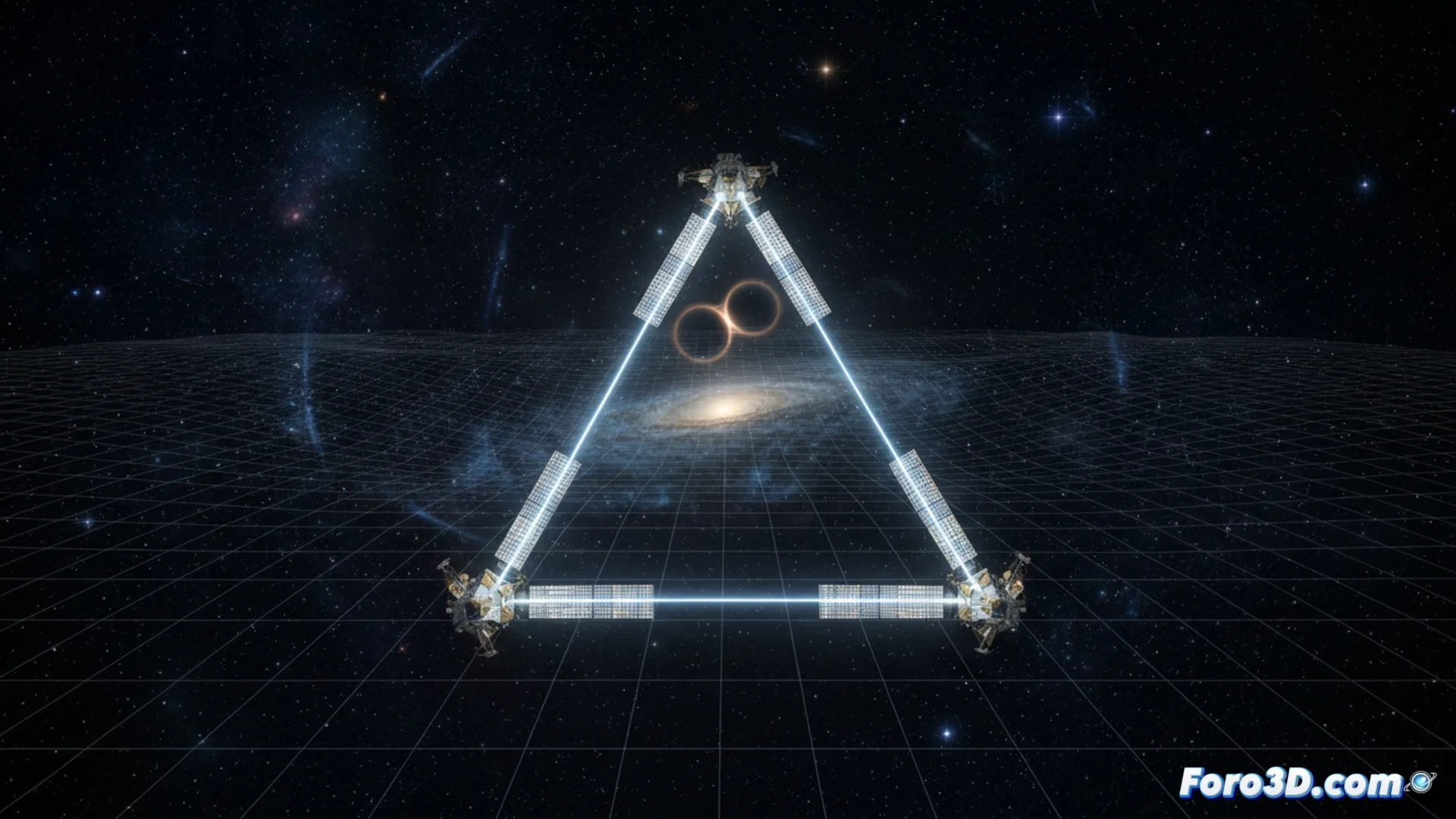
The LISA Mission Advances Toward Its 2035 Launch
The European Space Agency (ESA) leads the LISA project, which will be the first observatory designed to detect gravitational waves from space. Its launch is planned for the mid-2030s and is carried out with the support of NASA and multiple ESA member countries. By placing its technology in orbit, LISA will be able to perceive these space-time ripples at frequencies that ground-based detectors cannot reach, offering an unprecedented view of the cosmos. 🛰️
Scientific Objectives and Types of Signals
This unique capability will allow the mission to investigate astrophysical events on an enormous scale. It will be able to analyze, for example, how supermassive black holes merge in galactic cores or examine binary systems of white dwarfs in our galaxy. Each phenomenon generates a characteristic gravitational wave signature. By deciphering these signals, scientists will be able to better understand the nature of the objects that produce them and test the laws of general relativity under extreme conditions.
Key Phenomena LISA Will Study:- Collisions and mergers of black holes with enormous masses.
- Compact binary systems, such as pairs of white dwarfs, within the Milky Way.
- Ripples in the fabric of space-time at very low frequencies.
LISA will open a completely new window to observe the universe, listening to the distortions in space-time that traditional telescopes cannot see.
The Scientific Team Preparing the Mission
To ensure the mission's success, the ESA and NASA selected a group of twenty experts who form the LISA Science Team. Until the end of 2025, this team is dedicated to precisely defining what the instruments need, creating the algorithms that will analyze the data, and organizing how observations will be conducted. Their work is essential to have everything ready when LISA begins operating.
Main Tasks of the Team:- Establish the technical requirements for the onboard instruments.
- Develop software to process the complex data received.
- Plan observation campaigns to maximize discoveries.
Overcoming Challenges of Extreme Precision
Although detecting these cosmic ripples may seem like science fiction, the challenges are very concrete. One of the biggest consists of calibrating the laser interferometers with unprecedented accuracy. The required precision is so high that it equates to measuring the change in thickness of a human hair over the distance from Earth to the planet Jupiter. Overcoming this obstacle is key for LISA to be able to listen to the faint whisper of the universe. 🔬