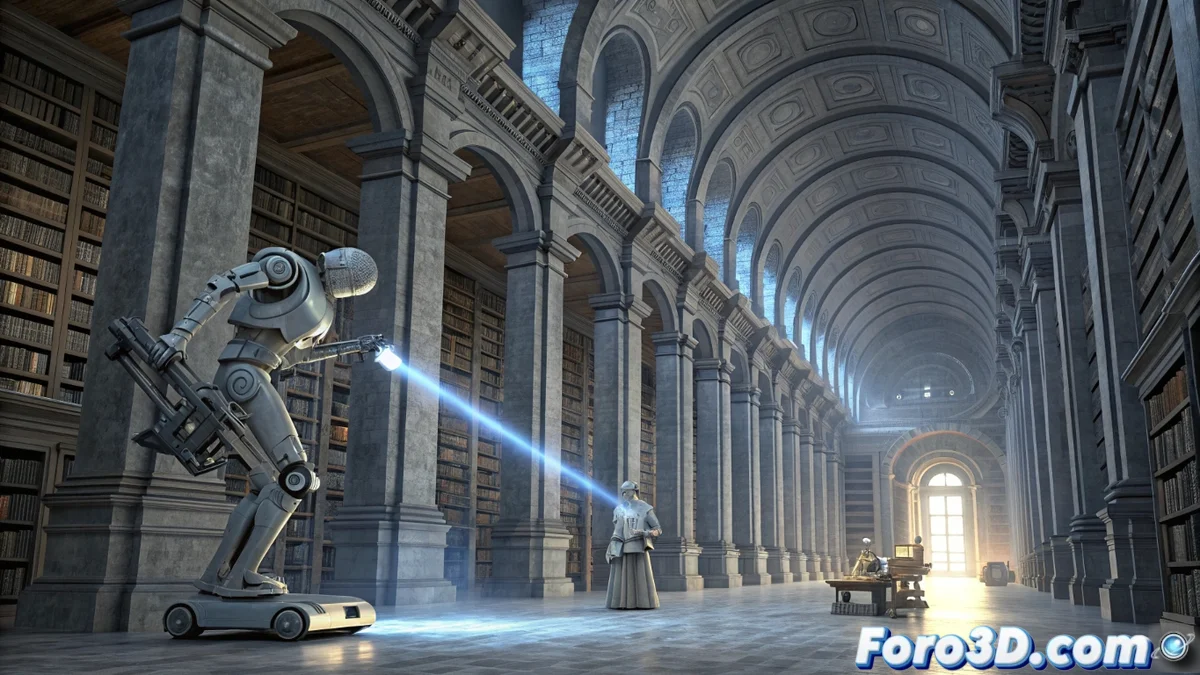
The Library of Alexandria is Purged with Algorithms
The air in the vast hall remains still, saturated with particles of ancient papyrus. A low and constant hum, emitted by advanced devices, replaces human murmur. There is no fire, only the cold bluish flash of laser scanners that examine each roll with relentless meticulousness. A unified world authority oversees this operation. Its goal is not to annihilate knowledge, but to filter it. A central algorithm, designated as The Criterion, analyzes every phrase, every idea, and every historical figure in fractions of a second. 🤖
The algorithm that dictates which past endures
When the system identifies what it classifies as misinformation, it acts instantly and aseptically. The robotic arm places the already digitized document into a plasma disintegration unit located on its platform. A silent and contained flash turns the physical text into fine mineral residue that is collected in a container. No high temperature spreads, nor is there any trace of the smell of burned paper. Only a faint vapor, remnant of the suppressed memory, is sucked away by ducts at the top. In this way, the global chronicle is modified instantly, preserving only the segments that match the authorized version of the facts. The machines do not hesitate, do not weigh. They only obey.
Features of the purging process:- Evaluation in milliseconds: The Criterion processes concepts and names at extreme speed.
- Plasma elimination: Physical originals are disintegrated in an integrated incinerator, without bulky residues.
- Operational silence: The scanner's confirmation beep and the whisper of disintegration replace all organic sound.
They build the most perfect oblivion: a past without edges, without dissent, and therefore, without humanity.
The terrifying efficiency of a knowledge dystopia
What is most unsettling is the total absence of noise. No voices of scholars or debates are heard. The crackling of flames has been replaced by machine acoustic signals and the faint hiss of plasma. The natural light that once bathed the parchments is now artificial, emanating from the devices themselves, projecting geometric and lifeless shadows. This space, once bustling and chaotic, functions as an inverse assembly line where collective memory is disassembled. Every manuscript that vaporizes extinguishes an alternative perspective for understanding the now.
Elements that define the new environment:- Cold artificial light: Comes from scanners and robots, creating a clinical and sterile atmosphere.
- Absence of human intervention: Archiving robots execute all tasks with surgical precision.
- Real-time rewriting: The historical narrative is continuously updated and purified.
The final paradox: order versus obliteration
A historian from another era, transported here, might not notice the catastrophe immediately. He would observe neatness, efficiency, and digital preservation. Only upon approaching a text he knew and seeing it vanish before him would he understand the magnitude of the act: they are building oblivion. The supreme irony lies in the fact that, to safeguard a declared truth, they have erected the most absolute falsehood: a seamless chronology, without discordant voices and, consequently, devoid of what makes us human. Absolute knowledge, filtered by an algorithm, reveals itself as the greatest deficiency. 😶