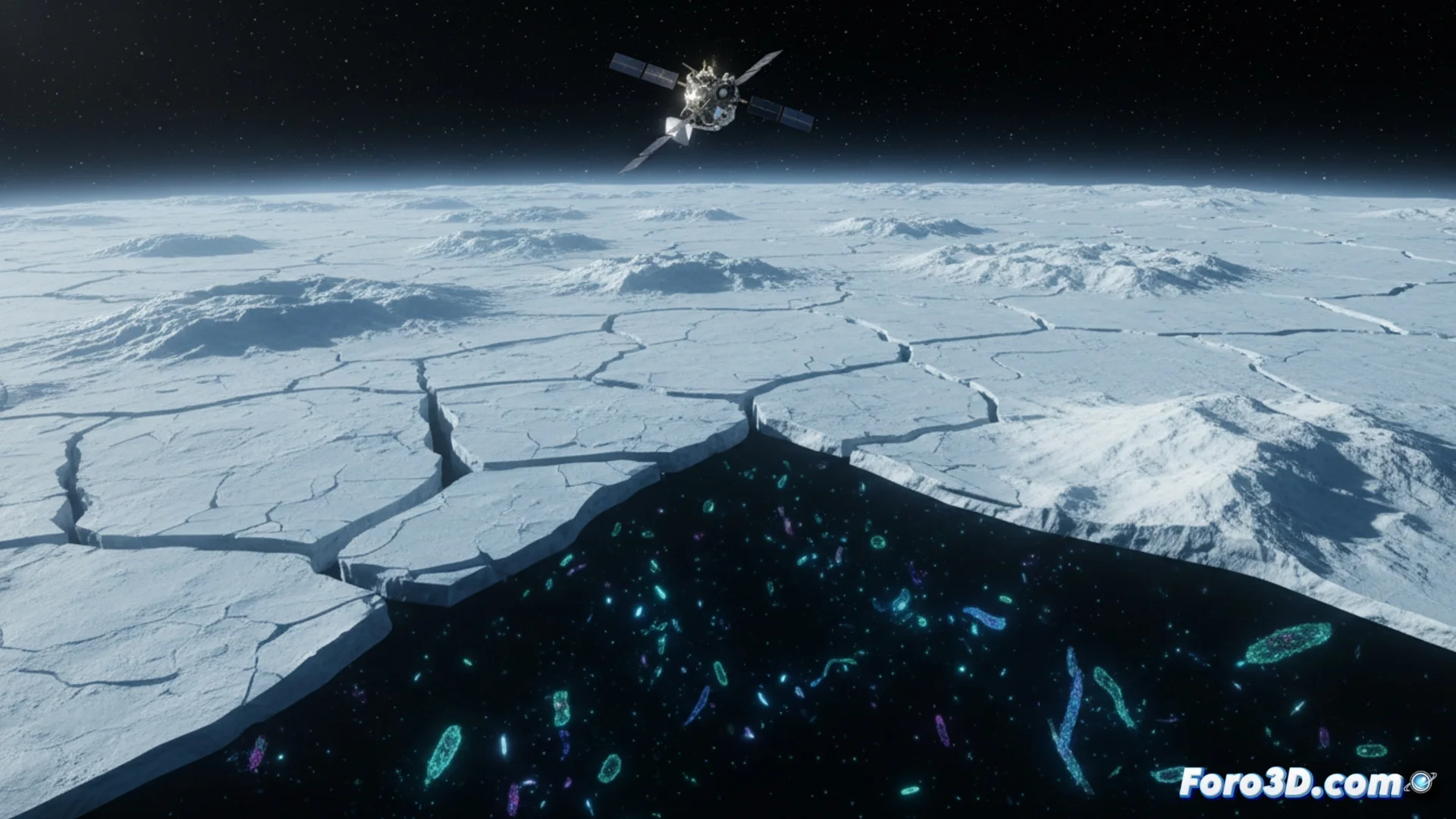
The Juno Probe Accurately Measures Ice on the Moon Europa
NASA's Juno spacecraft has successfully determined the exact thickness of the ice layer enveloping Europa, one of Jupiter's most intriguing satellites. This information, captured during a close flyby, resolves a long-standing scientific debate and establishes the depth at which possible signs of life might be found in its vast subsurface ocean. 🛰️
A Crucial Data Point for Exploring the Hidden Ocean
Knowing the thickness of the outer crust is fundamental for preparing upcoming missions aiming to reach the internal sea. Experts now understand that any lander robot or cryobot drill must be built to overcome that icy barrier. This discovery helps optimize the design of technology that will search for biomarkers or water samples with microorganisms.
Implications of the Finding:- Defines the engineering challenge: drilling at least 20 kilometers of ice on average.
- Allows focusing efforts on developing drilling and sampling systems capable of operating in extreme conditions.
- Concentrates the search for life in a known depth range, making exploration more efficient.
To find life beyond Earth, we must first figure out how to penetrate a planetary-scale ice crust. At least now we know the thickness of the obstacle.
The Technique That Revealed the Internal Structure
Although Juno was not originally designed to study Europa in depth, its gravity measurement instrument and radio wave experiment were decisive. By examining how the satellite's gravitational pull slightly altered the spacecraft's path, the scientific team was able to infer its internal structure. The combined data reveal a substantial ice crust, though with regional variations, pointing to active geology beneath the surface.
How the Measurement Was Obtained:- Analysis of perturbations in Juno's trajectory caused by Europa's gravity.
- Use of the radio experiment to map the gravitational field with high precision.
- Interpretation of the data to model mass distribution and, therefore, the thickness of the ice layer.
The Next Big Step: Penetrating the Ice
The challenge is no longer just scientific but also one of advanced engineering. Finding evidence of extraterrestrial life on Europa depends on our ability to create technology that can drill tens of kilometers through ice on a distant, frigid world. Juno's measurement provides the essential parameter to turn that dream from speculation into a defined technical objective. 🔬