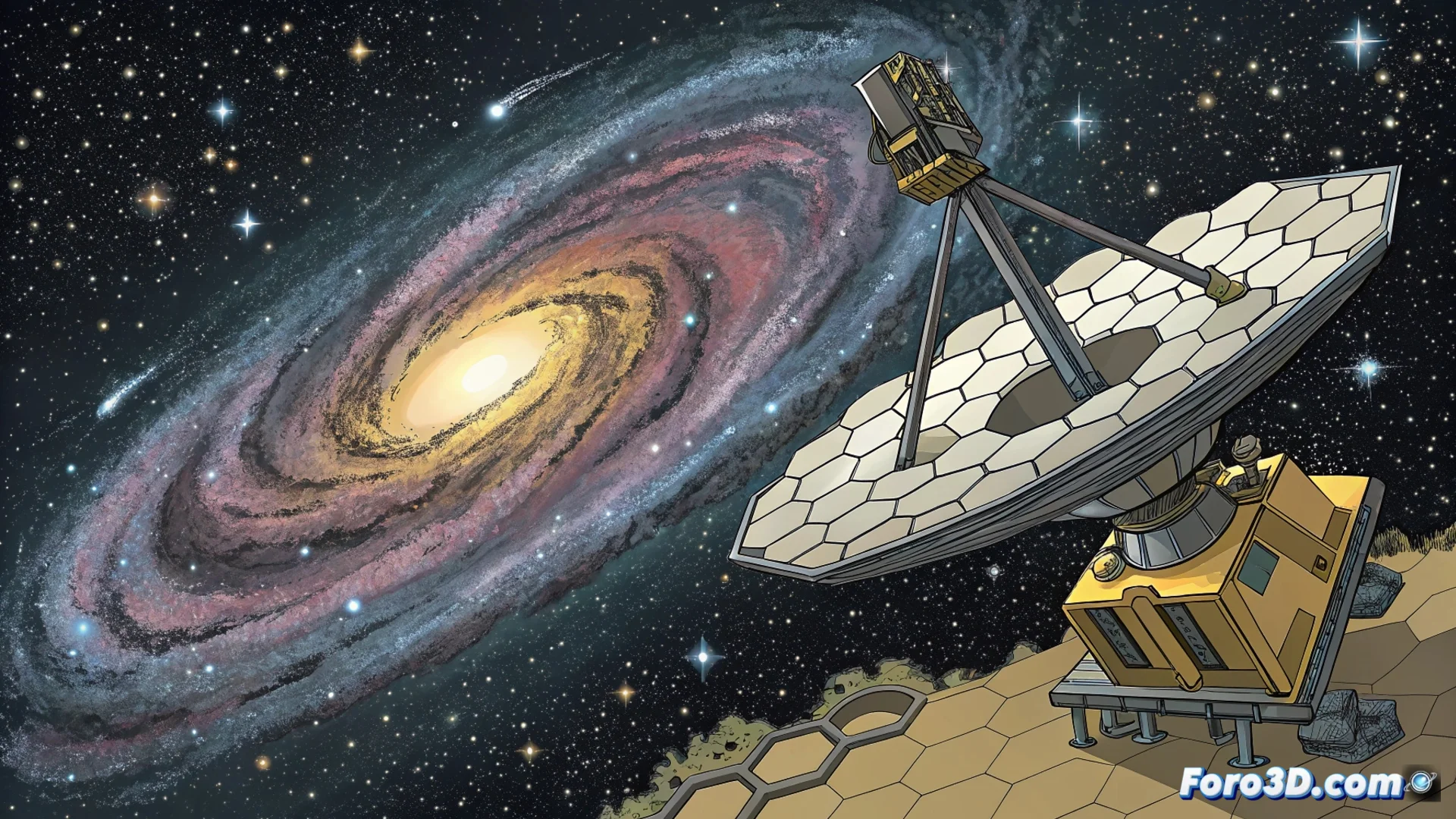
The James Webb Telescope Studies the Dwarf Galaxy Sextans A
The James Webb Space Telescope directs its observational power toward a cosmic object that acts as a time machine: the dwarf galaxy Sextans A. Located about 4 million light-years away, its scientific value does not lie in the distance, but in its exceptionally primitive chemical composition. Astronomers classify it as an ideal laboratory for investigating the origins of the cosmos. 🔭
A Chemical Window into the Primitive Universe
The importance of Sextans A lies in its extreme low metallicity. In astrophysics, the term "metal" encompasses all elements heavier than hydrogen and helium. This galaxy retains only between 3% and 7% of these elements compared to our Sun. This scarcity indicates that it has processed very little stellar material throughout its history, showing a state similar to that of galaxies when the universe was young.
Key Features of Sextans A:- Pristine Composition: Its low content of heavy elements makes it an analog of the first galaxies.
- Unique Environment: It offers conditions to study how stars form without the influence of many metals.
- Target for Webb: Its infrared instruments can penetrate dust and precisely measure its faint chemical signature.
Observing galaxies like Sextans A is like looking at a photograph of the teenage universe, where fundamental processes were simpler and more direct.
Revealing the Secrets of Star Formation
By analyzing Sextans A, the James Webb not only investigates the chemistry of the early cosmos but also the different rules that may govern the birth of stars in such a metal-poor environment. Under these conditions, the gas collapses to form stars in a distinct way, affecting their mass, luminosity, and evolution.
What Webb Can Discover:- Formation Mechanisms: How gas and dust clouds condense in an environment with few heavy elements.
- Stellar Populations: Detailing the types of stars that predominate and their distribution in the galaxy.
- Evolutionary History: Reconstructing the timeline of star formation events in Sextans A.
A Distraction-Free Cosmic Laboratory
Galaxies like Sextans A, which have avoided accumulating many "metals," offer astronomers a clean study environment
Related Links