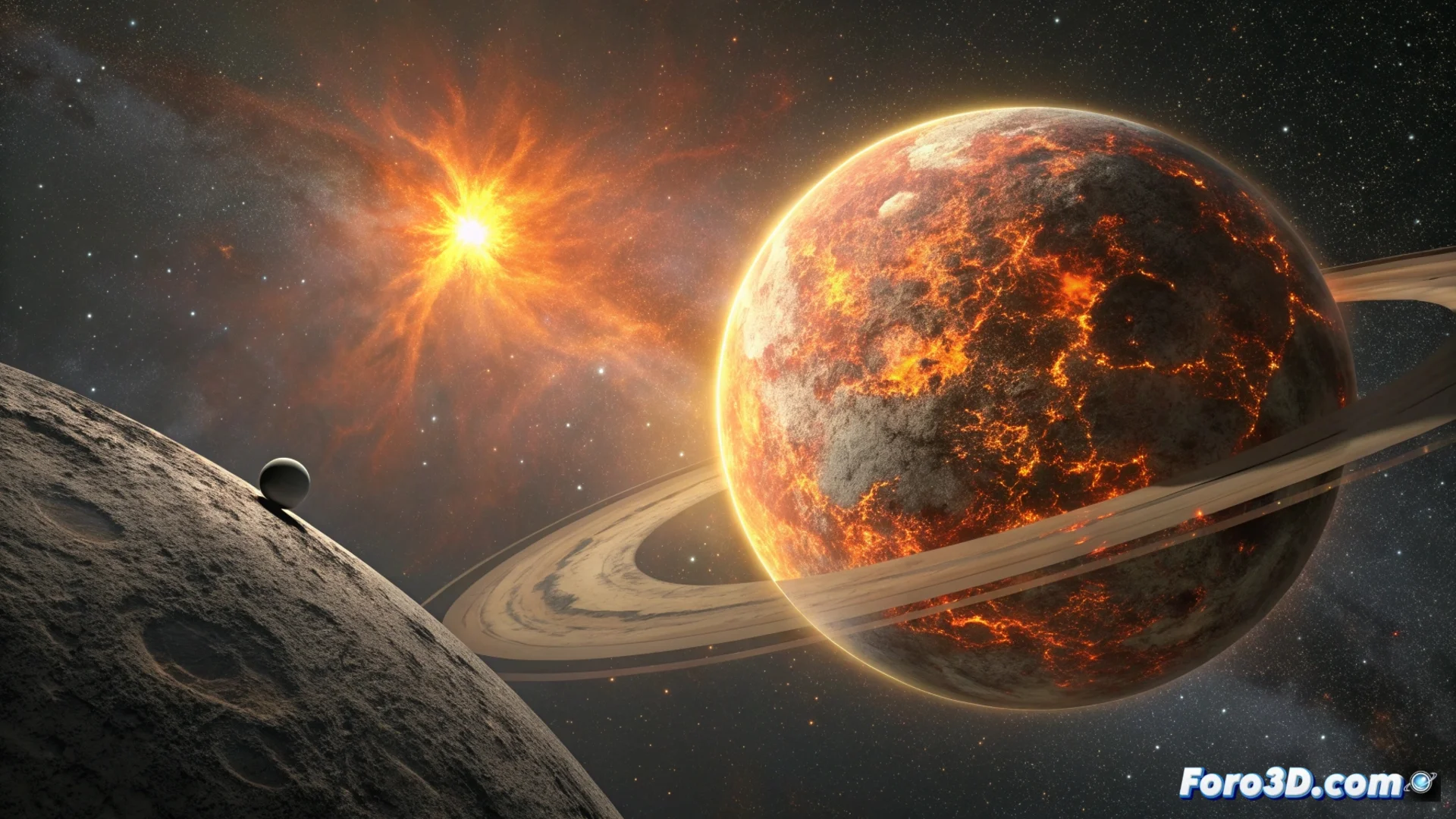
The James Webb Telescope Detects an Atmosphere on an Extreme Super-Earth
A discovery by the James Webb Space Telescope calls into question what we know about rocky planets. The data indicate that the exoplanet TOI-561 b, an infernal world, retains a gaseous envelope despite extreme conditions. 🪐
A World That Challenges Planetary Models
TOI-561 b is 50% larger than our planet and completes an orbit around its star in less than half an Earth day. This proximity generates surface temperatures exceeding 2000 °C, an environment where astronomers believed it was impossible for a primitive atmosphere to persist. However, the James Webb has captured a spectral signature suggesting otherwise.
Key Characteristics of TOI-561 b:- Classified as a rocky super-Earth with a size considerably larger than Earth's.
- Orbits an orange dwarf star at a minimum distance, completing each orbit in just 12 hours.
- Its surface is so hot that scientists theorize the presence of oceans of molten rock.
The new findings challenge current models on how atmospheres evolve and survive on planets under intense radiation bombardment.
The Technique That Reveals the Invisible
For this analysis, the scientific team used the Webb's NIRSpec instrument. They applied the transmission spectroscopy method, which involves analyzing the star's light filtered through the planet's atmosphere as it transits in front. This technique allows identifying which molecules absorb light at specific wavelengths.
Details of the Atmospheric Finding:- The detected signal is solid and points to a gaseous envelope denser than any model predicted for such a planet.
- The composition could be rich in hydrogen or contain water vapor, although the data are still preliminary.
- The discovery opens a scientific debate on the origin and nature of this persistent atmosphere.
Implications for Searching for Habitable Worlds
This finding not only redefines the resilience of atmospheres in hostile environments but also expands the criteria for seeking potential conditions on other worlds. If an atmosphere can survive in a hell like TOI-561 b, astronomers will need to review where and how to search for biosignatures in the future. The James Webb continues to demonstrate its ability to transform our understanding of the cosmos. 🔭