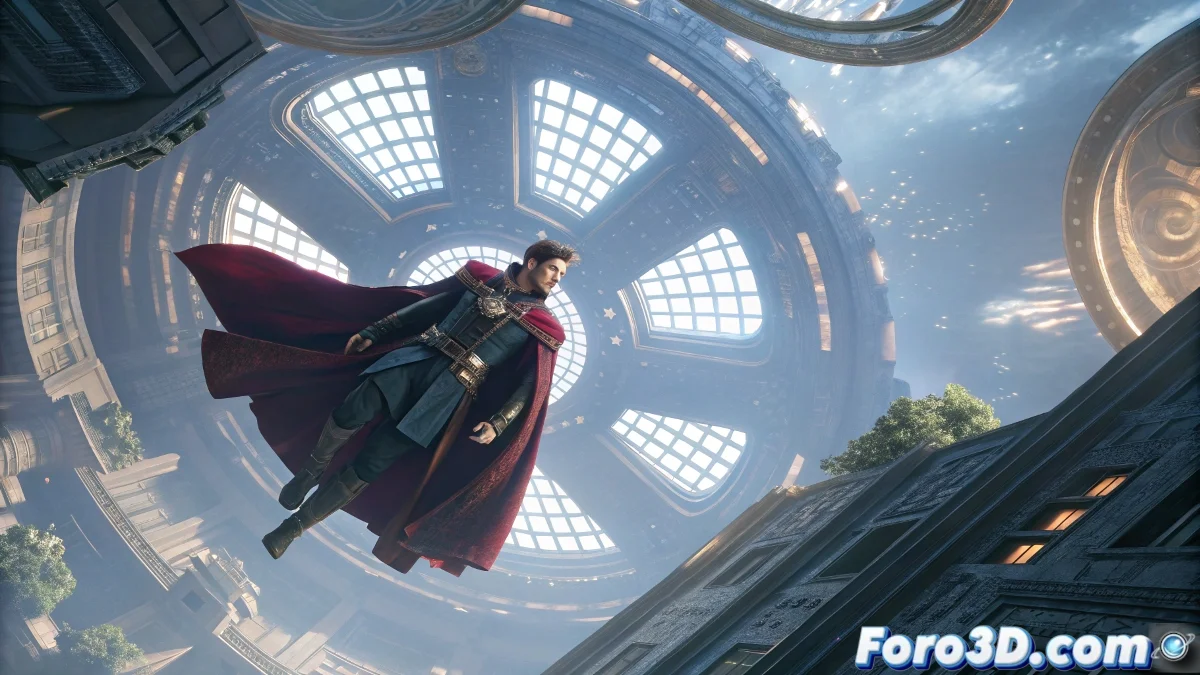
When Magic is Written in Code 🧙♂️💻
In Doctor Strange in the Multiverse of Madness, Trixter VFX faced a unique challenge: breaking the laws of physics in a believable way. Their solution was to blend advanced mathematics, chaotic simulations, and a lot, a lot of rendering.
Geometry that Defies Euclid
The fractal effects required:
- Animated boolean operations in Houdini
- Particle systems that replicate magical chaos
- Custom shaders in Redshift for infinite surfaces
Arcane fact: "Each fractal is actually 7 layers of simulations: from edge thickness to inner glow," reveals the breakdown.
The Human Body as Cosmic Clay
Body Deformations
- Special rigs in Maya with stretch controls
- Animated displacement textures
- Physical motion blur for brutal transitions
Portals that Swallow Reality
- Vector fields in Houdini that distort space
- Particle simulations trapped in vortices
- Dynamic light interactions in Nuke
VFX Spells in 3ds Max
Alternatives for foro3d wizards:
- TyFlow - For fractal dispersion effects
- Phoenix FD - Liquid simulations for portals
- Arnold/OSL - Shaders for distorted reality
- Morpher - Basic body deformations
Tip: Use Rayfire to simulate geometry that fractures multiverse-style.
The VFX Artist's Paradox
As the breakdown aptly summarizes: "We spent 3 weeks simulating a portal that distorts space-time... and the audience only remembers that Strange's cape moved on its own." But when that effect makes millions believe (for a second) in magic, every GB of corrupted cache is worth it. ✨
"In the VFX multiverse, there's a reality where renders always finish on time... but clearly it's not this one." - Anonymous Trixter sorcerer.