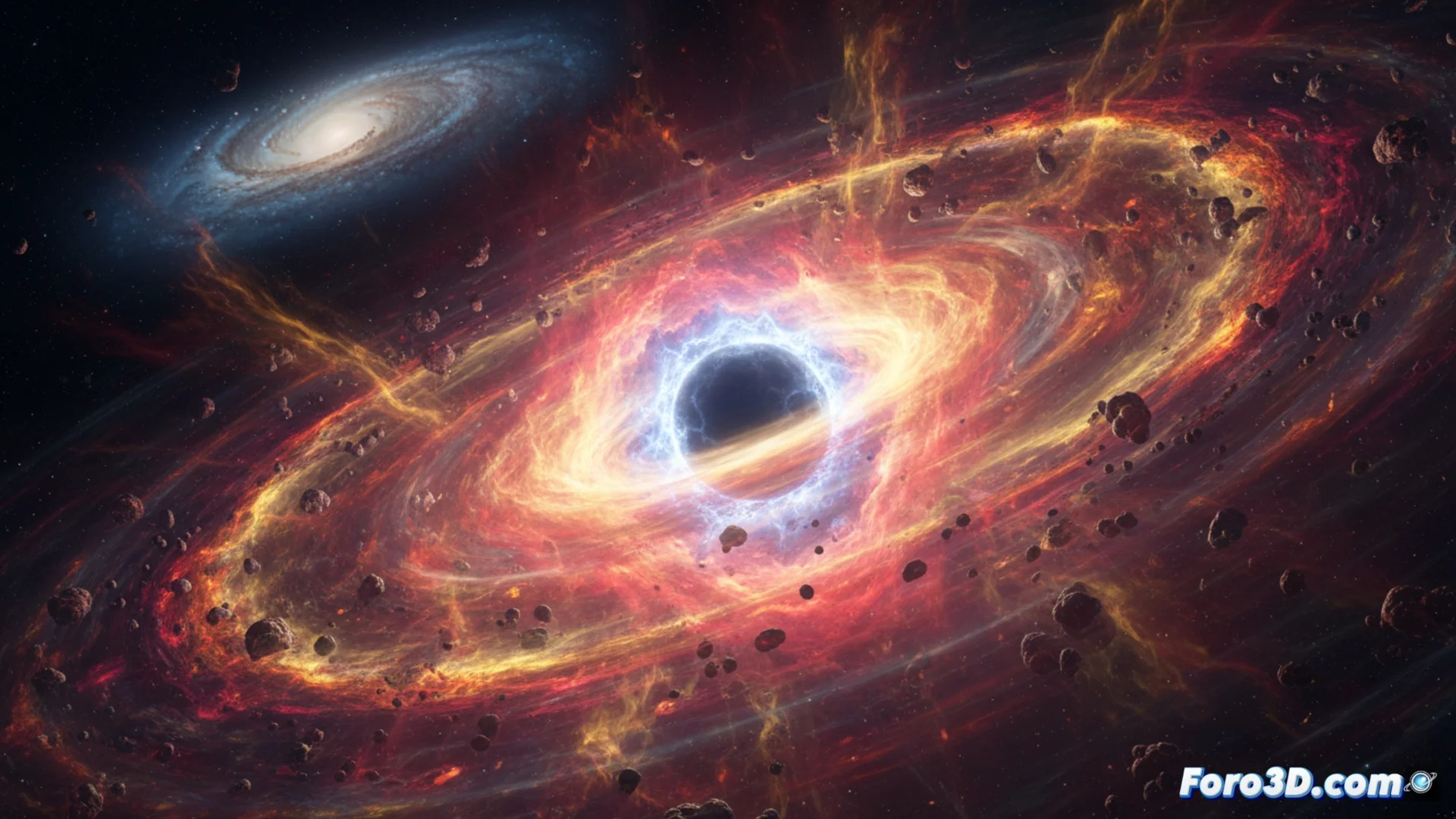
The Engines of Little Red Dots Could Be Black Hole Stars
A new scientific hypothesis suggests that the heart of the mysterious Little Red Dots (LRDs) is not an ordinary galaxy, but a black hole star in its early stages of development. This finding changes how we understand the growth of these massive cosmic objects. 🔭
An Innovative Technique to Unravel the Light
The study surpasses previous methods, which relied on the galaxy eclipsing, by presenting a new procedure to isolate the black hole's luminous signature. It is based on assuming that the [OIII]5008 spectral line emanates only from the host galaxy, allowing its contribution to be subtracted. By applying this technique to 98 LRDs observed with the NIRSpec/PRISM instrument on the JWST space telescope, the resulting spectrum shows unequivocal signals.
Key Findings in the Median Spectrum:- A Balmer jump more powerful than in massive passive galaxies.
- An optical continuum that fits the behavior of a black body.
- The presence of a marked Balmer decrement and emission lines such as FeII, HeI, and OI.
These characteristics are clear signs of dense gas envelopes and provide population-level evidence that these black hole stars power the LRDs.
Properties and Cosmic Context of These Objects
In the typical LRD, the black hole star dominates ultraviolet light emission, generates the Balmer jump, and contributes significantly to longer wavelengths. These objects do not appear anywhere; they usually inhabit low-mass galaxies that have experienced recent star formation bursts, linking their origin to this violent process.
Implications of Detection Methods:- "V-shaped" selection criteria prioritize detecting the most dominant and bright black hole stars.
- Less luminous versions could explain other active galactic nuclei with broad lines that JWST is discovering.
- It is calculated that these stars are so frequent and their life so brief that almost all supermassive black holes could have gone through this youthful phase.
A Hidden Teenage Phase for Cosmic Giants
The research paints a picture where even the most voracious black holes had a tumultuous growth stage. During this rebellious teenage phase, they remained hidden behind a dense curtain of gas, feeding frenziedly before emerging and establishing themselves as the dark giants that dominate galactic centers today. 🌌