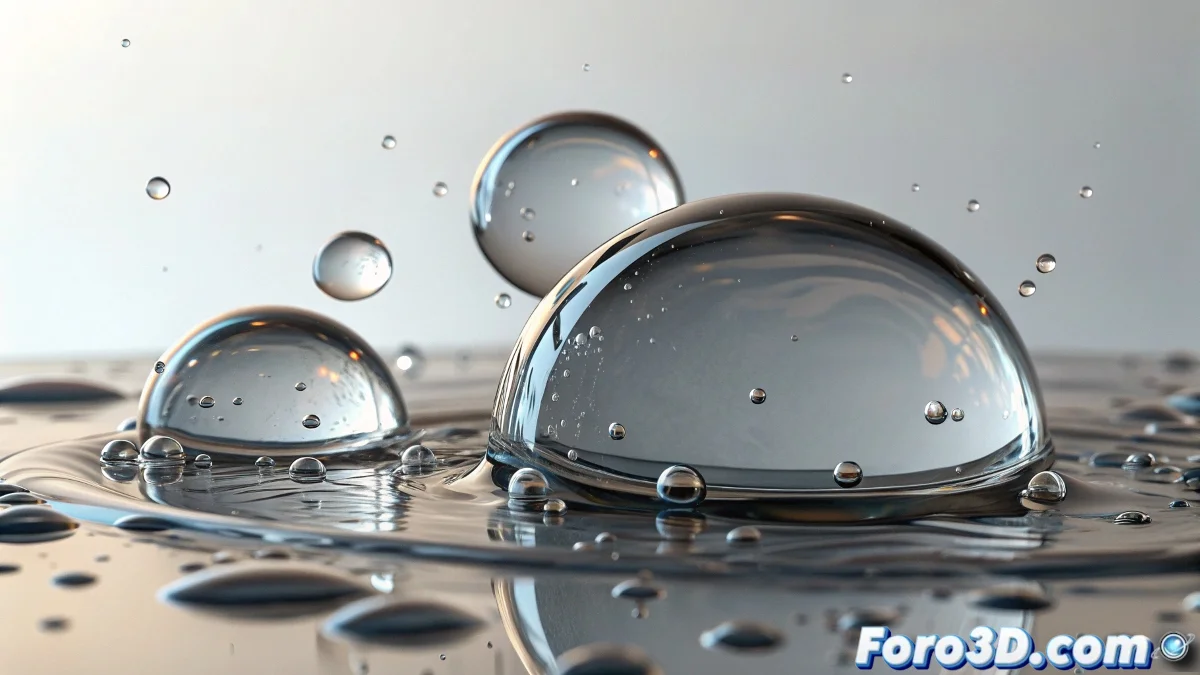
When Drops Decide to Become Tablecloths
The problem of the drop that spreads instead of maintaining its spherical shape is one of those challenges that separates beginners from experts in RealFlow. The frustration is understandable when you've tried all the obvious parameters and your drop keeps behaving more like spilled honey than a real water drop. This behavior indicates that you're fighting against a fundamental imbalance between the liquid's cohesion and adhesion forces.
The fact that you've experimented with surface tension, viscosity and external pressure shows you're on the right track, but the values probably aren't in the correct relationship. The key isn't in maximizing a single parameter, but in finding the perfect balance between several.
Effective Surface Tension Setup
Surface tension is your main ally, but it needs much higher values than you might intuitively think. For water, values between 50 and 100 are a good starting point. However, surface tension alone isn't enough - it needs to work together with adequate viscosity and a correctly configured interaction radius.
In the surface tension daemon, activate use min/max and set a max distance of 2-3 times the particle radius. This ensures that surface tension acts consistently across the entire drop, not just locally. The strength parameter should be between 5-20 for most cases.
- Surface tension: 50-100 for water
- Max distance: 2-3 times the particle radius
- Strength: 5-20 depending on drop size
- Use min/max activated for precise control
A perfect drop is like a good friend: it maintains its shape under pressure but knows when to flow
Combination with Viscosity and Density
Viscosity is the second pillar for maintaining shape. Values between 10 and 50 create that "sticky" behavior that prevents the drop from spreading too quickly. However, very high viscosities can make the drop behave like tar - the trick is to find the sweet spot where the drop slides but doesn't deform.
Density also plays a crucial role. Values between 1000 and 2000 (similar to real water) provide the necessary inertia for the drop to maintain its momentum and shape. Very low densities make the drop too "light" and susceptible to deformations.
- Viscosity: 10-50 for ideal balance
- Density: 1000-2000 for realistic inertia
- Moderate external pressure (1-5)
- Progressive combination of parameters
Advanced Setup with Specialized Daemons
In addition to the surface tension daemon, the Coriolis daemon can help maintain the drop's cohesion. Configured with low values (0.1-0.5), it acts as a gentle centripetal force that keeps particles together. It's not physically accurate for drops, but it works as an effective creative hack.
To specifically control how the drop interacts with the surface, use the contact daemon with low stickiness (0.1-0.3) and moderate friction (0.2-0.4). This allows the drop to slide without sticking too much or spreading excessively.
- Coriolis daemon: 0.1-0.5 for cohesion
- Contact daemon with low stickiness
- Moderate friction for controlled sliding
- Combination of multiple daemons
Emitter and Resolution Optimization
Particle resolution directly affects the drop's ability to maintain its shape. With too few particles, the drop will tend to form visible polygons instead of a smooth sphere. Use at least 20,000-50,000 particles for a medium-sized drop, with radius between 0.01-0.05.
The type of emitter also matters. An object emitter with an initial spherical shape provides a much more stable base than a loose particle emitter. Configure the emitter to generate the complete drop at once, rather than emitting continuously.
- 20,000-50,000 particles per drop
- Radius: 0.01-0.05 depending on scale
- Object emitter with spherical shape
- Complete emission in one frame
Mastering this technique will allow you to create everything from realistic dew drops to cohesive liquid effects for cinematic projects. Because in RealFlow, even the most rebellious drop can learn to maintain its spherical elegance with the right combination of parameters 😏
Recommended Starting Configuration
Base values for a water drop:
Surface tension: 75
Viscosity: 25
Density: 1000
Max distance: 0.15
Strength: 12
Resolution: 30,000 particles