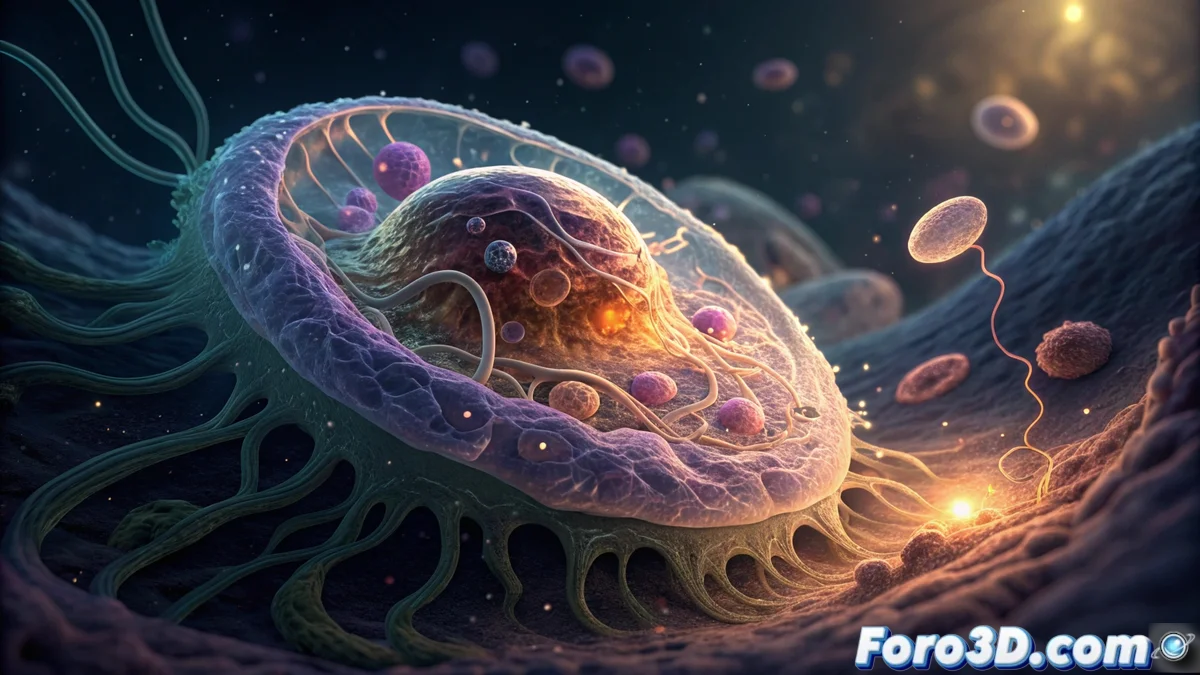
Asgard Archaea Reveal the Origin of Complex Cells
A lineage of microorganisms known as Asgard archaea has become the central piece for deciphering one of biology's greatest mysteries: the emergence of eukaryotic cells. These are the ones that make up all animals, plants, and fungi, and their appearance marked a turning point in the history of life on Earth 🔬.
The Genetic Tale of an Ancestral Fusion
Scientists analyze the genome of these archaea and discover that they contain a surprising number of genes that were previously considered exclusive to eukaryotes. These genes are responsible for complex functions, such as forming a dynamic cytoskeleton and handling internal vesicles. The main theory, called endosymbiosis, proposes that a primitive archaeon, similar to the Asgard ones, incorporated a bacterium without destroying it, initiating a collaboration that would change everything.
Key Evidence in Asgard Genes:- They possess genes for proteins that shape the cell membrane and create an internal scaffold.
- They have genetic machinery for processing and transporting molecules in compartments, a precursor to organelles.
- Their genetic profile suggests they were pre-adapted to establish a stable symbiotic relationship.
The incorporated bacterium evolved to become the mitochondrion, the organelle that powers the eukaryotic cell.
The Challenge of Studying These Elusive Microbes
To confirm this hypothesis, it is crucial to observe Asgard archaea directly. However, culturing them in the laboratory poses a huge technical challenge. These organisms thrive in extreme conditions, lacking oxygen, such as in seabed sediments or hydrothermal vents, and their growth rate is extremely slow.
Recent Advances in Their Cultivation:- Specialized bioreactors have been developed that mimic their natural high-pressure, low-nutrient environments.
- Scientists can now keep some strains alive long enough to study their structure and physiology.
- This allows investigating cellular interactions in real time and testing how symbiosis may have developed.
A Look at the Past That Defines Us
Understanding Asgard archaea is like opening a window to the precise moment when two primitive forms of life united to generate something radically new and more complex. Every cell in our body carries the heritage of that symbiotic event. So, in essence, our existence as multicellular organisms may depend on a fortuitous microbial encounter that occurred billions of years ago, a "digestive error" that turned out to be the greatest evolutionary success 🌱.