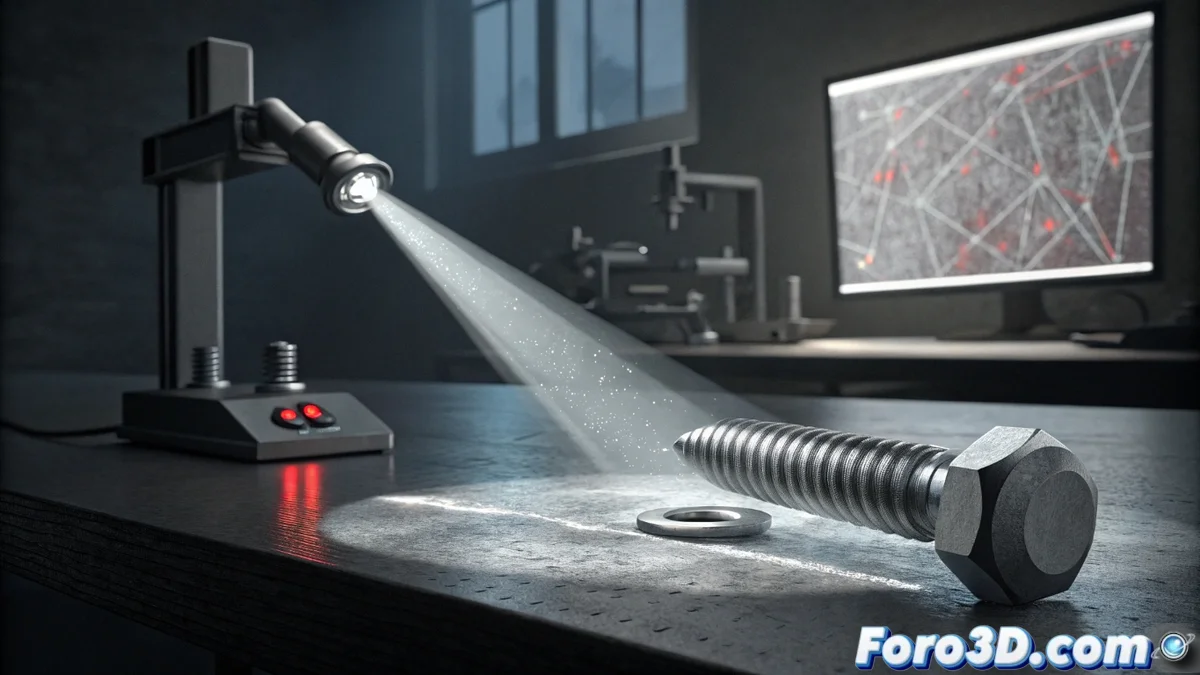
The 3D Scanner Discovers an Industrial Sabotage Screw
When an industrial machine suffers a catastrophic failure, the investigation points to a possible malicious act. 🔍 The forensic team recovers a clamping screw from the debris and decides to analyze it with cutting-edge technology to search for evidence.
Capturing Physical Evidence in Digital Form
To document the component, the experts use an industrial GOM ATOS Q 3D scanner. This equipment captures the complete geometry of the part with micrometric precision, generating a point cloud true to reality. The scan data is imported directly into the GOM Inspect metrology software, where technicians measure critical dimensions and the thread pitch. The goal is clear: compare these measurements with the manufacturer's original technical specifications.
Metrological Analysis Process:- Digitize the physical screw with a high-resolution 3D scanner.
- Import the point cloud into GOM Inspect software for processing.
- Accurately measure the diameter, length, and thread profile.
A component that does not meet the standard and is installed on purpose can only have one explanation: the intention to damage.
The Truth Emerges from Overlaying Models
Within GOM Inspect, the investigators perform a key operation: they overlay the point cloud of the scanned screw with the original 3D CAD model, managed in SolidWorks. This visual and dimensional comparison leaves no doubt. The recovered screw does not match the official design; its measurements vary and the thread pitch is different. This rules out natural wear and confirms that it is a piece deliberately replaced so that the machine would fail under operational load. 🛠️
Key Findings from the Comparison:- Millimetric discrepancies in the screw's main dimensions.
- A thread pitch different from that specified in the original drawings.
- Overall geometry that does not conform to any known manufacturing standard.
From Technical Proof to Legal Report
The final forensic report details how the anomalous part did not meet any standard and its installation was a deliberate act. The 3D digital evidence, with its deviations documented to the millimeter, becomes a crucial element for the legal investigation. This method demonstrates how combining metrological capture technology and analysis software can transform a simple screw into definitive proof of industrial sabotage. Sometimes, the smallest and seemingly insignificant element is the one that unmasks the entire plan.