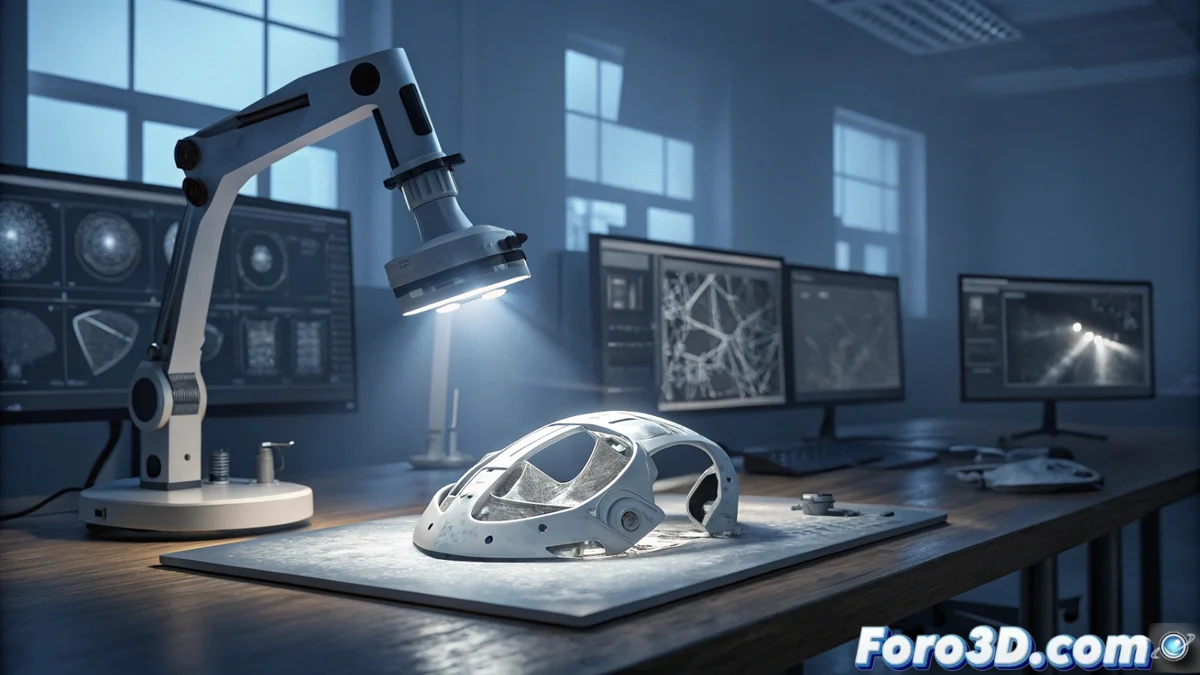
3D Reconstruction of a Headlight Identifies a Vehicle in a Hit-and-Run
When a driver flees after a hit-and-run, the physical evidence is often reduced to small plastic fragments from the headlight. These remnants, previously almost useless, now become definitive proof thanks to three-dimensional digital forensic methods. This technique allows determining the exact model of the vehicle involved. 🚗
Digitalizing Each Piece of Evidence
The first step is to capture the geometry of each piece of plastic found. Experts use a high-precision 3D scanner, such as the Artec Micro, to obtain a millimeter-accurate digital model of each fragment. This equipment records the shape and surface texture, creating a faithful virtual copy that will serve as the basis for subsequent assembly.
Key Scanning Features:- Captures the geometry and relief of the remnants with submillimeter accuracy.
- Generates a textured 3D model of each fragment separately.
- Preserves the physical evidence digitally for risk-free manipulation.
The fleeing driver may think they only left some broken plastics, unaware that each fragment holds the shape of their car.
Assembling the Virtual Puzzle
With all the scanned models, specialized reverse engineering software, such as PolyWorks or Geomagic Wrap, is used. These programs align and join the pieces digitally, reconstructing the complete shape of the original headlight. It is a process similar to assembling a puzzle, but in a virtual three-dimensional space.
Reconstruction and Comparison Process:- The software registers and assembles the 3D fragments to form a complete component.
- The digital reconstruction is compared with an extensive CAD database of automotive components.
- Upon finding a match, the manufacturer, model, and year of the vehicle are identified.
From Digital Evidence to the Suspect List
This methodology transforms seemingly insignificant remnants into concrete information. Identifying the car model drastically narrows the investigation field, allowing law enforcement to focus their resources. 3D forensic technology thus proves to be a fundamental tool for solving cases where traditional clues are scarce. 🔍