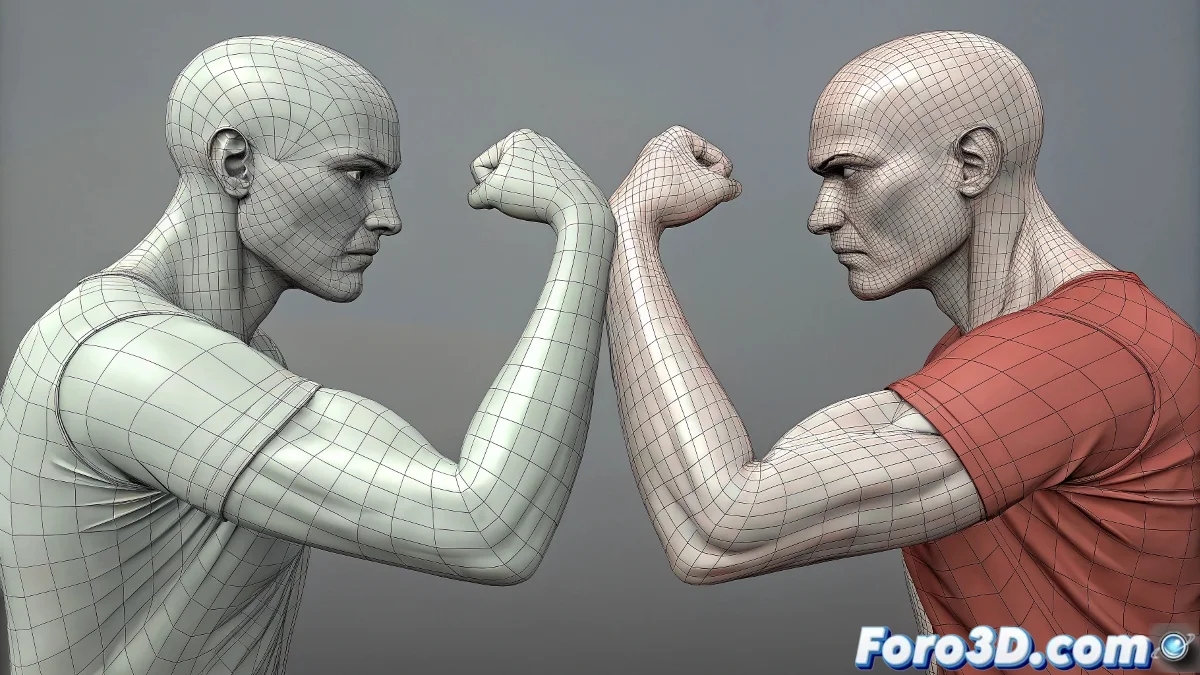
The Eternal Debate: Mathematically Perfect or Practical? 🤔
In theory, surfaces (NURBS or patches) should win by a landslide in deformation. Their mathematical basis in curves promises smooth, artifact-free movements. But as any 3D artist with deadlines would say: "In the real world, polygons rule". Why?
When Surfaces Shine... and When They Don't
For simple deformations in clean structures, surfaces can offer advantages:
- Smoother deformation in basic joints (elbows, knees)
- Less pinching in pronounced curvatures
- Require less manual adjustment in ideal cases
But as with everything in life, perfection is the enemy of practicality. When you try to apply it to a full character, problems arise:
A veteran rigger once said: "Surfaces are like that ex who promised wonders... until you had to live with them day to day".
Why Polygons Won the War
The industry opted for polys for compelling reasons:
- Universal compatibility with engines and tools
- Topology adaptable to critical areas
- Work with all modern deformers
- Allow retopology and selective optimization
Additionally, with techniques like Dual Quaternion Skinning or Delta Mush, polygonal meshes achieve deformation quality that matches (or surpasses) surfaces in most real cases.
The Final Verdict
Yes, in a controlled lab with perfect geometry, surfaces can deform better. But in the jungle of 3D production, where characters have wrinkles, clothing, and exaggerated expressions, polygons offer:
- More artistic control
- Fewer technical headaches
- Predictable results throughout the pipeline
So unless you're animating perfect cylinders for an academic project, stick with polys. Even though surfaces remain that sexy option we look at nostalgically... from afar. 📏💻