Star Wars Outlaws: the first open-world game in the saga that wins the VES 2025 award for visual effects
Considered part of the Lucasfilm Games renaissance, Star Wars Outlaws marks a historic milestone as the first open-world video game in the saga. Protagonized by the thief Kay Vess, who gets involved with criminal syndicates like the Pyke Syndicate and Crimson Dawn, the game was published by Ubisoft and developed by Massive Entertainment, winning the prestigious VES 2025 Award for Outstanding Visual Effects in a Real-Time Project. 🏆
An expanded universe between movies
Set between The Empire Strikes Back and Return of the Jedi, Outlaws combines familiar faces and places with completely new planets and characters. The narrative unfolds in an expansive open world where players can freely explore while interacting with iconic factions like the Ashiga Clan and Hutt Cartel, all rendered with exceptional visual quality. 🌌
Main game features:- First open world in the Star Wars saga
- Setting between episodes V and VI
- Original protagonist with their own story
The game received the VES 2025 Award for Outstanding Visual Effects in a Real-Time Project
World design with realistic wind
Massive Entertainment implemented a wind system based on the Beaufort scale within its Snowdrop engine. This technical innovation allowed elements like grass, clouds, and ribbons on windows to react dynamically to wind strength. For planets like Toshara, developers analyzed how aerodynamics would affect architecture and vegetation, creating extraordinarily believable environments. 💨
Technical innovations in the Snowdrop engine:- Realistic wind system Beaufort scale
- Dynamic reaction of vegetation and particles
- Architecture and design influenced by environmental factors
Ray tracing and cinematic lighting
Ray tracing became fundamental to maintain visual continuity in diverse environments, from cryogenic chambers to collapsing tunnels. Snowdrop enabled advanced volumetric simulations of nebulae and space content, with variable densities that added depth to the experience. Laser beam and explosion lighting adapted intelligently according to the time of day and environment. ✨
Advances in lighting and effects:- Ray tracing for consistent lighting
- Volumetric simulations of clouds and nebulae
- Adaptive lighting for different conditions
Speed and immersive physics
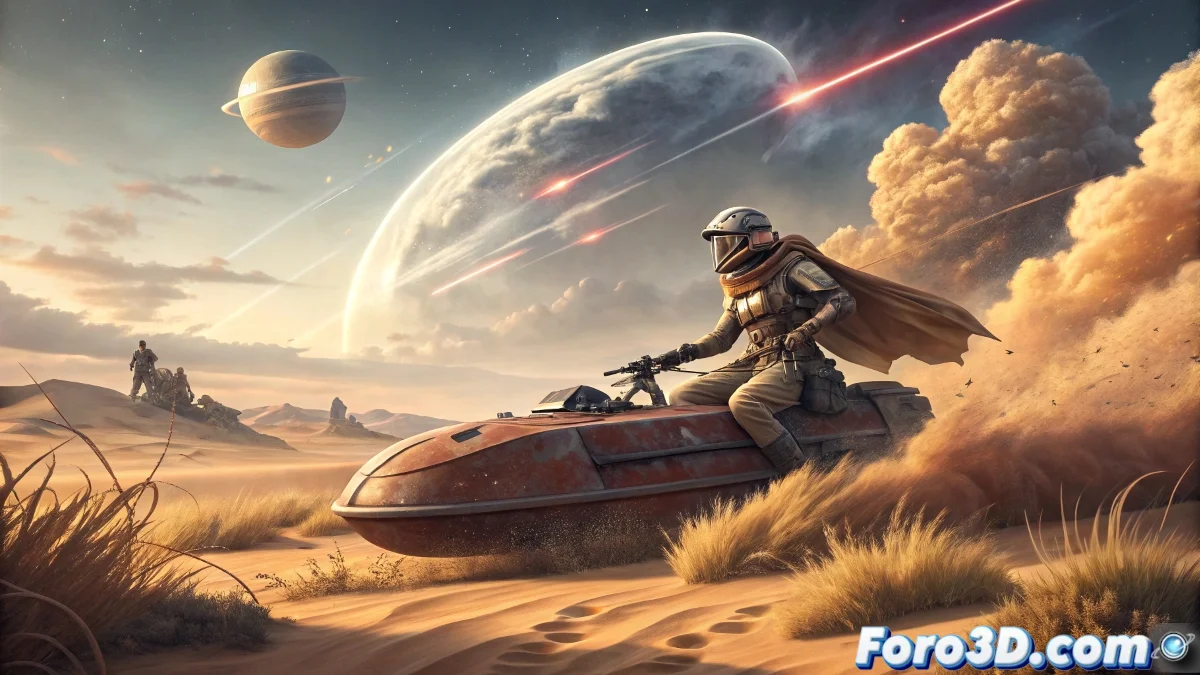
The speeders were designed to feel real despite floating, generating dust, mud, and particle effects according to the terrain. Every jump and landing included dirt spikes and detailed physical reactions. The camera replicated Ultra Panavision 70 lenses, used in Rogue One, to achieve a faithful cinematic aesthetic to the Star Wars universe in every shot. 🚀
The art behind galactic immersion
While players dodge blasters and explore Toshara, developers meticulously adjust every blade of grass and virtual dust cloud. This dedication to technical detail demonstrates that even in a galaxy far, far away, someone has to care about digital wind and the small elements that, together, create a truly immersive experience. 😄