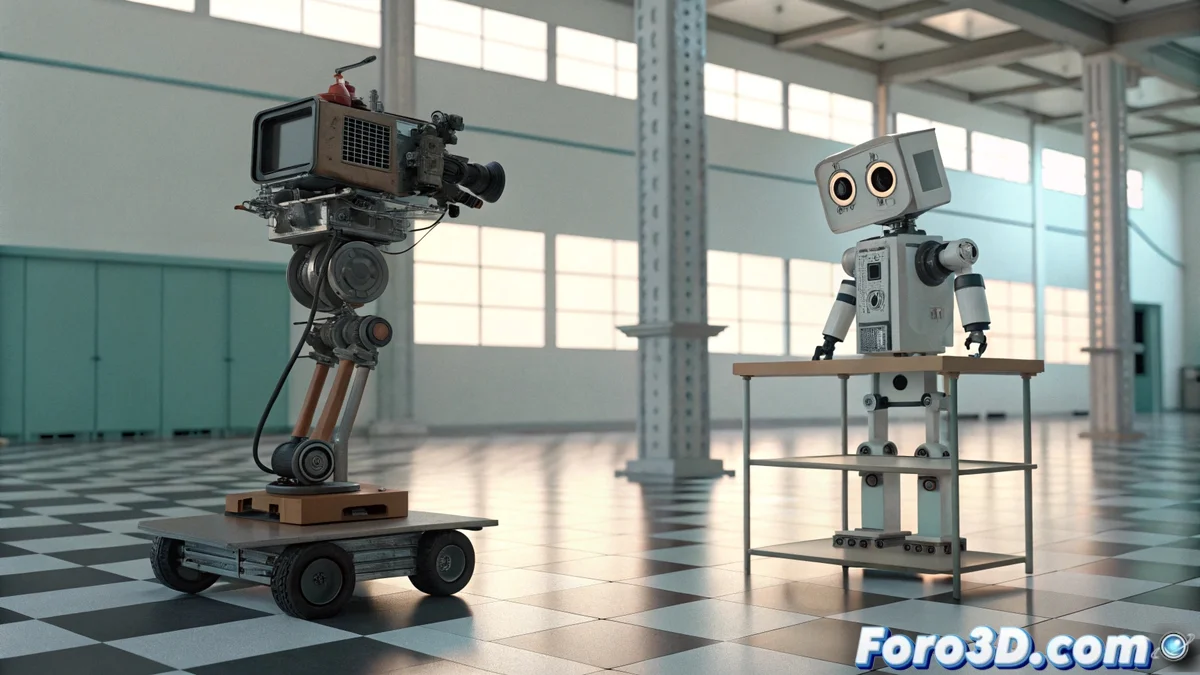
Shakey, the Robot That Started Intelligent Robotics
At the Stanford Research Institute, a historic project called Shakey forever changed the concept of autonomous machines. Developed in the late 1960s, this device was the first to effectively combine the ability to move, perceive its environment, and reason to make decisions without direct human intervention. Its team managed to unite a computer, visual and proximity sensors, and a wheeled chassis, creating an entity that could think before acting 🤖.
A Pioneering Three-Layer Architecture
Shakey's system was organized into three levels that functioned in a coordinated manner. This separation between perceiving, planning, and executing became a fundamental model for robotics.
Shakey's three functional levels:- Execution level: Controlled basic physical actions, such as rolling forward, turning, or pushing objects.
- Intermediate perception level: Translated data from the camera and rangefinder into a symbolic model that the computer could interpret, allowing the robot to understand corners, doors, and blocks.
- Upper reasoning level: Housed the STRIPS program, which analyzed the state of the world, defined a goal, and generated a logical sequence of commands for the lower levels to carry out.
Shakey demonstrated that a machine could plan its actions step by step to achieve complex goals, such as navigating between rooms or stacking blocks.
The Algorithmic and Conceptual Legacy
The technical challenges that the team overcame left an indelible mark on artificial intelligence. It was not just about building a robot, but about creating the intellectual tools for it to function.
Key contributions from the Shakey project:- Developing vision algorithms so that a machine could identify shapes and obstacles in its environment.
- Creating new ways of representing knowledge that allowed a computer system to reason about the world.
- Implementing and refining search and planning methods, popularizing concepts such as state spaces and production systems.
A Slow Pace for a Swift Revolution
Although its name suggested a tremor, Shakey moved slowly and deliberately, a pace that reflected the immense computational power it needed to process each decision. Today, a common smartphone far surpasses the capacity of its entire machine room. However, the fundamental ideas that it tested and validated—the integration of perception, planning, and action in a modular architecture—became the foundation upon which contemporary autonomous robots and AI systems are built. Its story is a reminder that the digital revolution often advances in slow but decisive steps ⚙️.