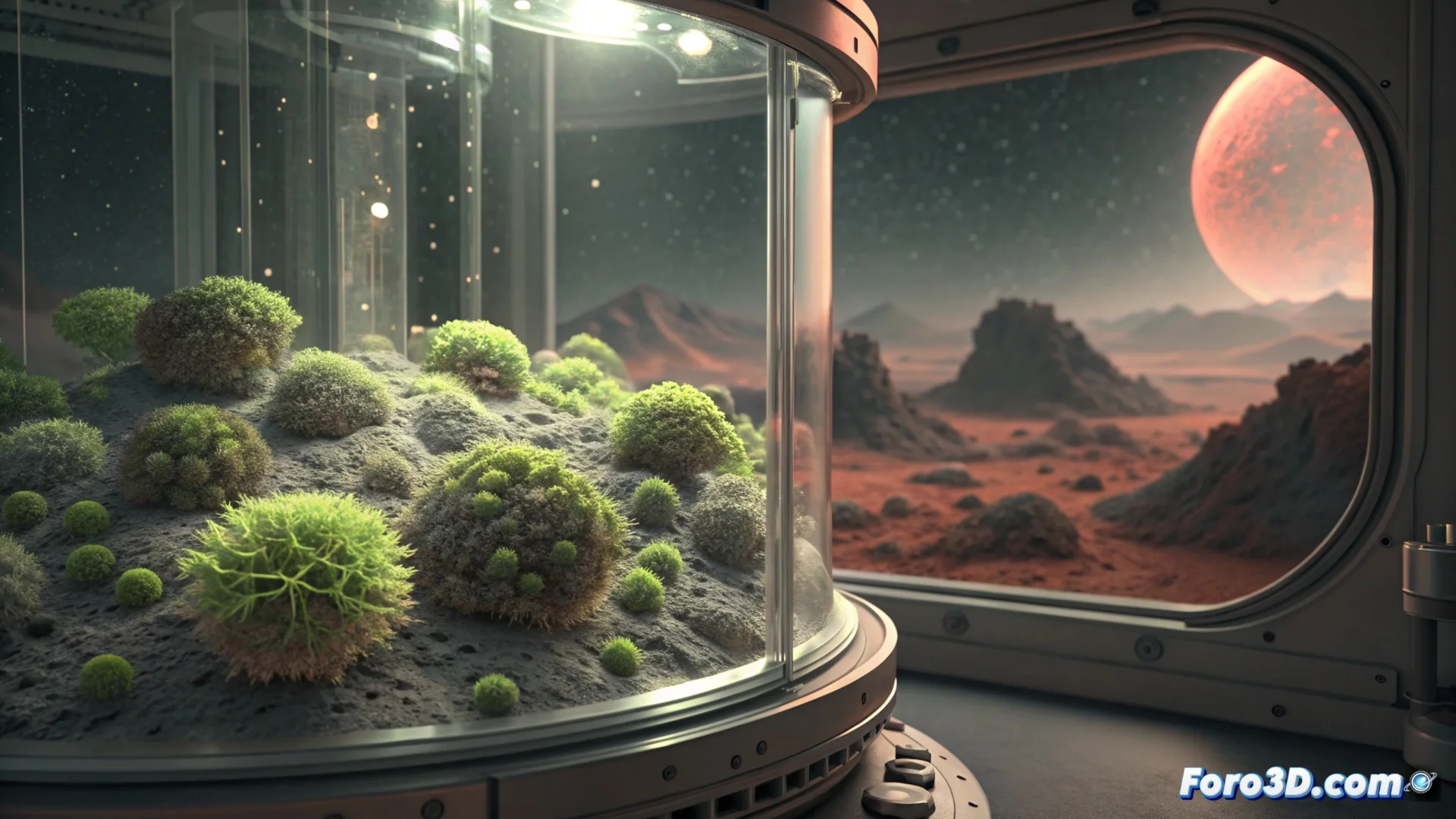
Scientists Test Lab-Grown Lichen to Colonize Mars
A team of researchers is cultivating lichen in the laboratory with a clear objective: to test whether this organism can survive on the red planet. This living being, a symbiosis between a fungus and an alga, is famous for inhabiting the most hostile places on Earth. The purpose is to evaluate its capacity to generate oxygen, process nutrients, and fix Martian regolith, essential steps for humans to establish themselves there. 🌱
The Experiment Replicates Harsh Martian Conditions
The scientists subject the lichen samples to an environment that faithfully copies the surface of Mars. This includes an atmosphere rich in carbon dioxide, extremely low temperatures, high levels of ultraviolet radiation, and minimal atmospheric pressure. They closely observe how the organism behaves and whether it manages to maintain its basic metabolic functions.
Key Simulation Conditions:- Atmosphere mainly composed of CO₂, similar to Mars'.
- Temperatures dropping well below freezing.
- Exposure to intense UV radiation, without the protection of a strong magnetosphere.
- Environmental pressure reduced to a fraction of Earth's.
Initial data reveal that certain lichen species exhibit remarkable resilience, suggesting their potential as an indigenous biological resource for future missions.
Practical Applications in Space Exploration
If the trials progress, lichen could be incorporated into the life support systems of Martian bases. Its role would be twofold: producing breathable oxygen and helping to transform Mars' sterile dust into a substrate more like soil. This biogenic approach seeks to minimize the enormous logistics and cost of sending all materials from our planet.
Possible Uses in Missions:- Integrate lichen into bioreactors to generate oxygen continuously.
- Use it as a "biological pioneer" to condition regolith and make it suitable for other crops.
- Develop controlled greenhouses where lichen prepares the ground for more complex ecosystems.
A Small Organism for a Giant Leap
While some projects imagine Martian gardens, this work focuses on the interplanetary equivalent of moss growing on a rock. The idea is that this humble lichen could act as the first layer of a new ecosystem, paving the way and making the dream of inhabiting another world more sustainable. The results continue, but each data point brings that possibility a little closer. 🚀