Scarlet Challenges the Rules of Visual Perception
The Scarlet project, directed by digital artist Chris Bjerre, does not seek only to display striking images. Its main goal is to explore how the human mind processes and, at times, accepts visual stimuli that contradict logic. To achieve this, the team builds a narrative that alters reality progressively and subtly, prioritizing perceptual research over pure spectacle. 🧠
A Fusion Between the Real and the Simulated
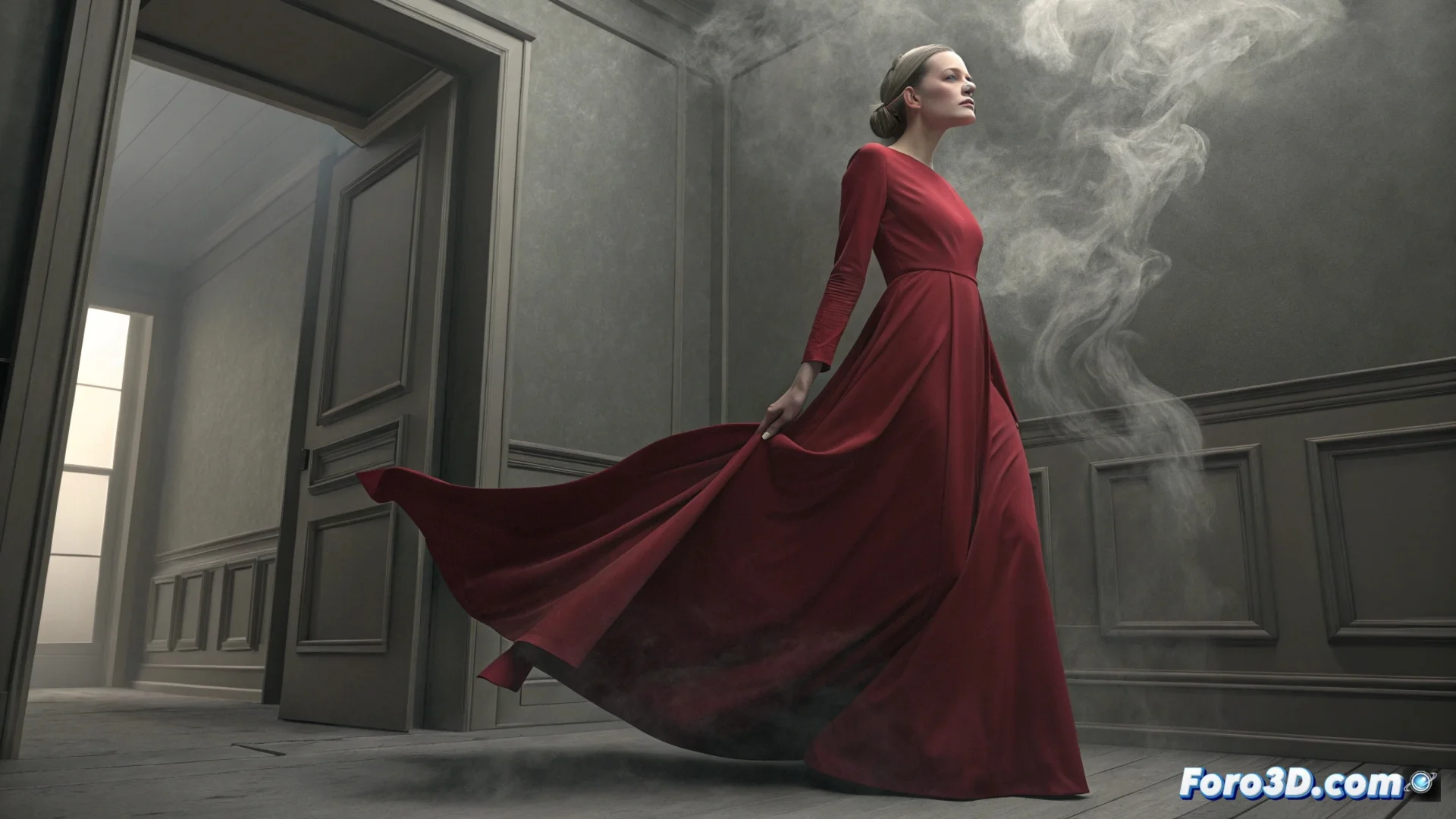
The methodology is based on integrating live-filmed elements with digital image generation. Scenes are recorded with actors and physical sets, then their appearance and behavior are digitally manipulated. The software Houdini is key for simulating fluid and particle dynamics, altering the movement of fabrics or smoke. Subsequently, Nuke is used to combine all elements in the final shot. The purpose is for the audience to detect an anomaly but not be able to immediately pinpoint its technical origin.
Technical Pillars of the Project:- Practical Filming: Base of real actors and physical scenography to ensure a tangible starting point.
- Houdini Simulations: Elements like costumes and smoke are manipulated to move in unnatural but visually coherent ways.
- Composition in Nuke: All layers are assembled, adjusting lighting and color to maintain perfect visual continuity.
The greatest visual effect is to make the audience doubt what their eyes see, a trick that no render alone can achieve.
Deceiving the Mind, the True Challenge
The main challenge does not lie in rendering complex graphics, but in making the brain accept them as possible. The team applies principles of Gestalt psychology, where the mind completes missing information based on known patterns. By slightly modifying these patterns in motion or texture, a controlled sense of strangeness is generated. The meticulous adjustment of lighting and color prevents the effect from being perceived as an error, maintaining coherence in every shot.
Strategies to Manipulate Perception:- Apply Gestalt Principles: Recognizable patterns are subtly altered so that the brain tries to complete the information incorrectly.
- Adjust Lighting and Color: Precision work is done to unify real and digital elements, avoiding visual dissonances.
- Create Believable Anomalies: The goal is to generate a distortion that the viewer perceives but cannot rationalize.