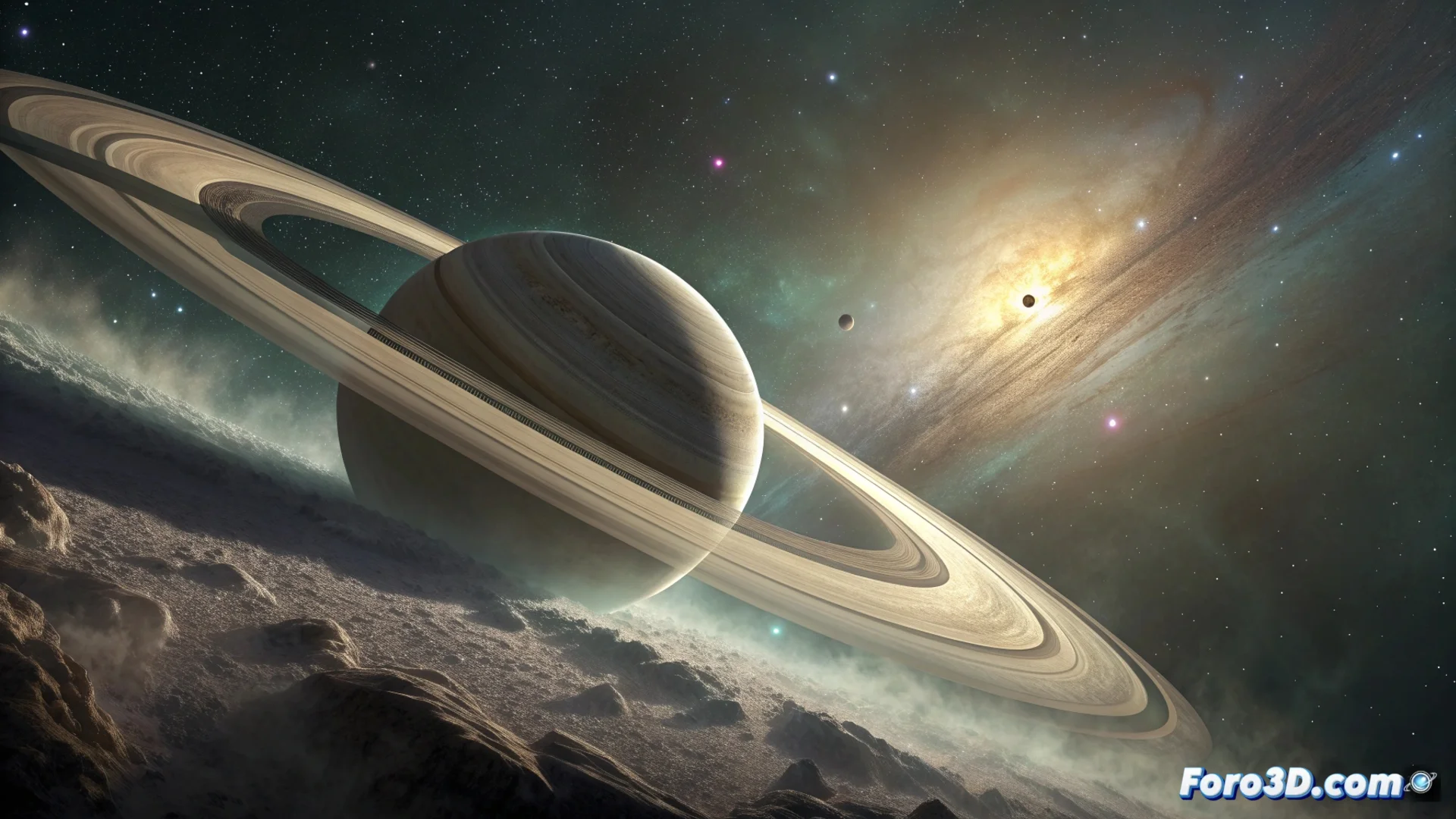
Saturn's Rings Form a Huge Dust Torus, Reveals James Webb
The classic view of Saturn's rings as flat and thin disks is obsolete. Recent observations from the James Webb Space Telescope reveal a more complex and voluminous reality: a gigantic torus of material that completely envelops the gas giant 🪐.
A Three-Dimensional Structure Captured in Infrared
The James Webb's infrared instruments allow analyzing the composition and shape of the ring system with unprecedented detail. The data confirm a morphology resembling a cosmic donut, a three-dimensional structure where ice and rock particles occupy an enormous spatial volume. This directly contrasts with the two-dimensional simplification used until now.
Key Features of the Revealed Torus:- Complex volumetric shape, similar to a torus or donut.
- Composition of ice particles, rock, and fine dust.
- Extends from the planet's inner regions to very large distances in space.
Saturn didn't settle for a simple belt; it opted for a giant cosmic donut.
Diffuse Dust: The Invisible Part of the System
The bright and recognizable rings we see from Earth represent only the densest and most compact section of this torus. However, James Webb detects a tenuous dust cloud surrounding this central structure. This diffuse envelope is much more extensive than previously thought, indicating that the material is more dispersed and occupies a larger space than estimated with optical telescopes.
Implications of the Discovery:- The total volume occupied by the rings is greater than calculated.
- The material is distributed non-uniformly, with a dense central region and a diffuse outer corona.
- Observations in visible light only show part of the complete system.
Rewriting the Nature of the Rings
This James Webb finding forces a review of models on the formation, dynamics, and evolution of Saturn's rings. Understanding their true three-dimensional shape and the extent of the diffuse dust is crucial for understanding their origin and interaction with the planet and its moons. Astronomy gains a richer and more complex perspective on one of the solar system's icons 🔭.