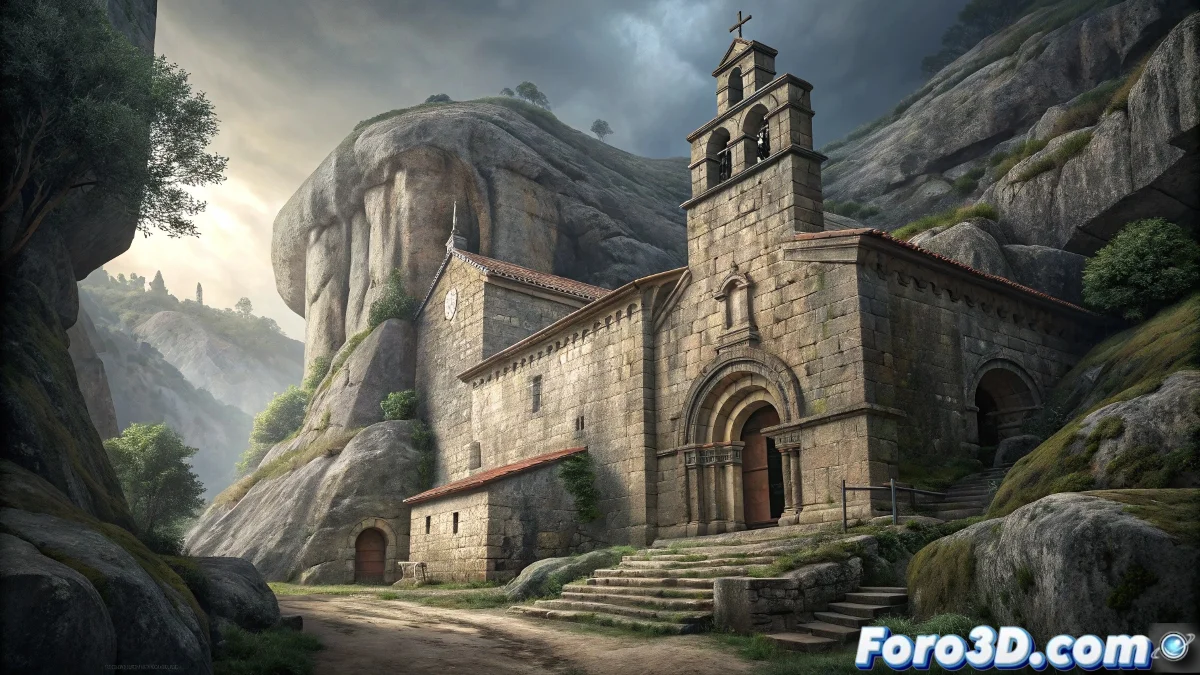
When rock becomes sacred architecture
The San Pedro de Rocas Monastery in the Ourense Ribeira Sacra represents one of those miracles of human adaptation where architecture is not built on the ground, but emerges from the rock itself. This 6th-century religious complex, carved directly into the stone, offers a unique challenge for 3D modeling: capturing that organic fusion between the natural and the artificial that defines its essence. In Rhinoceros, we can explore this symbiosis, recreating not only the architectural forms, but the atmosphere of contemplation that permeates every corner of this sacred space.
What is fascinating about this project is how it requires rethinking the principles of traditional modeling. Instead of building from scratch, we must digitally sculpt the mother rock to reveal the architectural forms that the Visigothic monks discovered in the stone fifteen centuries ago. Every curve, every surface, and every volume must convey that organic quality that distinguishes rock-cut architecture from conventional construction.
Modeling San Pedro de Rocas is not creating architecture, it is revealing the one that already existed in the stone
Workflow in Rhinoceros
- Historical research and precise architectural documentation
- NURBS modeling of rocky surfaces and carved elements
- PBR texturing for realistic geological materials
- Atmospheric lighting that simulates Galician forest light
The geometry of the sacred
The process begins with the topographic recreation of the Ribeira Sacra environment. In Rhinoceros, NURBS surface tools allow capturing those organic terrain forms that so characterize the Galician landscape. Attention to details such as the orientation of rock veins, differential erosion in different types of stone, and natural geological formations is crucial to create a visually credible base.
Boolean operations become the heart of the modeling process, allowing extraction of architectural volumes from the rock mass as the original builders did. This approach is not only technically efficient but philosophically replicates the historical process: revealing spaces instead of building them. The result is forms that feel emerged from the stone rather than placed on it.
Advanced techniques for rock-cut architecture
- SubD modeling for complex organic rocky forms
- Displacement maps for micro-details of erosion and texture
- History layers to maintain flexibility in modeling
- Sculpting tools for handcrafted manual details
Strategic lighting becomes the most powerful tool to convey the spirituality of the space. The setup of directional lights that simulate Galician light filtering through natural openings, combined with warm light points suggesting candles or oil lamps, creates that chiaroscuro play that so characterizes excavated sacred spaces. Light not only illuminates but defines the emotional character of each space.
In Rhinoceros, every NURBS surface tells a story of faith carved in stone
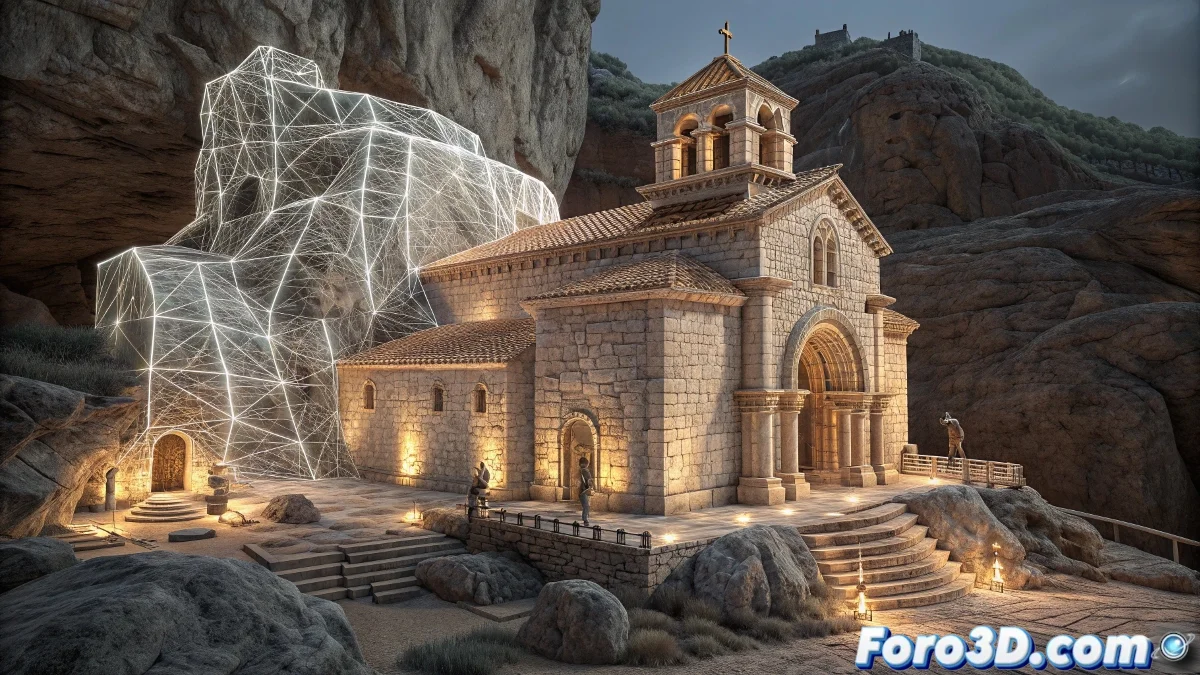
Textures that breathe history
PBR texturing takes on special importance in a project where materials are protagonists. The creation of roughness maps that capture the different stone qualities—from surfaces polished by centuries of human contact to barely touched rough areas—contributes to that sensation of historical authenticity that the project seeks. Normal maps that simulate water erosion, moss growth, and medieval tool marks add those layers of history that transform a 3D model into an immersive visual experience.
The integration of archaeological elements—anthropomorphic sarcophagi, medieval inscriptions, remains of mural paintings—not only visually enriches the scene but connects the model to the historical reality of the monastery. Every added element must feel like an integral part of the space, not an artificially placed object.
And as you render the final scene, you can't help but wonder if those shadows cast in the medieval crypts contain something of the echo of the Gregorian chants that once resonated between these stones 🏰