Digitally Scrutinizing the Limoges Heist with ZBrush 🏛️
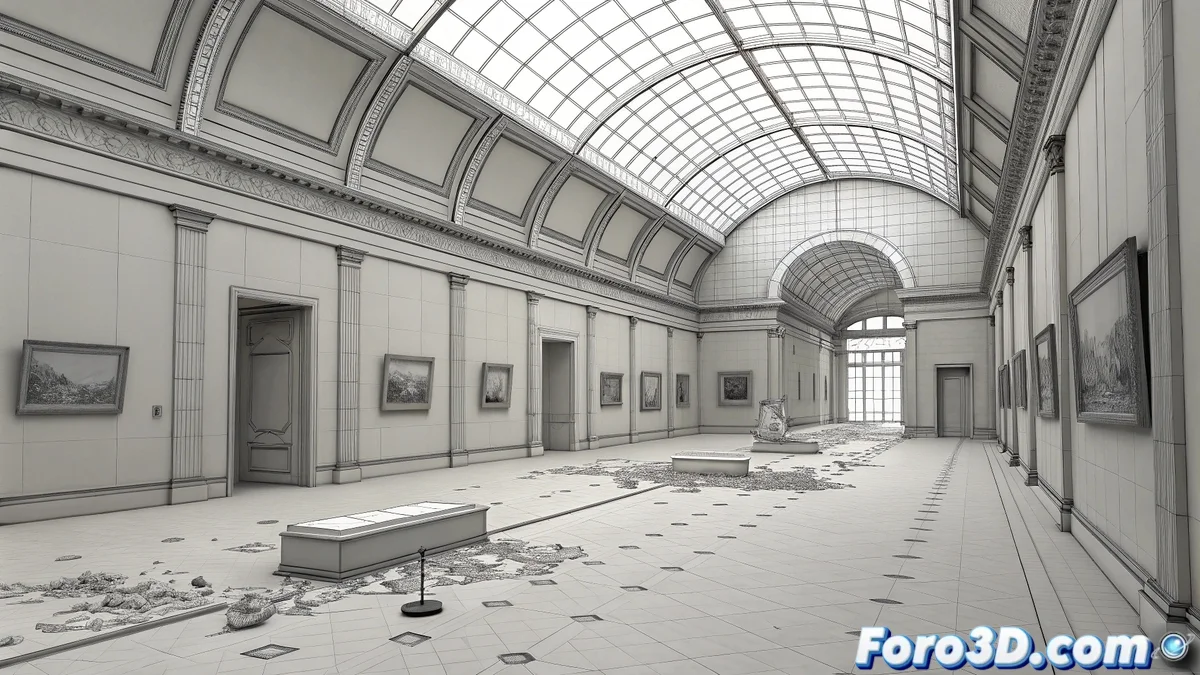
During the early morning of September 4, 2025, the National Adrien Dubouché Museum in Limoges suffered a robbery where three valuable Chinese porcelain pieces valued at 9.5 million euros were stolen. This event not only shocked the world of cultural heritage but also lends itself to a ZBrush modeling exercise where we will recreate the crime scene in mesh mode, highlighting the geometric precision that both art and police investigation require.
Modeling the Museum Structure in DynaMesh
The process begins with a base cube to which DynaMesh is applied to sculpt free-form volumes. Using brushes like Move and TrimDynamic, the main museum facade is defined, paying special attention to the violated window that served as access for the thieves. The geometry is intentionally kept in low poly count, preserving clarity in the polygon flow and allowing wireframe mode to reveal the building's underlying structure. 🪟
Sculpting the Stolen Porcelain Pieces
Each of the three pieces—two 14th-15th century plates and an 18th century vase—is modeled as an independent SubTool. With ZAdd and DamStandard brushes, the delicate curves and characteristic edges of Chinese porcelain are carved, avoiding textures or colors to emphasize the purity of the forms. The use of ZRemesher ensures a clean and efficient topology, crucial for appreciating the historical value and fragility of these masterpieces.
Modeling stolen heritage in wireframe is a reminder that what endures is the form, even when the physical object disappears.
Setting the Crime Scene
To convey the chaos of the heist, narrative elements are added such as:
- Shattered display cases with fractal geometry
- Porcelain fragments scattered on the floor
- Abandoned tools like crowbars or glass cutters
- Footprint marks suggested through deformations in the floor
All these elements are modeled in low poly count and integrated as additional SubTools, maintaining the visual coherence of mesh mode.
Composition and PolyFrame View
Organizing the SubTools into logical layers and activating PolyFrame mode reveals the edges and vertices of the entire scene, creating a technical visualization that evokes both architectural plans and forensic reports. The camera is adjusted to frame the broken window as the focal point, with polygon lines guiding the gaze toward the interior where the empty display cases lie. This composition not only documents the heist but also symbolizes the vulnerability of cultural heritage.
Rendering and Conceptual Meaning
Although ZBrush allows advanced renders, for this exercise, direct viewport captures in wireframe mode are chosen, highlighting the geometric nature of 3D modeling. The absence of color and texture underscores the physical loss of the pieces, while the precision of the mesh pays homage to the work of restorers and investigators seeking to return the stolen items to their place.
While Interpol searches for real clues, we seek to ensure the DynaMesh doesn't collapse when sculpting the display case fragments. In the end, the only reward is a ZBrush file that, unlike the porcelains, will never be stolen... though sometimes you wish someone would take your first modeling attempts. 😅
And by the way... being grateful when someone helps you is a sign of gratitude! 🙏