Discovering Digital Portals with Houdini 🏛️
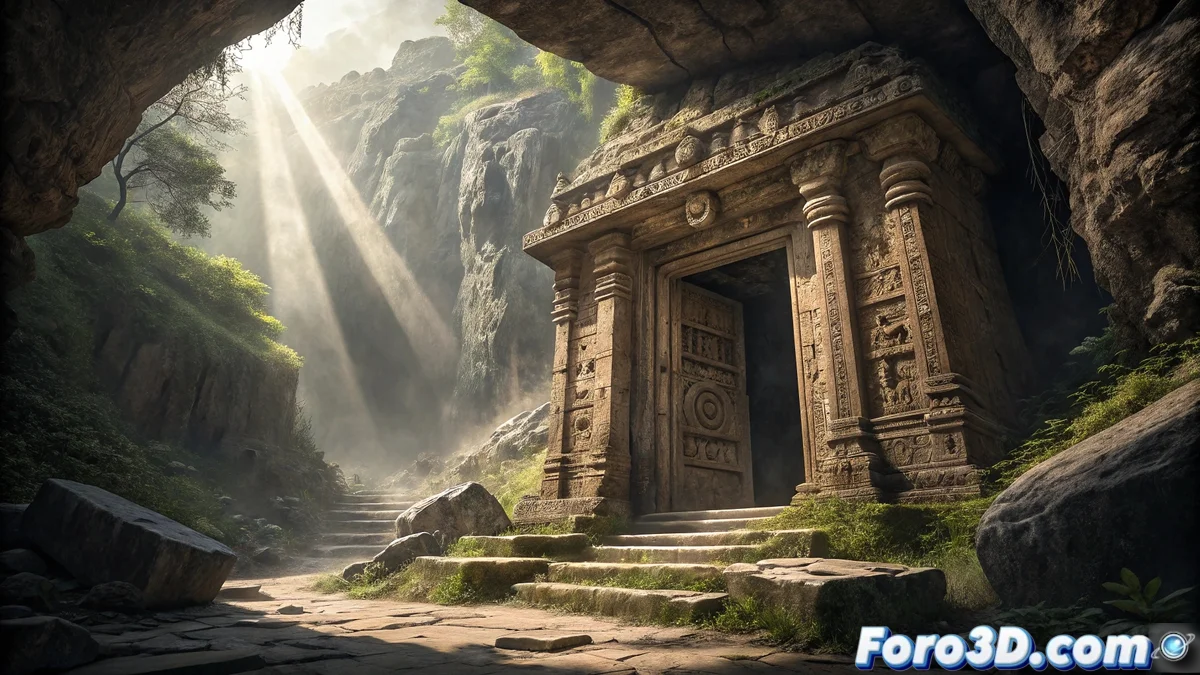
In southern India, a team of archaeologists has discovered a carved stone gate in a cave that could be the entrance to a lost city mentioned in ancient Hindu texts. This finding, laden with mystery and artistic complexity, finds in Houdini the ideal environment for its digital recreation. The combination of procedural modeling, advanced shaders, and volumetric effects allows capturing not only the physical appearance of the gate, but also the atmosphere of discovery and enigma that surrounds such archaeological finds.
Procedural Modeling of the Stone Structure
The process begins by creating the base geometry of the gate using polygon and subdivision nodes. Using PolyExtrude and PolyBevel, the main shape is defined with robust edges and irregular surfaces. For the engravings and carvings, procedural masking is employed with noise nodes and mathematical patterns that simulate ancient motifs without visible repetition. The VDB from Polygons modifier allows adding erosion and structural damage to the edges, creating that appearance of centuries of age. 🔍
Shaders and Materials for Aged Stone
Texturing is approached procedurally using Houdini's material system:
- Variable roughness layers with noise to simulate differential wear
- Procedural displacement maps for deep cracks and fractures
- Moss overlay and vegetation in humid areas with green color textures
- Base color variation using perceptual noise gradients
This approach ensures that every centimeter of the gate is unique and visually interesting.
Texturing ancient stone is telling the story of every crack without saying a word.
Dramatic Lighting and Atmospheric Effects
The lighting is set up to emulate sunlight filtering into the cave:
- Directional light main with a grazing angle that highlights engravings
- Point lights dim in specific areas to suggest indirect reflections
- Volumetric fog with density controlled by noise to simulate suspended dust
- Light linking so certain lights affect only volumes or geometry
This setup creates the characteristic "god rays" effect that adds drama and mystery.
Particle Systems and Additional Effects
To add life to the scene, the following are implemented:
- POP particles for dust motes illuminated by light rays
- Light Pyro simulations for mist that moves with air currents
- Static debris modeled around the base of the gate
- Subtle chromatic aberration in composition for an old lens effect
These elements reinforce the narrative of a place untouched for centuries.
Render and Final Composition
It is rendered with Karma or Mantra using adaptive sampling to handle fine details and volumes. Separate passes for:
- Beauty for the base image
- ID masks for selective post-render adjustments
- Z-depth for additional fog and blur effects
- Specular and reflection for fine control of highlights
In composition, contrasts are adjusted and vignetting is added to direct attention to the gate.
If the result is so convincing that viewers ask for the cave's coordinates, you can always say that the true lost city is in Houdini's node network... and that it requires an expedition through layers of parameters and renders. 😅