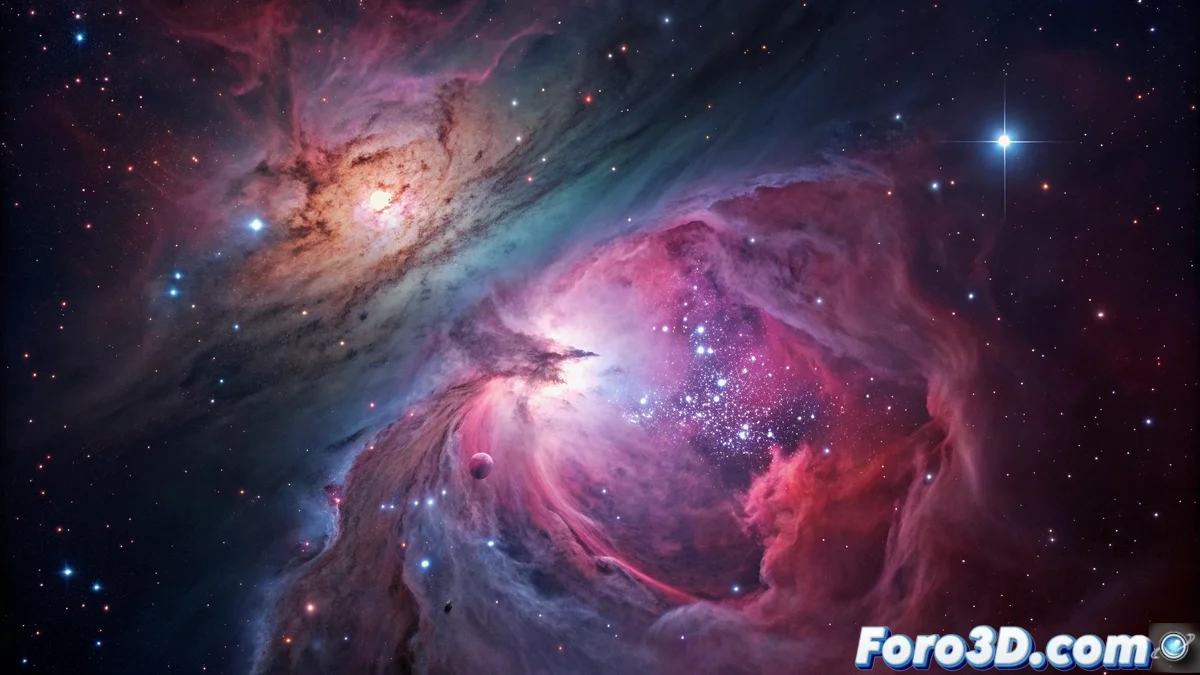
Simulating the Cosmos: Recreating the Birth of a Solar System 🌌
Researchers have managed to capture for the first time the birth of a solar system in the Orion Nebula, showcasing a visual spectacle that opens new doors to understanding star formation. This astronomical feat inspires the digital recreation of such an event using Houdini, where particle and volume simulations allow for building cosmic scenes of extraordinary complexity and beauty. From the initial chaos of interstellar gases to the formation of a protoplanetary disk, each step can be modeled with scientific and artistic precision.
Creating the Cosmic Particle Base
The process begins inside a POP Network in Houdini, where millions of particles are generated distributed in a 3D volume that will act as the raw material of the nebula. Using nodes like Scatter to populate the space and POP Force to add chaotic movement, the behavior of cosmic gases under initial gravitational forces is simulated. The density and distribution of these particles lay the foundation for the nebulous structures that characterize regions like Orion. 🪐
Transforming Particles into Nebulous Volume
To convert the swarm of points into a continuous and organic cloud, a VDB from Particles node is applied. This process generates a dense volume that can be shaped with Volume Noise to carve irregularities, filaments, and cavities, replicating the gaseous formations observed in real space. Adjusting the intensity and frequency of the noise allows control over the level of detail and realism of the nebula, avoiding the artificial appearance of a uniform volume.
The controlled chaos of Volume Noise is what turns a generic volume into a nebula full of cosmic history.
Forming the Proto-star and Protoplanetary Disk
At the center of the simulation, a point light source is placed that acts as a proto-star, around which a rotating particle disk is generated. Employing POP Spin to impart angular movement and POP Drag to smooth the dynamics, the effect of orbiting material that will eventually form planets is achieved. The scale and density of this disk are crucial for maintaining scientific plausibility while seeking visual impact.
Color and Viewport Visualization
Houdini allows assigning color attributes directly to particles and volumes for rich visualization during the process. Using a palette of red, blue, and purple tones—typical of nebulae due to light scattering and chemical composition—interstellar gas is brought to life. Adjusting color transparency and intensity in the viewport helps distinguish between dense and diffuse zones, providing immediate feedback on the scene's evolution.
Final Dynamics with Pyro Solver
To add greater dynamism and volumetric turbulence, the simulation is connected to a Pyro Solver. This step introduces additional forces that model the interaction between gases at different temperatures and densities, creating the characteristic flows and swirls of stellar nurseries. Orbiting the camera around the scene in the viewport allows appreciating how the nebula and protoplanetary disk come to life in real time, culminating in a visually striking representation of the birth of a solar system.
While astronomers celebrate having captured this phenomenon light-years away, we celebrate that Houdini didn't crash after simulating ten million particles. In the end, the true big bang is the one that happens in your RAM when you hit play. 😅