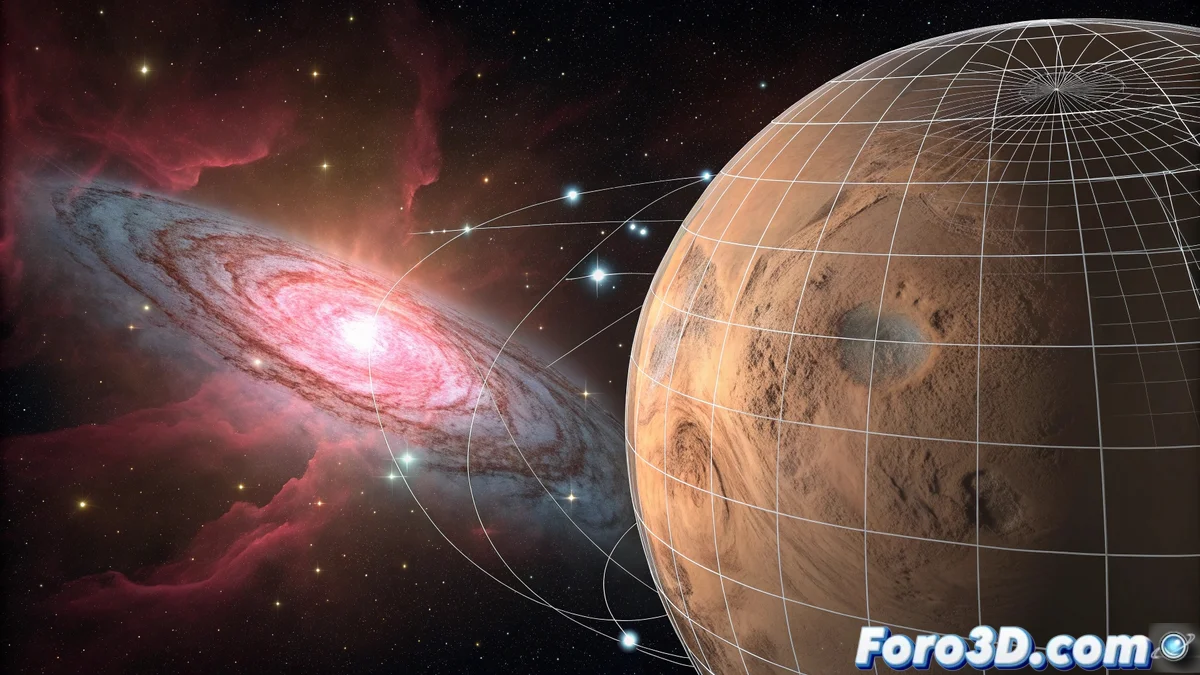
Exploring the Secrets of the Cosmos with 3ds Max 🚀
Scientists have confirmed the existence of Mars' solid core, reinforcing similarities with Earth, while astronomers capture images for the first time of the birth of a solar system in the Orion Nebula. These twin discoveries offer a unique window into both the interiors of planets and the origin of stellar systems, inspiring 3D artists to recreate these astronomical scenes with 3ds Max. From precise modeling of planetary structures to simulating cosmic chaos, the software's tools allow translating scientific data into stunning visual experiences.
Layered Modeling of Mars' Interior
The process begins with a sphere representing Mars. Using the Slice modifier, a clean cross-sectional cut is made that reveals the planet's internal layers: crust, mantle, and the newly discovered solid core. Applying TurboSmooth refines the geometry, while Displace modifiers add realistic surface irregularities to the crust. For the core, Subsurface Scattering is used with grayish metallic tones, suggesting the iron and nickel composition confirmed by scientists. 🌌
Simulation of the Orion Nebula with Particles
To recreate the birth of a solar system, Particle Flow is used to generate clouds of cosmic gas and dust. Setting up emitters with Vortex and Wind forces achieves the characteristic swirls and filaments of nebulae. Integrating Phoenix FD for advanced volumetric effects, the particles gain density and dynamism, mimicking telescopic images of Orion. A central newborn star is modeled as a sphere with intense emissive material, surrounded by a rotating accretion disk of particles.
Recreating the cosmos is a reminder that every pixel of stellar dust on screen represents billions of tons of real matter.
PBR Materials and Lighting Effects
Materials play a crucial role in both scenes. For Mars, PBR textures of the Martian surface are used with a high roughness channel and low specular, capturing the planet's dusty appearance. In the nebula, volumetric materials with bluish and reddish colors—assigned via gradients—simulate the light emission from ionized gases like hydrogen and oxygen. Lighting with Arnold Render ensures that light interacts physically with the volumes, creating ethereal beams and halos.
Split-View Composition
A creative montage unites both discoveries in a single image through a split view. On the left, Mars' cross-section is illuminated with sidelight that emphasizes the layers. On the right, the Orion Nebula glows with deep tones, framed by particles suggesting cosmic motion. A smooth transition—perhaps a blurred separation line or opacity gradient—unites both worlds visually and conceptually.
Workflow and Optimization
To handle the technical complexity:
- Separate Render Layers for Mars and the nebula
- Proxy objects for heavy particle geometry
- Adaptive Sampling in Arnold for controlled noise
- Post-production to adjust color balances and contrasts
This structure allows for quick iteration without sacrificing visual quality.
While astronomers celebrate deciphering the secrets of Mars and Orion, we celebrate that 3ds Max didn't crash while rendering 10 million particles. In the end, the universe may expand infinitely, but our RAM has very clear limits. 😅