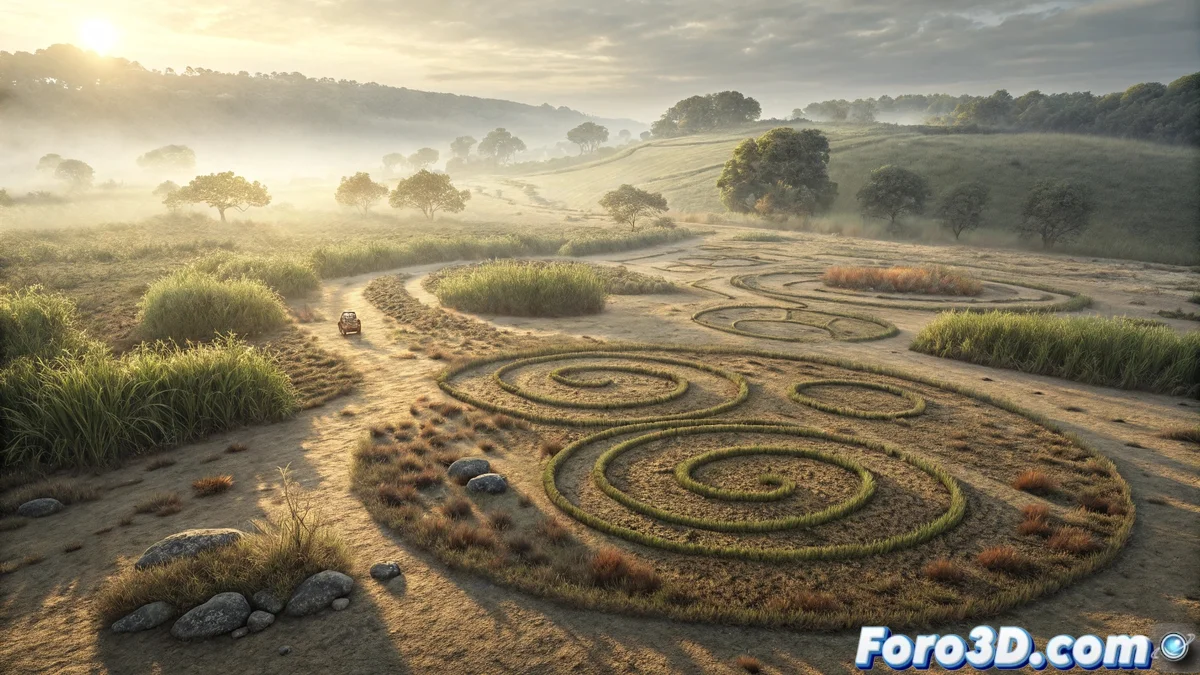
Shaping the Botanical Mystery with 3ds Max 🌿
In Croatia, a team of botanists has discovered perfect vegetation circles reminiscent of Africa's famous Fairy Circles. Their impeccable geometry and unknown origin make them the perfect subject for recreation in 3ds Max. The scene combines organic terrain modeling, procedural vegetation distribution, and atmospheric effects that accentuate the mystery of the phenomenon, allowing exploration of both technical precision and the visual narrative of the natural enigma.
Terrain Modeling with Natural Variations
The process begins by creating a base plane with sufficient subdivisions to apply deformation modifiers. Using Displace with procedural noise maps, subtle irregularities are generated in the terrain that simulate a natural field—gentle elevations, depressions, and micro-relief. The Noise modifier adds additional variation across multiple frequencies, avoiding the artificial appearance of a perfectly smooth plane. For the circles, Selections based on circular masks are used to isolate the areas where vegetation will show variation. 🌾
Procedural Distribution with Forest Pack
Vegetation is distributed using Forest Pack for precise control:
- Density maps with circular shapes to define the patterns
- Height variation and scale within each circle
- Different species of grass and shrubs between inside/outside the circle
- Random orientation and natural tilt to avoid repetition
This approach creates believable transitions between normal vegetation and that of the circles.
Distributing vegetation procedurally is like being a digital gardener; you plant rules and harvest patterns.
Terrain Materials and Texturing
Realistic materials are applied using multimaterial slots:
- Base soil with clay soil textures and small rocks
- Grass with color maps varying between vibrant and dry greens
- Bump maps and displacement to simulate root protrusions
- Subtle seasonal variation between inside/outside of circles
The circles are differentiated through slight changes in tone and roughness.
Lighting and Atmospheric Effects
Lighting is set up to emphasize the mystery:
- Sun light with a low angle that casts elongated shadows
- Volumetric light with light fog suggesting morning humidity
- Light Exclusion so certain lights affect only specific areas
- Ambient Occlusion to accentuate depth at the base of vegetation
This setup creates dramatic contrasts that highlight the circular geometry.
Render and Post-Production
Rendering is done with Arnold or V-Ray using:
- Global Illumination for natural indirect light
- Denoiser to keep render times manageable
- Multi-Pass rendering for control in compositing
- Z-Depth pass for additional post-render fog effects
In post-production, curves and saturation are adjusted to enhance the circles.
If the circles turn out so perfect they seem like the work of extraterrestrial gardeners, you can always argue that the only alien in the scene is 3ds Max's Noise modifier. 😅