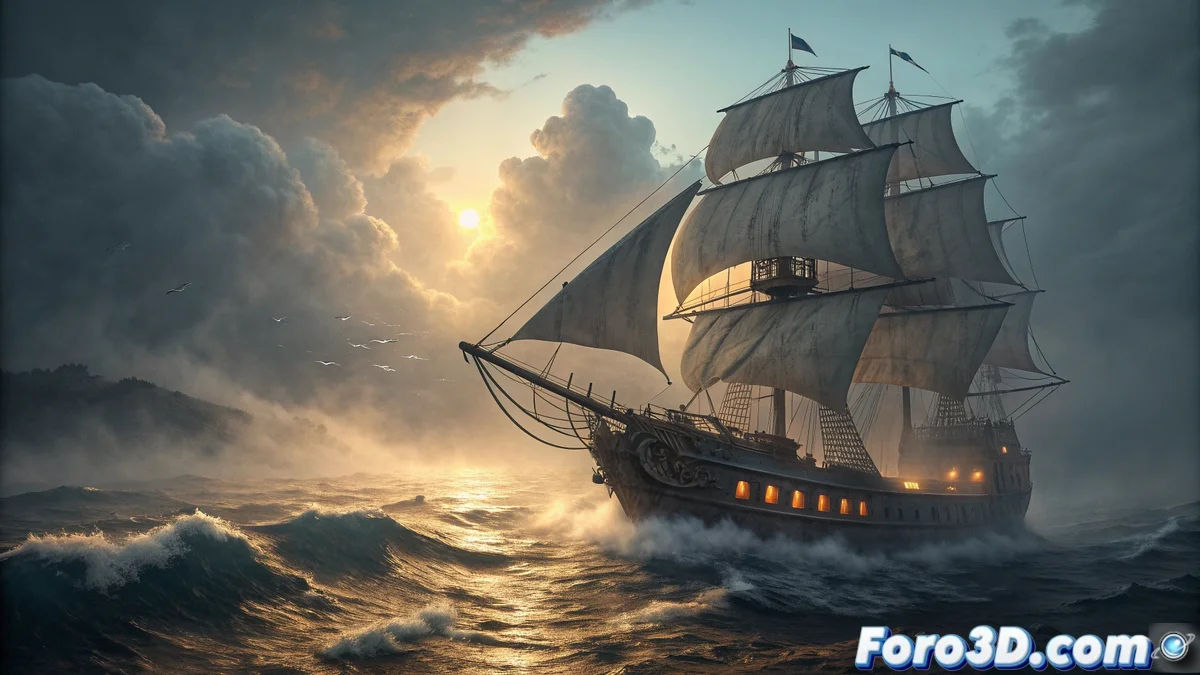
Shaping a Maritime Legend Digitally ⛵
A crew in the Indian Ocean claims to have sighted a 19th-century ship in perfect condition, with visible crew on board, that disappeared behind a bank of fog. This ghostly sighting, which experts attribute to mirages but captures the popular imagination, finds in Blender the perfect medium for its recreation. The scene combines historical modeling, water simulation, atmospheric effects, and dramatic lighting, offering an ideal technical and artistic challenge for 3D artists.
Modeling the Historical Ship
The process begins with historical references of 19th-century ships—frigates or clippers—modeling the base with extruded cubes and subdivided planes. The hull is built using curve modeling or mesh subdivision, adding details like portholes, hatches, and planking with array modifiers and bevels. Masts and yards are created with scaled and deformed cylinders, while sails are modeled as planes with Cloth modifiers to simulate wind ripple. Ropes and nets are added with Bezier curves converted to meshes. 🏴☠️
Crew and Deck Elements
For the ghostly crew, generic human models are used, posed in deck activities—raising sails, at the helm, observing the horizon. Cloth Simulation is applied to clothing for realism, and semi-transparent materials with subtle emission for a spectral effect. Deck elements like barrels, anchors, and capstans are modeled low-poly and distributed strategically to suggest recent activity.
A ghost ship is not empty; it is inhabited by silences that the modeling must make visible.
Water System and Oceanic Environment
The ocean is generated using Blender's Ocean Modifier, adjusting wave scale and foam parameters for open-sea conditions. A custom water shader combines:
- Transparency with appropriate IOR
- Specular reflections with variable roughness
- Normal maps for surface micro-details
- Procedural foam on wave crests
This setup creates a believable sea that visually interacts with the ship.
Atmosphere and Fog Effects
The fog enveloping the scene is created with a Principled Volume in a cube encompassing the entire scene. Adjusting density and anisotropy achieves the bank-of-fog effect that progressively blurs the ship. Marine spray particles are added with particle systems emitted from the waves, enhancing the sensation of a humid, salty environment.
Dramatic and Spectral Lighting
The lighting uses a sun light with a low angle simulating sunset or dawn, creating marked silhouettes and long reflections on the water. Point lights with warm color temperature are placed in deck lanterns, while a volumetric directional light from behind the ship creates a "god rays" effect through the fog. The use of light paths and volumetric scattering adds mystery and depth.
Render and Post-Processing
Rendering is done with Cycles for maximum quality in volumes and reflections. In Blender's compositor, the following are added:
- Glare with fog glow mode for ethereal details
- Mist pass to increase depth sensation
- Color grading toward bluish and cooled tones
- Lens distortion subtle to emulate vision through a spyglass
These adjustments finalize the atmosphere of inexplicability and wonder.
If you manage to make the render so convincing that your friends ask for the sighting coordinates, you can always say you have them... in the .blend file. 😅