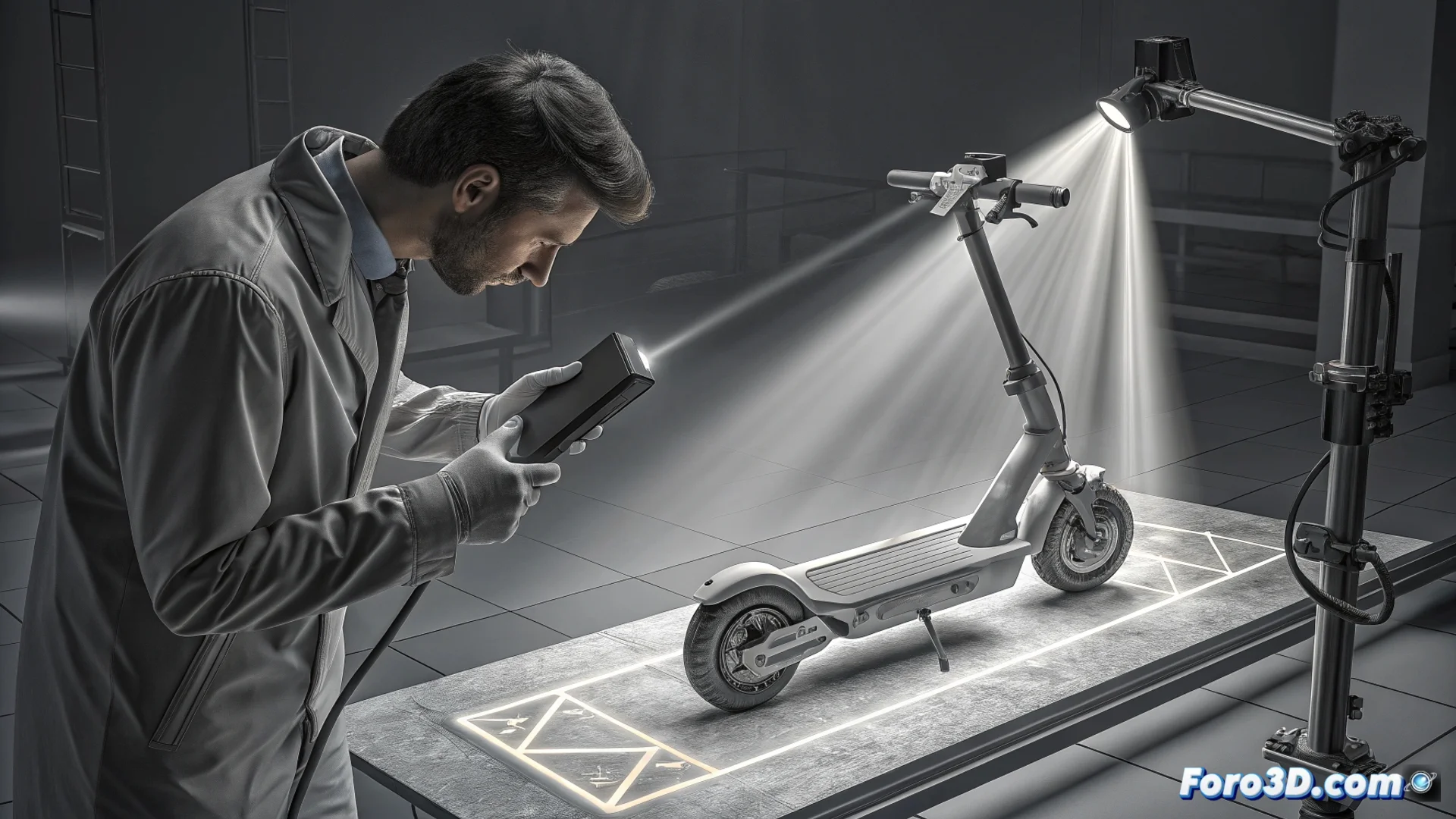
Reconstructing Accidents with Electric Scooters Analyzes Chassis Damage
The way to investigate accidents involving personal mobility vehicles is changing radically. Experts no longer rely solely on measuring marks on the asphalt. Now, they capture the scene with three-dimensional scanning technology to build an exact digital replica. This model becomes the objective evidence on which to base the entire forensic analysis. 🔍
Document Evidence with Millimeter Precision
A 3D laser scanner or photogrammetry system records every detail of the damaged vehicle. It captures dents, cracks, and breaks in the main structure. Specialized software processes this data to generate a precise polygonal mesh that represents the post-accident state. This deformed digital model is then compared with the original CAD plans of the scooter. The comparison shows the magnitude and exact direction of the forces that acted during the collision.
Key Advantages of the Forensic 3D Model:- Provides an objective and immutable database of structural damage.
- Allows measuring deformation vectors to deduce key impact parameters.
- Facilitates visualization and analysis of damage areas that the human eye might overlook.
3D scanning turns the chassis scars into a precise digital testimony of the accident.
Simulate the Impact to Calculate Critical Variables
Experts use the deformed digital model in advanced simulation software, such as finite element tools or multibody dynamics. In these platforms, they recreate the accident and adjust variables like initial speed or collision angle. The goal is for the damages produced by the simulation to match those documented in the real scan. This inverse analysis method determines the probable speed at the moment of impact with greater accuracy than classical formulas.
Parameters That Can Be Deduced:- Impact Speed: Calculated by matching virtual deformation with the real one.
- Contact Angle: Inferred from the force vectors applied to the model.
- Event Sequence: Simulation helps reconstruct the order of damages and collisions.
The Digital Fingerprint of an Accident
The next time you see an electric scooter