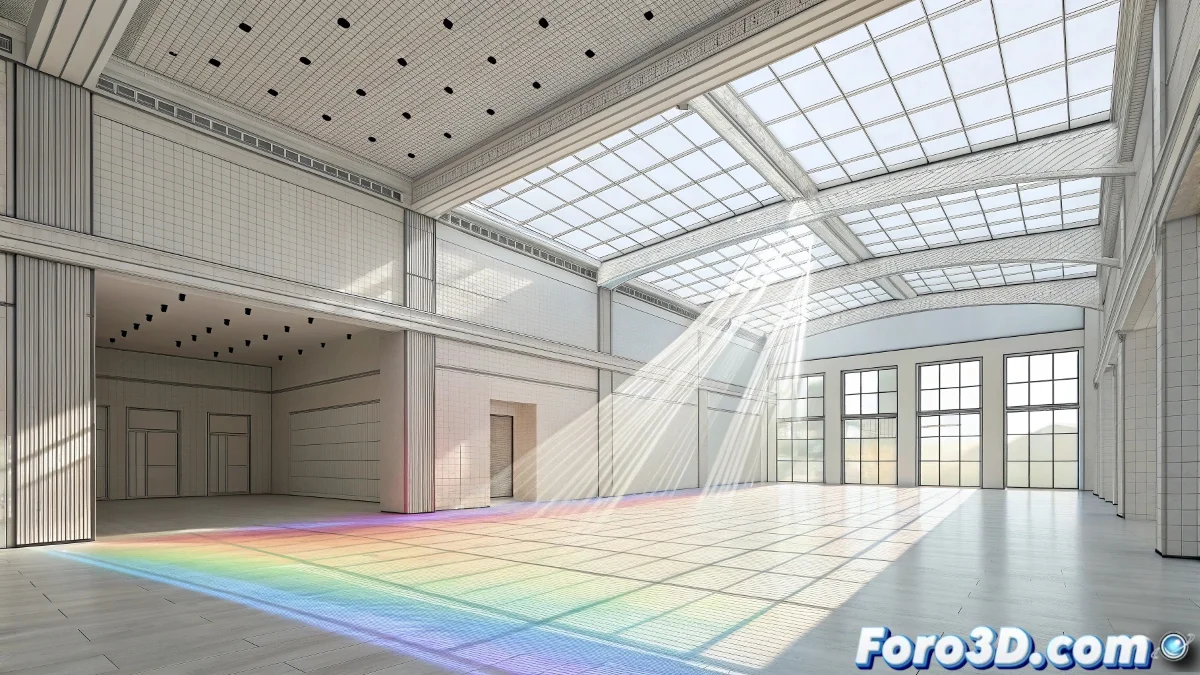
When Light Learned to Bounce in the Digital World
Radiosity in Autodesk Viz represents a historic milestone in the evolution of 3D rendering, being one of the first accessible systems that brought global illumination beyond the realm of academic research into the everyday workflow of 3D artists. This method, based on calculating how light energy is transferred between surfaces, radically transformed what was possible in terms of photorealistic lighting before the era of modern rendering engines. Where shadows were once mere absences of light, radiosity filled them with reflected color and life.
The most fascinating aspect of radiosity is how it faithfully replicates a phenomenon we experience constantly but rarely consciously analyze: how surface colors contaminate each other through multiple light bounces. That warm tone a red wall lends to a white ceiling, or the greenish reflection a plant casts on a nearby floor, ceased to be manually added effects and became natural consequences of physical calculation.
Radiosity doesn't add light, it reveals the light that was always there
Setup and Workflow
- System activation from Rendering / Advanced Lighting
- Initial calculation with quality parameter adjustment
- Mesh optimization for reasonable processing times
- Strategic transition to modern engines
The Calculation Process: Patience versus Perfection
Activating radiosity through Rendering / Advanced Lighting / Radiosity initiates a computationally intensive process where Viz divides the scene into elements and calculates how light energy is distributed among them. The Start button triggers this numerical dance where each surface becomes both an emitter and receiver of light, creating that network of light interdependence that characterizes real spaces. Patience during this phase is rewarded with lighting that breathes physical coherence.
The correct scene scale is crucial for accurate results. Radiosity operates with real-world units, where distances between objects directly affect how light attenuates and disperses. A scene built in generic units or with inconsistent scale can produce results where the lighting appears too intense or inexplicably dim, as the calculations are based on physical assumptions that depend on realistic measurements.
Key Parameters for Optimization
- Mesh resolution for balance between detail and time
- Number of subdivisions for quality in complex areas
- Material reflectance adjusted to realistic values
- Solution filtering to smooth calculation artifacts
Materials with realistic reflectance are the soul of a successful radiosity setup. Where in traditional lighting we could use arbitrary colors, here we must think in terms of diffuse reflection capacity. Pure white reflects approximately 80% of incident light, while darker colors may reflect only 10-20%. This physical correspondence ensures that light energy is conserved through multiple bounces, creating lighting that not only looks real, but behaves real.
In radiosity, every material doesn't have color, it has a reflection coefficient
Evolution Toward Modern Engines
While Viz's radiosity marked a before and after in its time, the evolution toward engines like V-Ray and Mental Ray represents the natural progress of rendering. These systems combine the best of multiple techniques—global illumination, path tracing, photon mapping—offering not only greater speed, but more granular artistic control. The ability to individually adjust different lighting components (direct, indirect, specular reflections, sub-surface scattering) provides flexibility that the monolithic radiosity approach cannot match.
HDRI compatibility in modern engines adds another dimension of realism, allowing ambient lighting to be not just generic diffuse light, but a complex lighting environment captured from the real world. Combined with physically based materials that respond predictably to different lighting conditions and physical cameras that replicate real lens behavior, the result is a workflow where realism emerges naturally rather than being painstakingly constructed.
Hybrid Strategy for Current Projects
- Preview with radiosity for quick lighting tests
- Final render with V-Ray for maximum quality and efficiency
- Maintaining consistent scale between both systems
- Material conversion to physical standards for V-Ray
The hybrid strategy of using radiosity for preview and V-Ray for the final render leverages the best of both worlds. Radiosity provides quick visual feedback on how light flows through the space, allowing adjustments to light placement and material colors without waiting for full renders. Once satisfied with the basic light distribution, transitioning to V-Ray for the final render ensures production quality with optimized render times and access to advanced effects like caustics, depth of field, and motion blur.
And as you contemplate how that scene that once required hours of calculation with radiosity now renders in minutes with superior quality, you appreciate how each technology, even the obsolete ones, built the foundations upon which modern rendering rests 💡