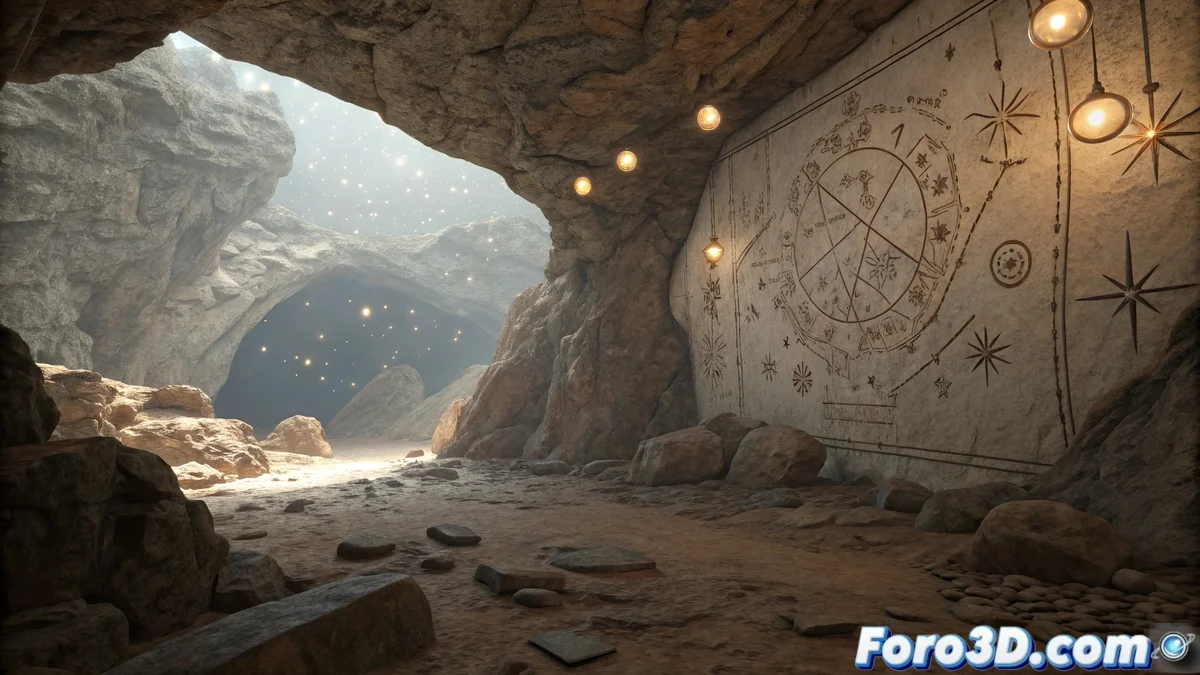
Mapping the Ancient Cosmos with Houdini 🌌
A team of archaeologists has discovered in the caves of the Caucasus what appears to be the first known stellar map, engraved in the rock. This finding could rewrite the history of astronomy by revealing how ancient civilizations observed and represented constellations. Houdini presents itself as the ideal tool to digitally recreate this discovery, thanks to its ability to generate procedural geometry, simulate complex environments, and animate celestial elements with scientific and artistic precision.
Procedural Modeling of the Cave with Heightfields
The process begins by creating the cave structure using Heightfields in Houdini. Through erosion and noise nodes, a credible geological surface is generated with irregular rock formations, stalactites, and eroded walls. This base terrain is then converted into 3D geometry using the Convert Heightfield node, ready for additional detailing. For the specific areas where the stellar engravings are located, flat sections of the wall are isolated using selection masks based on angle or curvature. 🗺️
Creation of Stellar Symbols
The engravings of the stellar map are generated in two complementary ways: as geometry carved directly into the rock and as emitted points representing stars. For the carved symbols, VDBs from curves that define the constellations are used, applying boolean operations to "engrave" these patterns into the cave wall. In parallel, a particle system emits points at positions corresponding to key stars, with size and intensity attributes based on hypothetical stellar magnitude.
Recreating an ancient stellar map is connecting two universes: that of rocks and that of stars, both governed by procedures.
Lighting and Discovery Atmosphere
The lighting is set up to emulate the archaeologist's experience: a main directional light simulates the lantern or torch that reveals the engravings, with a grazing angle that accentuates the depths of the carvings. Dim volumetric lights with amber tones create visible beams in the suspended dust, adding depth and mystery. The use of volumetric fog and dust particles animated with slight turbulence completes the atmosphere of a cave untouched for millennia.
Procedural Animation of Stellar Transits
To show the map in action, the star particles are animated to connect forming constellations using procedural trails. A solvers system calculates trajectories based on simple celestial movements, giving the impression that ancient astronomers captured not only positions but dynamics. This animation can be controlled with exposed parameters that adjust speed and direction, allowing exploration of different interpretations of the map.
Rendering and Final Elements
The scene is rendered with Mantra or Karma, leveraging Houdini's capabilities to handle complex geometry and volumes. Adaptive sampling adjustments ensure that the details of the engravings and stellar particles look sharp. In compositing, separate passes of beauty, volumetrics, and light effects allow balancing intensities without re-rendering the entire sequence.
While archaeologists decipher which stars each symbol represented, we decipher why the VDB solver sometimes generates more abstract shapes than the original map. In the end, our procedural render may not solve the astronomical mysteries, but at least it doesn't require thousands of years of erosion to look impressive. 😅