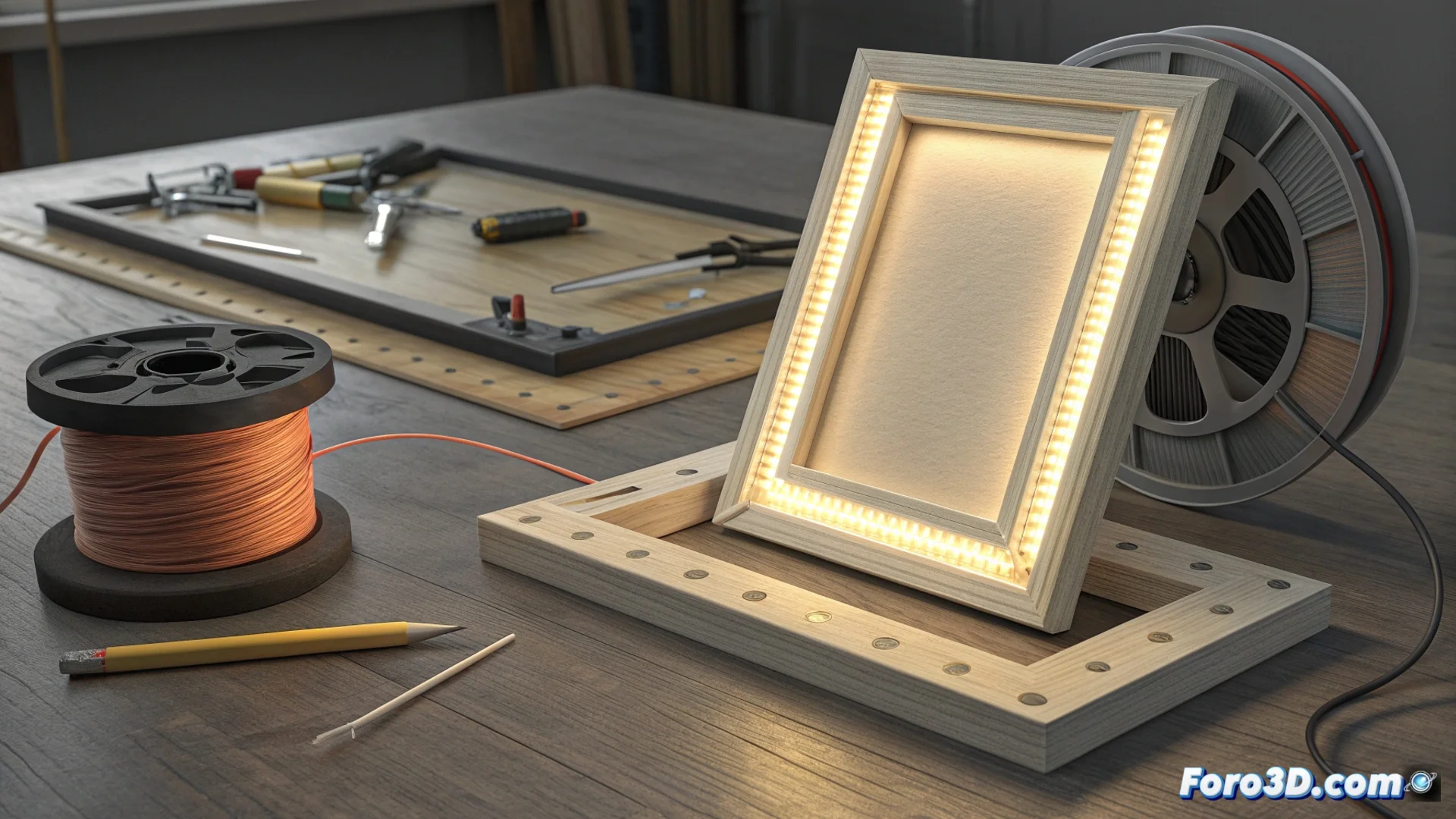
Print Picture Frames with Integrated Lighting
Fusing 3D printing with basic electronic components allows creating custom picture frames that enhance any image with light. The project involves designing a frame that internally houses an LED strip and a system to diffuse its light, offering a professional finish and highly customizable. 🖼️✨
Design the Structure and Light Channel
The first step is to 3D model a frame with a specific internal channel. This channel is strategically located behind the lip that holds the image, directing the light towards it. The geometry must allow inserting a standard LED strip and, subsequently, a diffuser piece. Precision in this design is key for everything to fit perfectly after printing.
Key Design Elements:- LED Channel: A continuous groove or slot that runs along the inner perimeter of the frame, sized for the chosen LED strip.
- Diffuser Housing: A space adjacent to the channel where the translucent piece that softens the light will be inserted.
- Electronics Compartment: A space on the back to hide the microcontroller and power supply.
The light should not hit the image directly, but be guided and diffused to create a uniform halo that envelops it.
Create and Test the Light Diffuser
To avoid perceiving the individual bright spots of the diodes, it is essential to use a diffuser. This piece is modeled as a translucent sheet that fits into the LED channel. Its inner face usually has a texture, such as micro-prisms or ridges, that helps break and disperse the light beams homogeneously.
Factors to Consider in the Diffuser:- Material: Commonly PLA or translucent white PETG is used. The color and opacity of the filament determine how much light it lets through and how it diffuses it.
- Thickness: It must be tested to balance good diffusion with light intensity loss. Excessive thickness can attenuate the light too much.
- Fixing: It can snap-fit into the channel or be glued with adhesive, forming a continuous and smooth line of light around the photograph.
Control the Lighting with Electronics
Complete customization of color and effects is achieved with a small microcontroller, such as an Arduino Nano or an ESP8266. This connects to an addressable LED strip (e.g., WS2812B or "Neopixel"), where each diode can be commanded independently.
Programming the microcontroller is straightforward. With a few lines of code, a static color that harmonizes with the image can be defined, or slow transitions and dynamic effects can be programmed. The system is powered by a 5V source, and all wiring and the board are hidden on the back of the frame.
This approach allows completely transforming the atmosphere of a work, though it's advisable to review the code so your family portrait doesn't end up under an unexpected psychedelic rainbow effect. 💡🤖