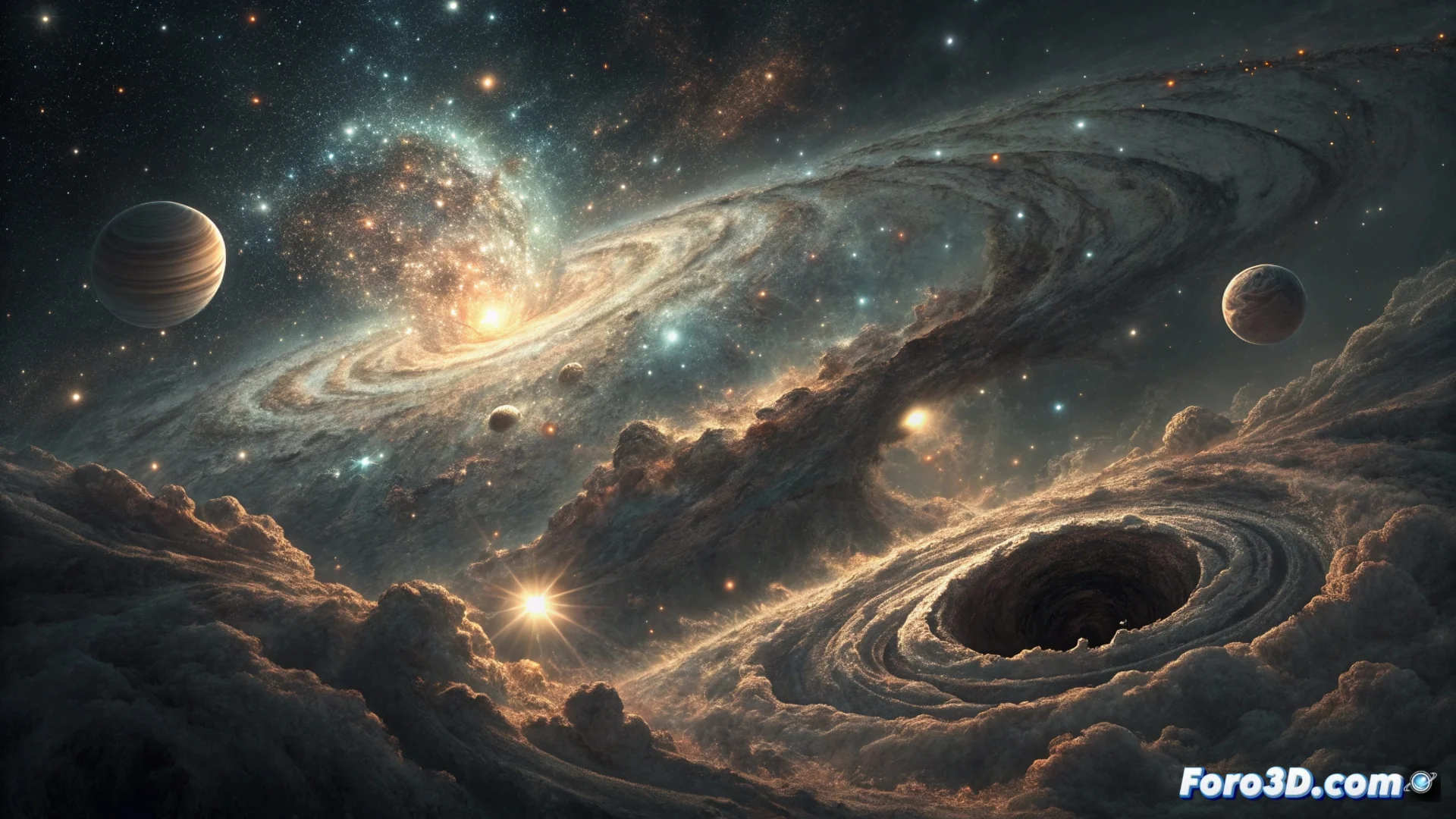
Primordial Black Holes Could Explain Early Massive Systems
The James Webb Space Telescope has begun to find enormous cosmic objects that existed when the universe was very young, such as the system known as UHZ1. This hosts a young galaxy with an extraordinarily massive central black hole. The fact that these monsters appear so soon poses a profound challenge to the cosmological theories we normally use. 👁️🗨️
An Alternative Mechanism from the Beginnings of the Cosmos
To solve this enigma, a mechanism involving primordial black holes is proposed. These are hypothetical objects that could have formed in the first instants after the Big Bang and that, according to some ideas, would constitute a part of dark matter. Their presence would alter how matter evolved on the smallest scales of the primitive cosmos.
The Accelerated Collapse Process:- A population of primordial black holes, with a range of masses, adds extra fluctuations to the matter density field.
- This additional granularity provides the power needed for the first dark matter halos to collapse and stabilize much earlier than standard models predict.
- Within these early halos, the heaviest primordial black holes migrate to the center due to effects like dynamical friction.
If you find a colossal black hole where there shouldn't even be time to form a star, maybe it wasn't born there, but was already visiting from the beginning of time.
Creating Cores Like UHZ1
By modeling the dynamical evolution with realistic orbital parameters and halo properties, the analysis reveals that certain mass functions of primordial black holes can produce systems with characteristics similar to those observed by the James Webb. The key mechanism suggests that a very massive primordial black hole can accumulate at the center and act as a seed.
Advantages of This Scenario:- Explains the rapid appearance of these massive objects without needing them to grow from extreme accretion rates.
- Does not require conventional supermassive black hole seeds, which would need more time to develop.
- Provides a direct link between primordial dark matter and the most massive structures we see in