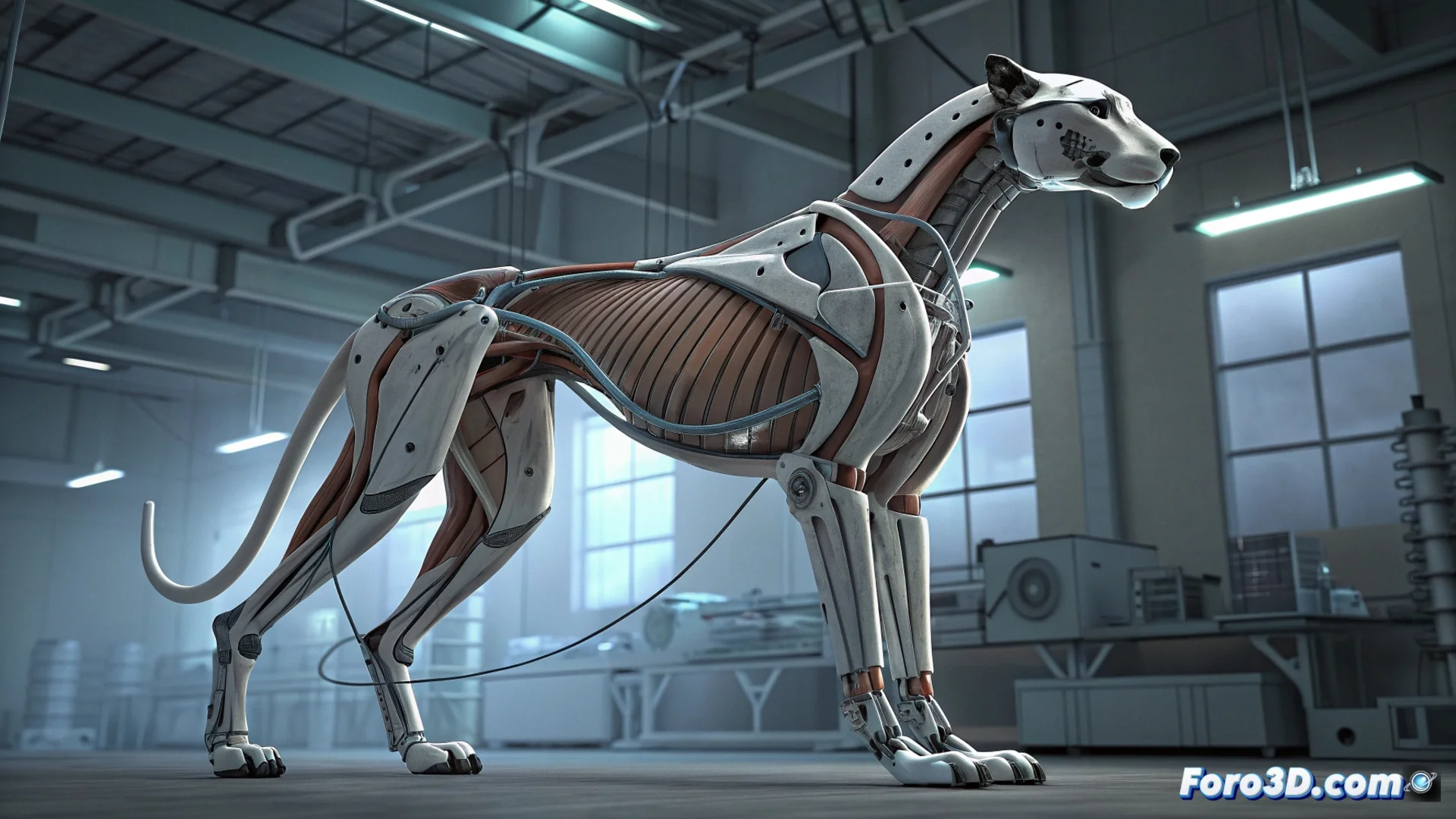
Pneupard: a pneumatic quadruped robot that imitates a cheetah
At Osaka University, a team of scientists is developing a quadruped robot called Pneupard, whose propulsion system is based exclusively on compressed air. This project seeks to replicate the mechanics of a cheetah's muscles, the fastest land animal. By replacing electric motors with pneumatic actuators, the robot gains a natural flexibility that allows it to move dynamically and adapt to the terrain. 🐆
Pneumatics define its mobility and flexibility
The pneumatic system is the core of Pneupard's capabilities. The actuators, powered by pressurized air, expand and contract to simulate real muscle contraction. This produces locomotion that is not only potentially fast, but also smooth and with inherent elasticity. The compliance or adaptability of these components allows the robot to interact with its environment more safely, as it can absorb impacts and modulate its force while moving. This approach represents a promising alternative for designing robots that must operate on uneven or changing terrain.
Key advantages of the pneumatic system:- Provides an intrinsic flexibility that imitates biological tissues.
- Allows fast movements and natural impact absorption.
- Facilitates safer interaction with unpredictable environments.
The elegance of natural movement requires more than just imitating the form; it needs to replicate the physics of muscles.
A physical laboratory to understand how animals move
The main purpose of Pneupard is not commercial, but to serve as an advanced research tool. Researchers use it as a tangible physical model to test theories about how animals coordinate their limbs and maintain balance. By analyzing data from its gait patterns, energy efficiency, stability, and locomotion rhythms in nature can be better understood.
Potential applications of this research:- Improve the design of walking robots for rescue or exploration.
- Inspire the development of more natural and adaptive robotic prostheses.
- Create new physical rehabilitation systems based on biological movements.
The path ahead between imitation and matching
Although its inspiration is the speedy cheetah, Pneupard's current speed resembles a leisurely stroll more than a race. This detail underscores a fundamental principle: emulating the sophistication and efficiency of biological systems is a complex engineering challenge. Pneupard is not the final destination, but a crucial step to close the loop between biology and robotics, demonstrating that sometimes the most elegant solution can be powered by simple compressed air. 🤖