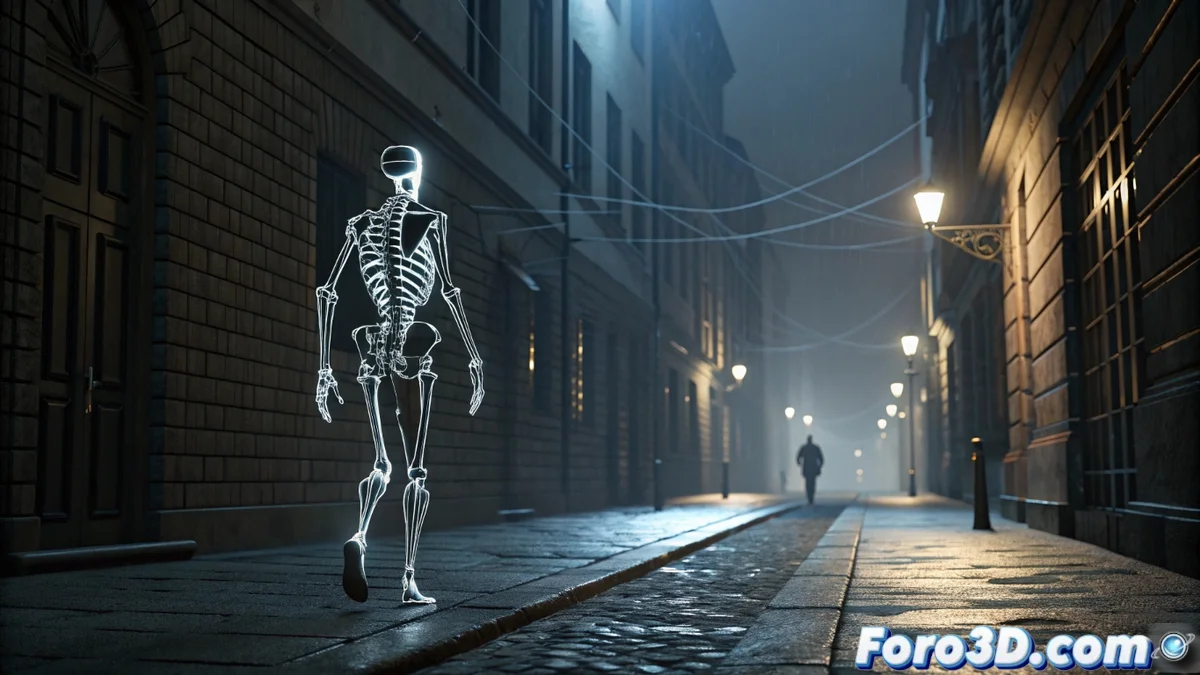
Photogrammetry and Motion Analysis for Forensic Identification
When surveillance cameras capture low-quality images or from behind, facial recognition becomes ineffective. The solution lies in a forensic pipeline that fuses photogrammetry with motion analysis to study gait, a unique biomechanical identifier. 🕵️♂️
3D Scene Reconstruction
The first step is to create an exact metric replica of the crime scene. Using camera tracking software like PFTrack or SynthEyes, lens parameters are calibrated and the three-dimensional environment is reconstructed. This calibrated 3D scene serves as a precise spatial foundation for all subsequent analysis, eliminating perspective distortions.
Reconstruction Process:- Calibration of the security camera lens to understand its distortion.
- Generation of a 3D mesh and textures of the environment where the recording took place.
- Establishment of a precise coordinate system for real measurements.
The solution lies in analyzing their way of walking, a biomechanical pattern as unique as a fingerprint.
Motion Extraction and Transfer
With the 3D scene ready, the individual's movement is isolated from the video material. This 2D tracking is transferred to a digital skeleton or rig within applications like Autodesk Maya or MotionBuilder. The result is an animation that faithfully captures the nuances of the gait: stride length, pelvic swing, and joint rotation.
Advantages of Skeletal Animation:- Eliminates visual noise from loose clothing or poor lighting.
- Provides a clean model for quantitative analysis.
- Allows visualization of the movement from any angle in the reconstructed 3D space.
Quantitative Analysis and Forensic Comparison
The skeleton animation is analyzed with specialized tools like Dartfish. Key parameters are measured and quantified: joint angles, walking speed, step frequency, and movement symmetry. This dataset forms a detailed biomechanical profile that can be objectively compared with the gait of a detained suspect, recorded under controlled conditions. The comparison provides objective evidence that supports or rules out a connection. 📊
The final challenge is often to validate this scientific method in court, demonstrating that motion data is as reliable as other evidence, especially when visual testimony is unreliable. Gait identification thus consolidates as a crucial forensic tool.