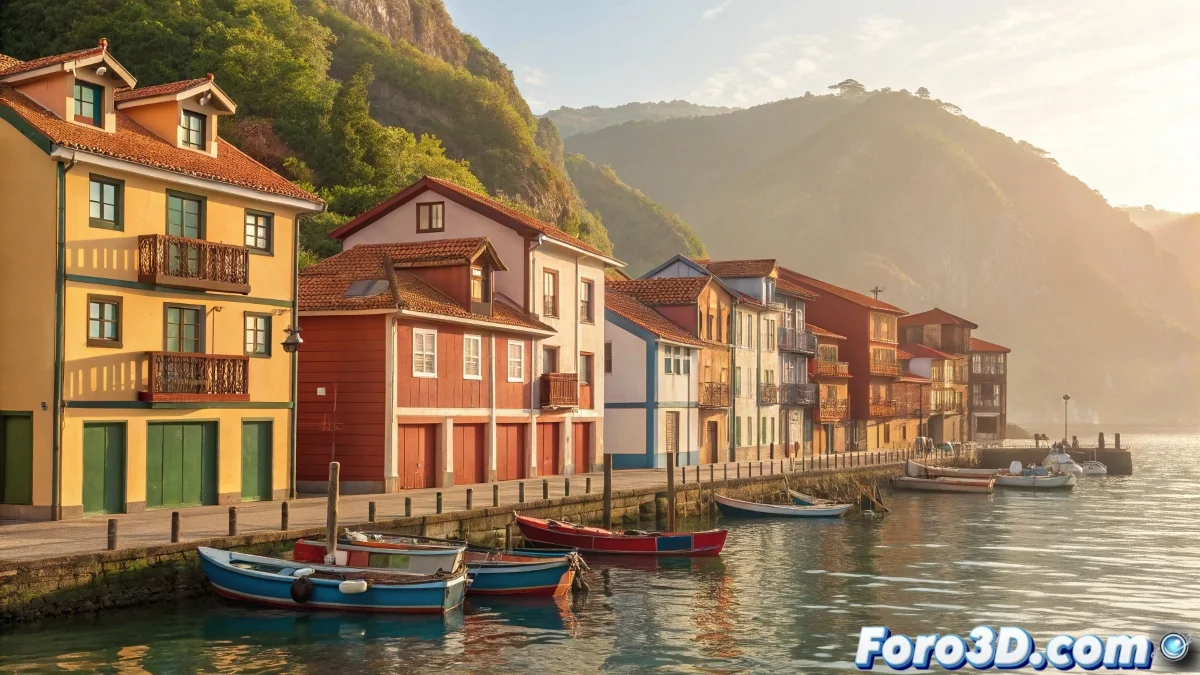
Pasajes de San Juan: Where the Sea Writes Stories
On the coast of Gipuzkoa, between mountains and sea, lies Pasajes de San Juan, a seafaring village that seems frozen in time. Its cobblestone and winding alleys cluster between colorful houses overlooking the natural harbor, creating a labyrinthine urban network that has inspired artists and writers. The most famous of them, Victor Hugo, was so fascinated during his stay in 1843 that locals claim his spirit still wanders the docks seeking new inspirations. This combination of traditional Basque architecture and literary legend makes it a perfect challenge for architectural modeling. ⚓
The Geometry of Seafaring Charm
What makes Pasajes de San Juan unique is its organic adaptation to the rugged topography of the Basque coast. The houses do not follow an orthogonal plan but adapt to the terrain, creating irregular and stepped volumes that face each other across alleys that resemble urban fissures. The wooden balconies, traditional colors, and the omnipresence of the sea create a visual palette that Rhinoceros can capture precisely thanks to its complex surface modeling tools.
Modeling the Seafaring Essence in Rhinoceros
Recreating the unique architecture of Pasajes de San Juan requires an approach that combines organic modeling with technical precision. Rhinoceros offers the ideal tools to capture both the irregular forms of the village and the traditional Basque construction details.
Base Terrain Setup
Start by importing or creating a contour curve that represents the rugged topography of the bay. Use the Loft command to generate a surface from the contour curves. Apply Rebuild to optimize the mesh and then use ExtractSrf to flatten the areas where buildings will be located. This base terrain will serve as a reference for organically distributing the architectural volumes, following the terrain adaptation logic that characterizes the village.
Terrain Commands:- loft to create surfaces from curves
- rebuild to optimize geometry
- extractsrf for buildable areas
- split to divide complex surfaces
Architectural Volume Modeling
Create the main volumes of the houses using Box and then deform these basic prisms with Bend and Twist to adapt them to the topography. For the characteristic curved facades, use Surface from 3 or 4 Corner Points. The gabled roofs are easily modeled with ExtrudeSrf applied to roof profiles. Maintain an organized layer hierarchy to manage different types of buildings.
In Rhinoceros, the key is to build clean geometry that can be parametrically modified.
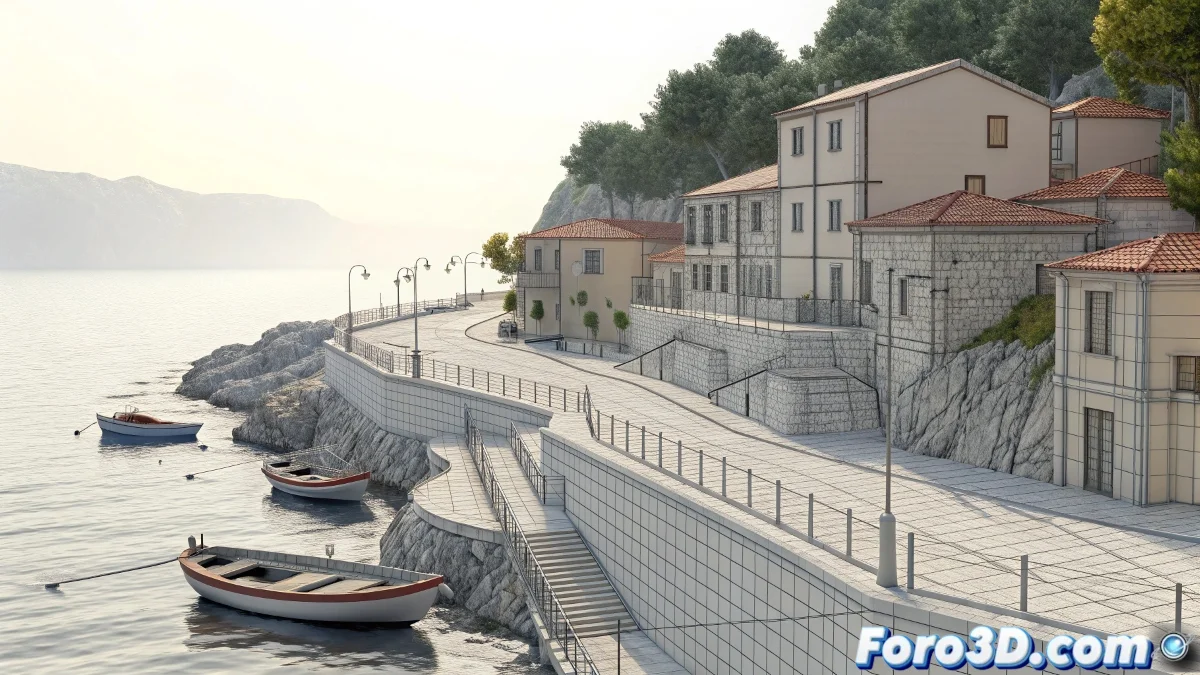
Traditional Construction Details
For the wooden balconies, use Array along Curve to distribute railings along the facades. Windows with shutters are modeled by extruding profiles and then applying BooleanDifference for the openings. Decorative elements like moldings and cornices are easily created with Sweep1 or Sweep2 applied to specific profiles. Don't forget to model the typical outdoor staircases that connect the different levels of the village.
Detail Tools:- array for repetitive elements
- sweep for moldings and cornices
- boolean operations for openings
- fillet to smooth edges
Urban Elements and Environment
The narrow alleys are modeled using Pipe applied to curves that follow the natural topography. For the port and traditional vessels, use Revolve to create hull shapes and then refine with Control Point Editing. Urban elements like street lamps, benches, and fishing nets add realism to the ensemble. Use Block to create instances of repetitive elements and optimize the file. 🏗️
Environment Elements:- vessels with revolve and loft
- docks with directed extrusions
- urban elements as blocks
- vegetation with instances
Once finished, you'll have a model where the geometry tells stories of tides and literati, though Victor Hugo probably never imagined that his favorite muse would end up converted into NURBS and polygons. 📐