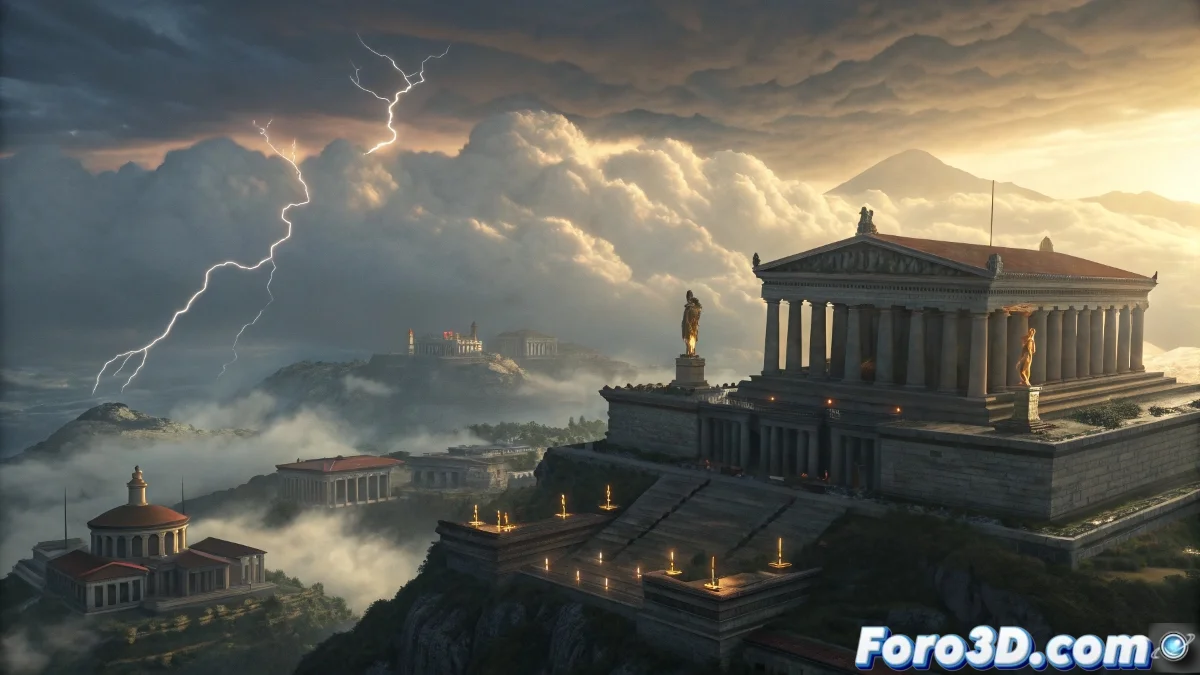
When the gods need to render 🏛️💻
The Olympo project by Entropy Studio is a visual ode to mythology, where every frame looks like a Greek fresco coming to life. Among smoke creatures and temples that defy gravity, this breakdown reveals how an epic universe was built from digital scratch.
Divine architecture: between the digital and the painted
For the monumental scenarios:
- Matte painting projected onto base geometry in Maya/Blender
- Camera displacement with depth maps in Nuke
- Procedural texturing for marble and ancient stone
Key fact: "Each floating temple required 3 versions: general view, medium detail, and close-ups with full modeling," explains the team.
Creatures born from chaos (digital)
Elemental beings
- Sculpted in ZBrush with hybrid anatomy
- Rigs in Maya for solid parts
- Simulations in Houdini for volatile elements (smoke, lava)
Magical effects
- Particles that respond to the creatures' "soul"
- Procedural shaders for stone → lava transitions
- God rays that interact with volumes
Recreating Olympus in 3ds Max
Alternatives for foro3d users:
- Forest Pack - Mythical vegetation and ruins
- Phoenix FD - Smoke/lava effects
- TyFlow - Magical particle swarms
- V-Ray/Arnold - Ancient material shaders
Tip: Use Camera Mapping to integrate matte paintings into 3D scenes.
The fragility of digital gods
As the breakdown aptly summarizes: "We rendered 300 frames of a perfect lava titan... only for the compositor to cover it with fog because 'it looked more mysterious'". But when that digital fog makes viewers cry, even Zeus would approve the change. ⚡
"In the VFX Olympus, even Apollo curses when the render farm goes down." - Anonymous Entropy artist.