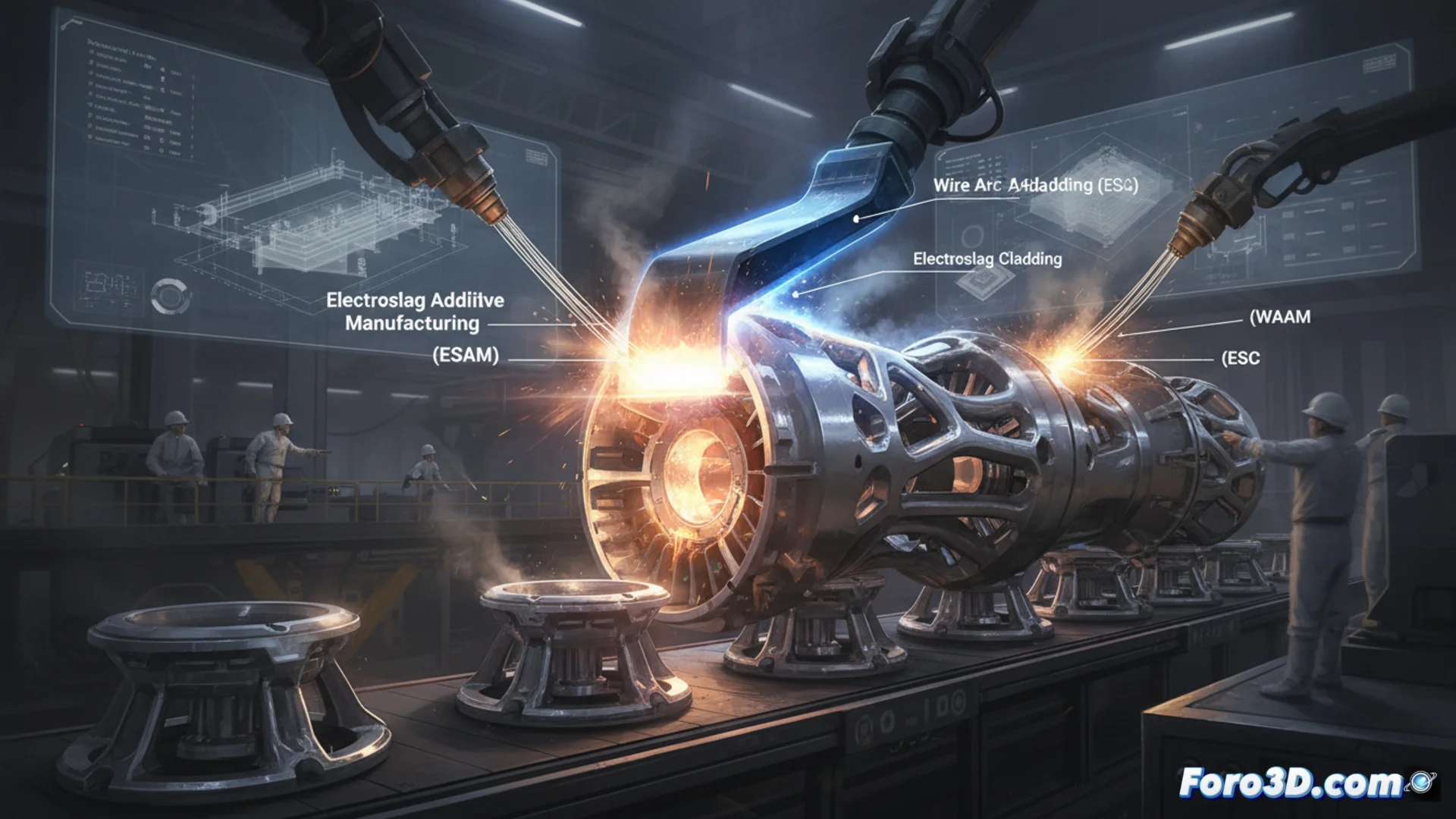
Oak Ridge National Laboratory Presents High-Speed Electroslag Additive Manufacturing
A team from the Oak Ridge National Laboratory and its partner ARC Specialties has unveiled a new advancement in metal 3D printing. This technique, called Electroslag Additive Manufacturing (ESAM), fuses two known methods to achieve unprecedented working speeds in creating large-sized parts. 🚀
A Hybrid Process that Multiplies Productivity
The ESAM method integrates tape electroslag cladding (ESC) and wire arc additive manufacturing (WAAM). This innovative combination achieves depositing metallic material at a much higher rate than conventional wire systems. The direct result is the ability to produce bulky components with a near-final shape in significantly reduced timeframes.
Key Features of the ESAM Process:- High Deposition Rate: Deposits metal several times faster than traditional wire-based additive processes.
- For Large Parts: Designed to manufacture industrial-scale components, weighing several tons.
- Robust Properties: Uses high-performance alloys, offering strong mechanical characteristics.
This technique could enable the manufacture of multi-ton components that are currently produced by casting or forging.
Promising Results with Advanced Alloys
The research, documented in Additive Manufacturing Letters, focused on evaluating the process using the alloy 625. The findings indicate that parts created with ESAM can achieve mechanical properties similar to those of components obtained by casting. The main advantage lies not only in quality, but in the drastic reduction of the time required for manufacturing.
Potential Industrial Impact:- Energy Sector: Ideal for producing large-scale metal parts required by these industries.
- Alternative to Forging/Casting: Positions itself as a more agile method for creating large and complex parts.
- Extreme Conditions: The relevance of using alloy 625 points to applications demanding maximum strength and durability.
Bringing Additive Manufacturing to Large Scale
The development of ESAM technology represents a significant step for additive manufacturing to be used in the production of large-scale structural components. By radically optimizing speed, it brings closer the possibility of manufacturing heavy parts in a timeframe that was previously unthinkable. The future of manufacturing ton-weight parts is no longer measured in endless weeks. 🔧