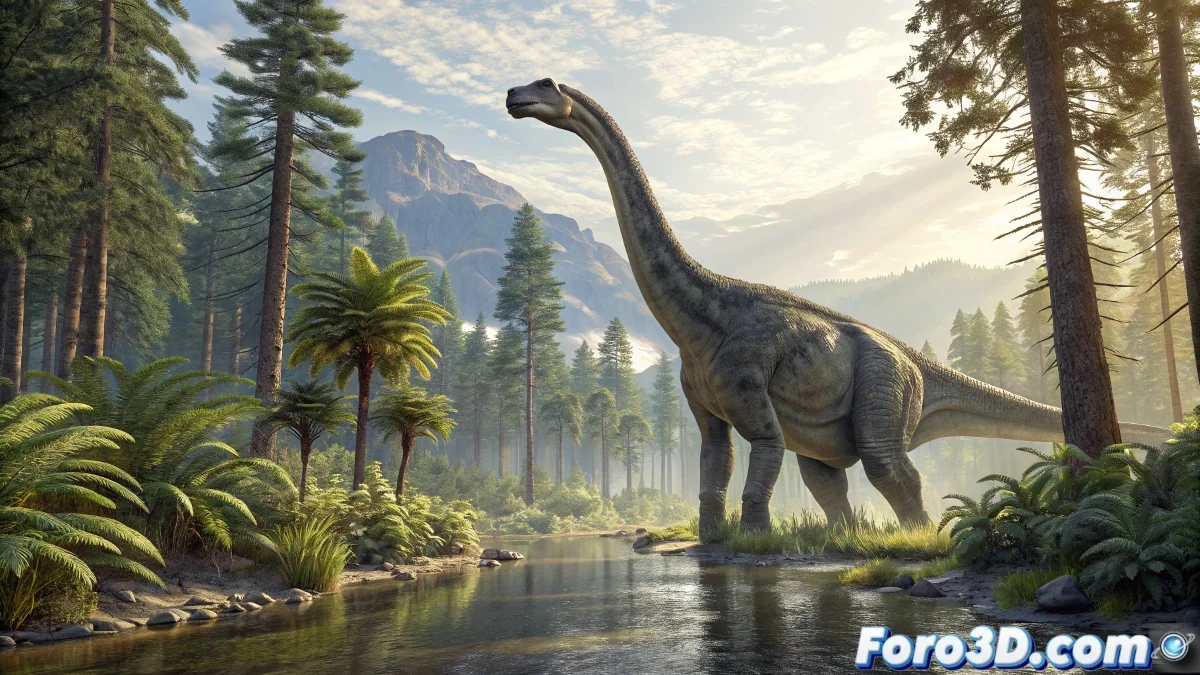
A New Patagonian Giant: The Titanosaur That Reveals Secrets of the Cretaceous
A team of Argentine and Spanish paleontologists has announced the discovery of a new titanosaurs species in the Bajo de la Carpa Formation, in the province of Neuquén, Argentine Patagonia. The find, which includes an exceptionally well-preserved partial skeleton, belongs to an animal that lived approximately 85 million years ago during the Late Cretaceous. This new species, yet to be officially named, represents an important link in understanding the evolution and diversification of titanosaurs, the group of sauropods that includes the largest animals to have walked the Earth. 🦕
A Discovery in the Land of Giants
What makes this find particularly significant is its temporal and geographical location. Neuquén is already famous for yielding some of the world's most spectacular dinosaurs, including Argentinosaurus and Patagotitan, but this new species appears to occupy a different ecological niche. With an estimated length of 12 meters and a height of 3 meters to the hip, it was considerably smaller than its giant cousins, suggesting adaptive specialization that allowed the coexistence of multiple sauropod species in the same ecosystem.
Distinctive Anatomical Features
The recovered skeleton, which includes dorsal and caudal vertebrae, elements of the pelvic girdle, and limb bones, presents several unique features that justify its classification as a new species.
Unique Skeletal Features
The vertebrae feature spinous processes with a distinctive rhomboid morphology, different from any other known titanosaurs. The hip bones show adaptations for particularly powerful musculature, suggesting specialized locomotion. The limb proportions indicate that this animal may have been more agile than larger titanosaurs, possibly adapted to navigate environments with denser vegetation or more rugged terrain.
Distinctive Features:- vertebrae with rhomboid spinous processes
- pelvic adaptations for powerful musculature
- limb proportions suggesting greater agility
- unique neural structures in the tail
Paleoecological Implications
The discovery suggests that Late Cretaceous ecosystems in Patagonia hosted greater titanosaurs diversity than previously thought, with different species occupying specific ecological niches. While species like Patagotitan specialized in reaching the highest vegetation, this new species may have grazed at lower levels, allowing coexistence through resource partitioning. This reinforces the theory that South America was a center of diversification for titanosaurs before their global dispersal.
Every new titanosaurs we discover is like finding a different piece of the same giant puzzle.
Study Methodology and Preservation
The fossils were discovered during an excavation campaign in 2022 and required over 1,500 hours of laboratory preparation. The use of computed tomography allowed the study of internal structures without damaging the fossils, revealing details about vertebral pneumatization (presence of air cavities) that reduced skeletal weight. The excellent preservation includes even impressions of muscle insertions, providing invaluable information on the animal's biomechanics.
Research Techniques Used:- computed tomography for internal structures
- bone histology analysis
- 3D reconstruction via photogrammetry
- finite element analysis for biomechanics
Geological and Temporal Context
The Bajo de la Carpa Formation represents a semi-arid alluvial plains environment with marked seasons, where these titanosaurs shared territory with carnivorous dinosaurs like Viavenator, terrestrial crocodiles, and turtles. Precise dating via volcanic zircon analysis places the site in the Santonian-Campanian, a critical period in dinosaur evolution just before their extinction. This context helps understand how these ecosystems supported such diversity of megaherbivores. 🌋
Ecosystem Context:- semi-arid alluvial plains environment
- contemporary with carnivorous dinosaurs like Viavenator
- presence of terrestrial crocodiles and turtles
- climate with marked seasons and periods of aridity
In the end, every new discovery in the rich Patagonian land reminds us that we still have much to learn about the age of dinosaurs, though we will probably need a few more discoveries to complete the family album of these giants. 🔍