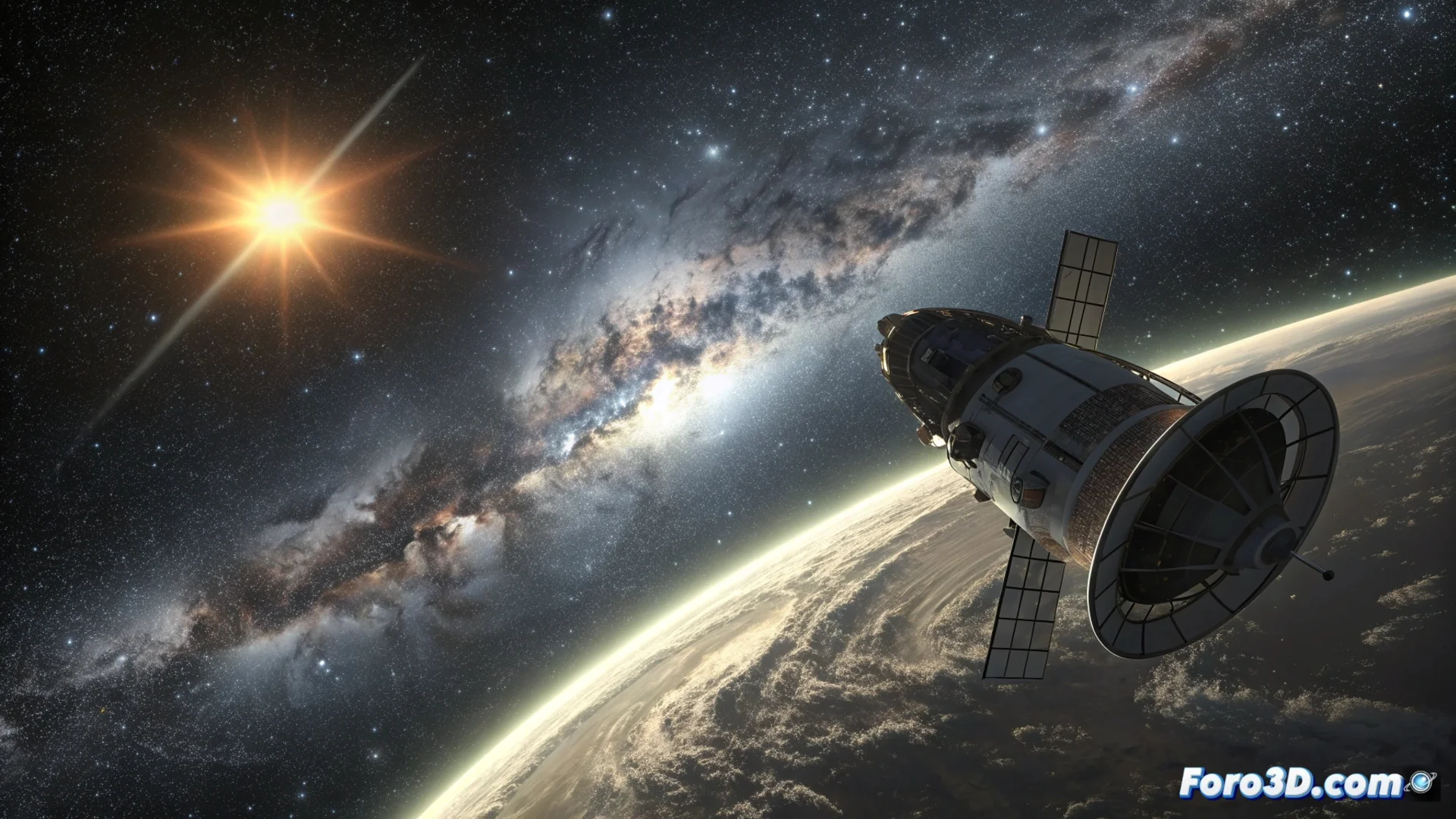
NASA's SPHEREx Observatory Completes the First All-Sky Infrared Map
Infrared astronomy has just achieved a historic milestone. The space telescope SPHEREx has finished scanning the entire celestial sphere, producing the first complete census in 102 distinct near-infrared bands. This project, operating from a solar polar orbit at 645 km altitude, culminates its main phase after two years of meticulous work. 🛰️
An Unprecedented Cosmic Atlas
The instrument has not only mapped the positions of hundreds of millions of galaxies but has also captured their unique spectral signature. This allows scientists to identify the chemical composition of distant objects, searching for elements like water ice and organic molecules in regions where stars are born. NASA has already released a video showcasing this universal panorama.
Key Mission Features:- Complete Spectral Coverage: Analyzes the sky in 102 distinct infrared wavelengths.
- Multiple Scans: Performs several complete passes during its mission to refine the data.
- Optimized Orbit: Operates from a solar polar orbit that enables stable and continuous observations.
SPHEREx's final archive will be a public resource for the global scientific community, democratizing access to this map of the cosmos.
Deciphering the Ingredients of Life and the Structure of the Universe
The collected data are invaluable for cosmology. They will enable analysis of how galaxies cluster on large scales and trace cosmic evolution. Additionally, it will be possible to investigate the structure and history of our Milky Way with unprecedented detail in this spectral range.
Main Scientific Applications:- Precision Cosmology: Study cosmic inflation and the formation of the first galaxies.
- Astrochemistry: Track the distribution of organic molecules and water in the galaxy.
- Galactic Archaeology: Understand the history and structure of the Milky Way.
A Legacy for Future Science
This first "infrared selfie of the universe", achieved with no more help than an orbiting telescope and observation time, lays the foundation for resolving fundamental questions. Astronomers trust that this map will help understand how the building blocks of life are distributed and unravel the mysteries of cosmic expansion. The universe now has its most complete portrait in infrared light. 🌌