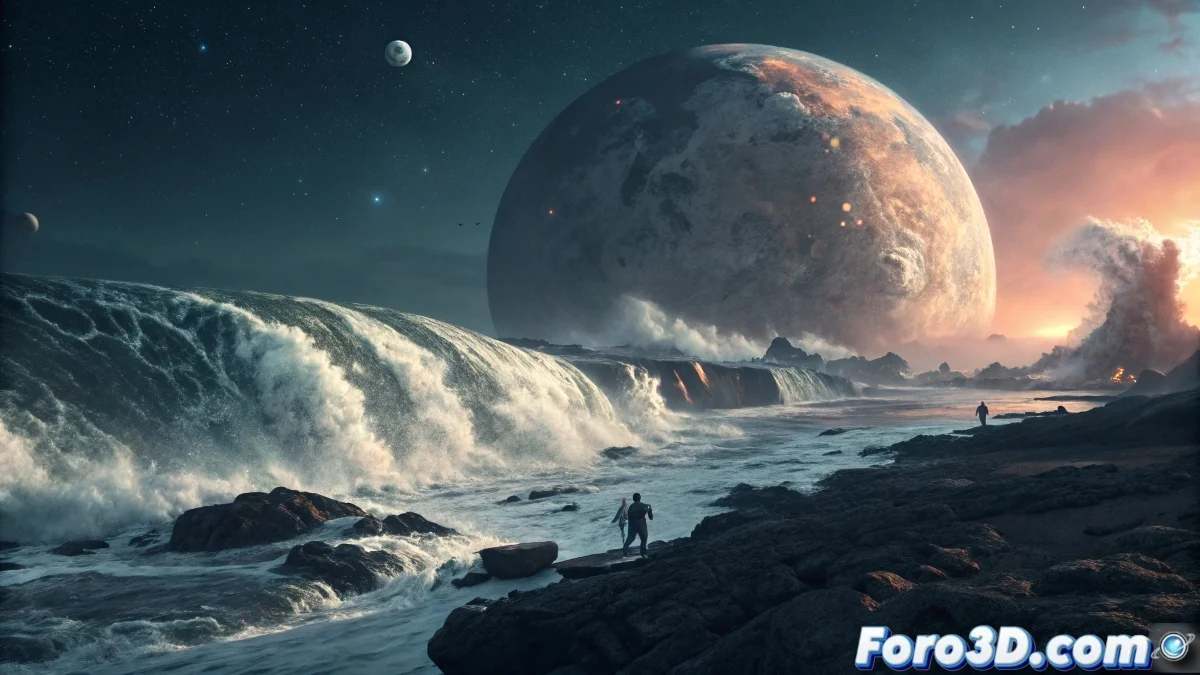
When the Lunar Apocalypse Needs a VFX Team
In Moonfall, DNEG didn't just have to destroy the Earth... but do it with cinematic style and a pinch of questionable science 🌍💥. The result was a catalog of natural disasters on a planetary scale that would make any physicist cry, but left the visual effects artists with a smile of "are they really paying us to do this?".
The Menu of the Day: Chaos on Demand
For this buffet of mass destruction, the artists cooked up:
- Crazy gravity simulations in Houdini - where the oceans decided that the laws of physics were mere suggestions.
- A Moon with an existential crisis, modeled in ZBrush and textured in Mari to show every crack of its cosmic drama.
- Renders that made the servers cough, combining Clarisse for environments and Arnold for that end-of-the-world lighting.
The best accident: a digital astronaut ended up with a panicked face in zero gravity... almost became the movie's official meme.
Tricks to Destroy a Planet (Without the CGI Showing)
DNEG learned that for global chaos you need:
- Disaster hierarchy: first the small buildings, then the skyscrapers (because even the apocalypse needs choreography).
- Textures with history: that Moon doesn't just break... it does so with geological layers that would tell its biography if they could.
- Composition in Nuke so the actors don't look like greenscreens with legs in the middle of the chaos.
The result was so convincing that even NASA's scientists scratched their heads... though more for the plot than the visual effects 🚀.
Lessons for Future World Destroyers
This project proved that:
- When Houdini says "I can't," it really means "I need more RAM."
- A good texture artist can make even the end of the universe look photogenic.
- Real scale matters: if you're going to destroy Tokyo, at least make it recognizable in the debris.
So the next time the Moon decides to visit Earth uninvited, we know who to call: the DNEG team, which has experience in Hollywood-budget interplanetary catastrophes 🌕✨.