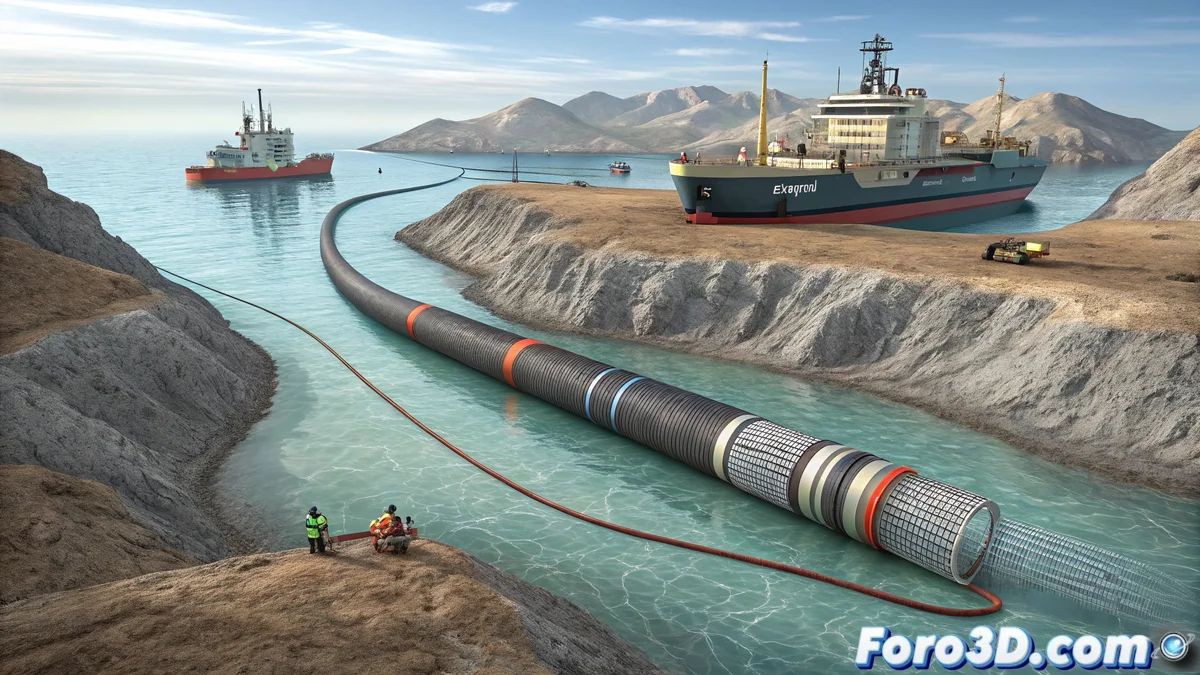
Ceuta Connects: A Submarine Cable Makes History
The autonomous city of Ceuta has taken a historic technological leap with the installation of the first submarine cable that directly connects it to the Iberian Peninsula 🌊. This infrastructure, laid in the waters of the Alboran Sea, will significantly improve communication and data transmission capacity, reducing dependence on less efficient methods. It is not just an engineering feat; it is a symbol of modernization and integration for a strategic region. Now, Ceuta is closer than ever, even if through fiber optics 💡.
Recreating the Engineering Feat in Rhino
Rhinoceros 3D presents itself as the ideal tool for modeling and visualizing this critical infrastructure project. Its precision in surface and curve modeling allows for a detailed recreation of the cable's route, the seabed topography, and contextual elements like ships or buoys. The goal is to generate a clear and attractive technical representation that communicates the magnitude and importance of this work, perfect for technical presentations or visual outreach. Because sometimes, an image is worth a thousand data points 📐.
In Rhino, a detailed scenario of the Strait of Gibraltar can be modeled with the submarine cable installed, creating models of the cable, installation ships, and marine topography.
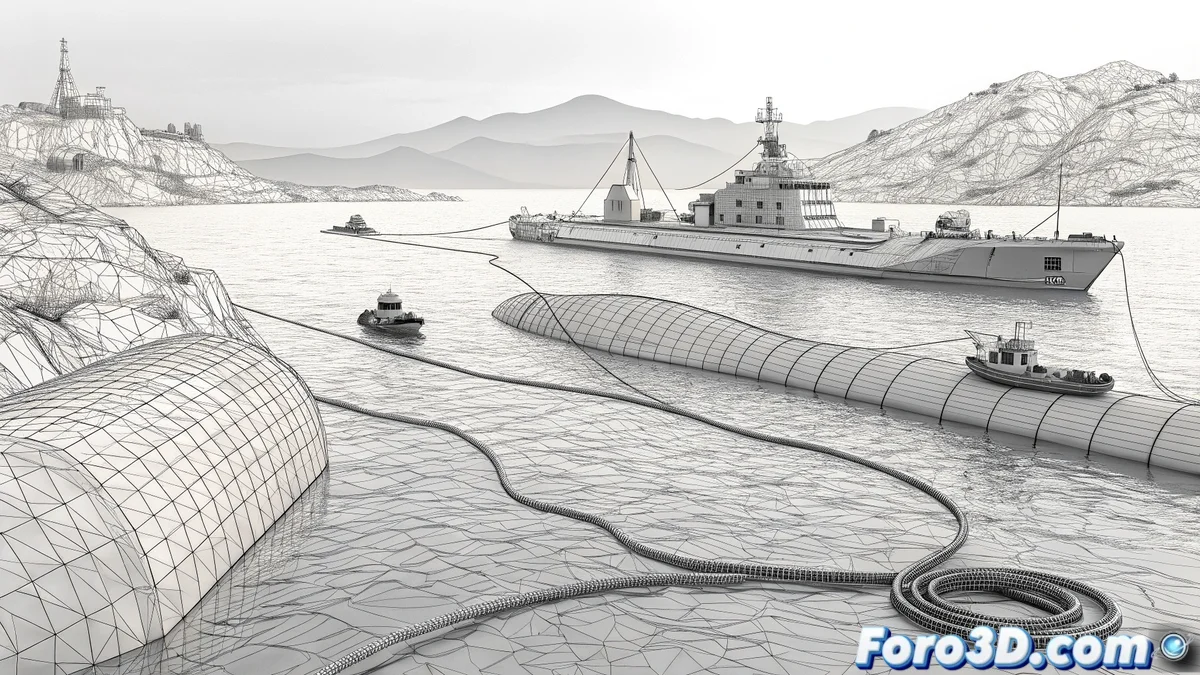
Project Setup and Environment Modeling
Starting a new file in Rhino with metric units is the first step to ensure scalar coherence. Organization into layers—Seabed, Cables, Ships, etc.—facilitates the management of different scene elements. The seabed is modeled using undulating surfaces that simulate the underwater relief, while the coasts of Ceuta and the Peninsula are created by extruding contour curves. The key is to maintain geometric simplicity to focus attention on the cable and its route 🗺️.
Cable Modeling and Technical Elements
The submarine cable is the protagonist of the scene. It is modeled by drawing a curve that follows the real route over the seabed and applying a circular sweep to generate its cylindrical geometry. It is important to add details such as connection points at both ends and some element that indicates scale, like specialized vessels. The assigned materials must reflect real properties: protective plastics and metals for the conductive cores. Key elements to include:
- Precise curve that defines the cable's route over the seabed.
- Cable geometry generated with sweep or extrusion tools.
- Installation ships modeled with simple but recognizable shapes.
- Buoys or markers that indicate critical laying points.
Materials, Lighting, and Rendering
Materials play a crucial role in the realism of the visualization. Water is simulated with a semi-transparent surface and subtle reflections, while the cable receives plastic or metallic textures with slight shines. Lighting is set up with a main sunlight to simulate a clear day, complemented with fill lights to avoid overly harsh shadows. Rendering is done with integrated engines or plugins like V-Ray, adjusting sampling and antialiasing parameters for a clean and professional result 🌅.
The Irony of the Submarine Connection
After centuries of shared history—and some disagreements—what definitively connects Ceuta to the Peninsula is a cable we can't even see... though it does have more bandwidth than ever 📡.