Giving Digital Shape to the Amazonian Mystery 🌿
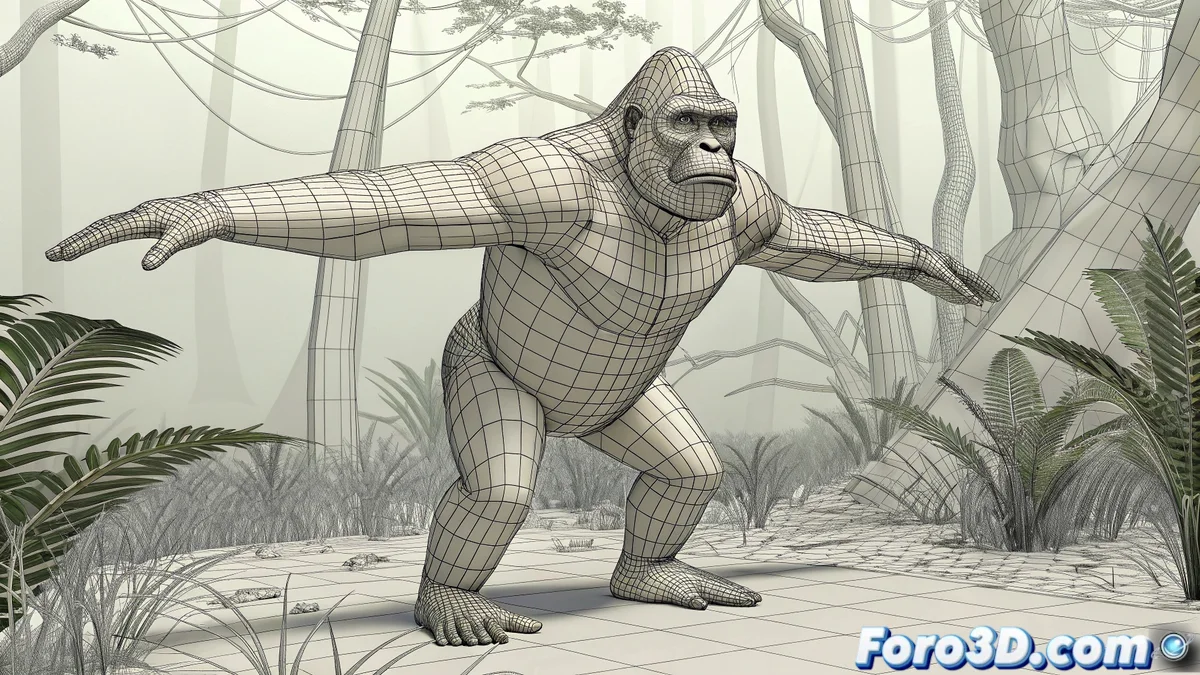
A hiker in the Brazilian Amazon jungle claims to have recorded a large humanoid creature, reigniting the debate about the existence of the South American sasquatch. This type of story, at the intersection between myth and possible reality, finds in Rhinoceros a powerful tool for its visual reinterpretation. NURBS modeling allows creating organic figures with anatomical precision, ideal for shaping beings that inhabit oral tradition more than zoology books.
NURBS Modeling of the Humanoid Creature
The process begins with NURBS curves that define the profile and basic proportions of the creature—approximately 2.5 meters tall, broad back, and robust limbs. These curves are extruded and lofted to generate continuous surfaces that form the torso, legs, and arms. NURBS modeling is ideal for this type of figure because it allows smooth and organic adjustments, creating believable muscular volumes without the rigidity of polygonal meshes. Details like large hands and disproportionate feet—key in witness descriptions—are added with precision. 🦍
Anatomy and Exaggerated Features
To capture the essence of the myth, certain anatomical features are exaggerated:
- Hunched shoulders and pronounced V-shaped torso
- Flattened skull with prominent jaw
- Long limbs and palms covered in geometric "fur"
- Semi-flexed posture suggesting primitive strength
These characteristics not only match sighting reports but also reinforce the narrative of a creature between human and animal.
Modeling a cryptid is navigating between known anatomy and the imagination needed to fill gaps.
Jungle Environment with Basic Geometry
The Amazon jungle is suggested through elements modeled with NURBS and surfaces of revolution: tree trunks as deformed cylinders, leaves as flat surfaces with organic curves, and roots as sweeps along curved guides. Although the focus is not hyperrealism, the strategic arrangement of these elements—creating layers of vegetation and vanishing points—contributes to the sense of depth and mystery. The resulting mesh serves as a solid base for future texturing or import into render engines.
Lighting and Sighting Atmosphere
To emulate the dim lighting of a video recorded among the undergrowth, a scene is set up with diffuse indirect light and some sun rays filtering through the vegetation. In Rhinoceros, this is achieved with directional lights that are soft and elongated shadow adjustments. The creature is positioned partially hidden by leaves or trunks, suggesting that fleeting moment of sighting reported by witnesses. The contrast between lit and dark areas adds drama and focuses attention on the humanoid figure.
Composition and Visual Narrative
The scene is composed to tell a story:
- Low angle that emphasizes the creature's size
- Foreground vegetation that frames the scene naturally
- Path or clearing that guides the gaze toward the figure
- Lack of direct eye contact to maintain mystery
These decisions transform a modeling exercise into an image loaded with narrative.
Export and Potential Uses
The final model is exported to formats like OBJ or FBX for use in render engines or realtime. Although Rhinoceros is not specialized in advanced materials, the clean NURBS topology allows for subsequent texturing in software like Substance Painter with excellent results.
While cryptozoologists debate the existence of these creatures, we debate with NURBS curves that resist closing cleanly. In the end, our Sasquatch may not be real, but the headaches from adjusting tangents absolutely are. 😅