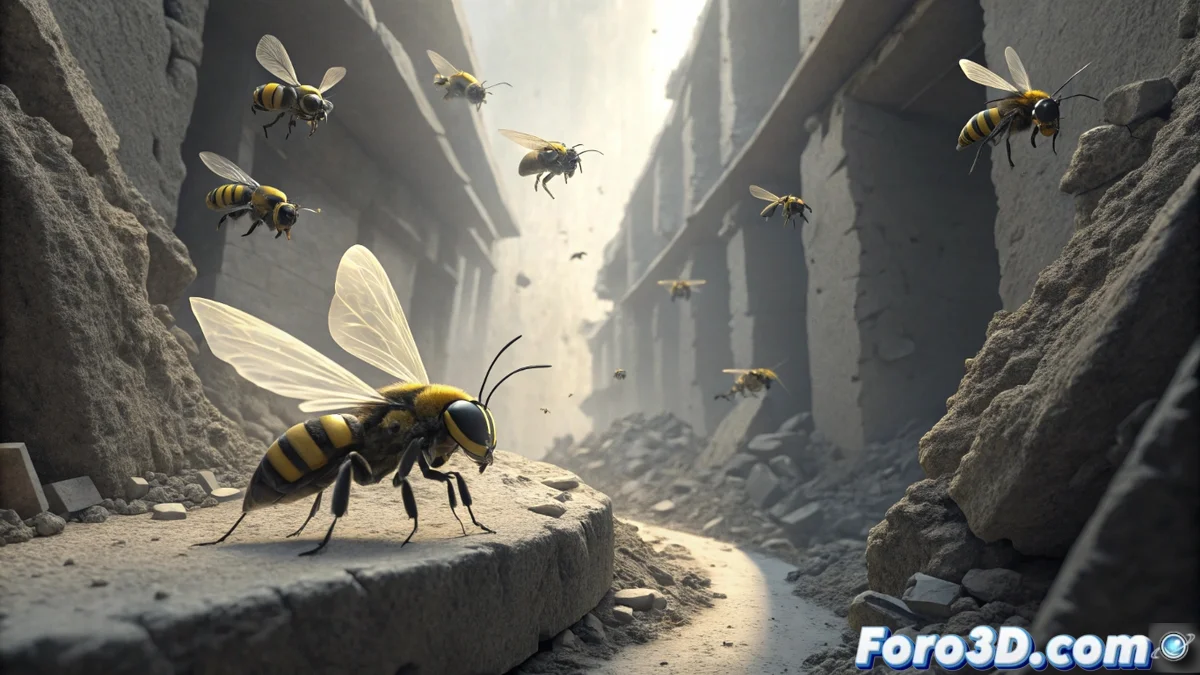
MIT Researchers Present an Aerial Microrobot that Imitates an Insect
A team from the Massachusetts Institute of Technology (MIT) has created a flying robot with minimal dimensions. This device, which weighs less than a paperclip and is the size of a microcassette tape, replicates the flight agility of a real bumblebee. Its design opens new possibilities for exploring spaces where common drones cannot enter 🐝.
A Flight System Inspired by Nature
The key to its operation lies in soft actuators made from rubber cylinders coated with carbon nanotubes. When voltage is applied, an electrostatic force is generated that causes these cylinders to compress and stretch rapidly, flapping the wings. This architecture is not only lightweight but also impact-resistant, allowing complex maneuvers and recovery from collisions.
Main Design Features:- Ultra-reduced dimensions: Comparable to a microcassette, ideal for confined spaces.
- Minimal weight: Less than that of a standard metal paperclip.
- Efficient actuation: Wings driven by rubber cylinders and carbon nanotubes, without heavy motors.
This lightweight and powerful architecture allows the robot to move with agility and withstand physical collisions.
Future Applications in Critical Scenarios
The ultimate purpose of this technology is to deploy swarms of microrobots on high-complexity missions. They could access areas devastated by earthquakes or accidents to locate trapped people, or inspect the interior of industrial machinery without dismantling it, transmitting data instantly.
Potential Operational Uses:- Debris Search: Explore inaccessible corners after a natural disaster.
- Technical Inspection: Assess the condition of pipes, reactors, or complex engines.
- Environmental Surveillance: Monitor dangerous or contaminated environments for human teams.
Current Challenges and Next Steps
In its current phase, the bumblebee robot requires a thin cable to receive power, which restricts its autonomy. Engineers are working to overcome this limitation. Future research could explore wireless charging systems or, more visionary, methods for the robot to obtain energy from environmental sources, a concept that seems straight out of science fiction but guides research in bio-inspired robotics 🤖.