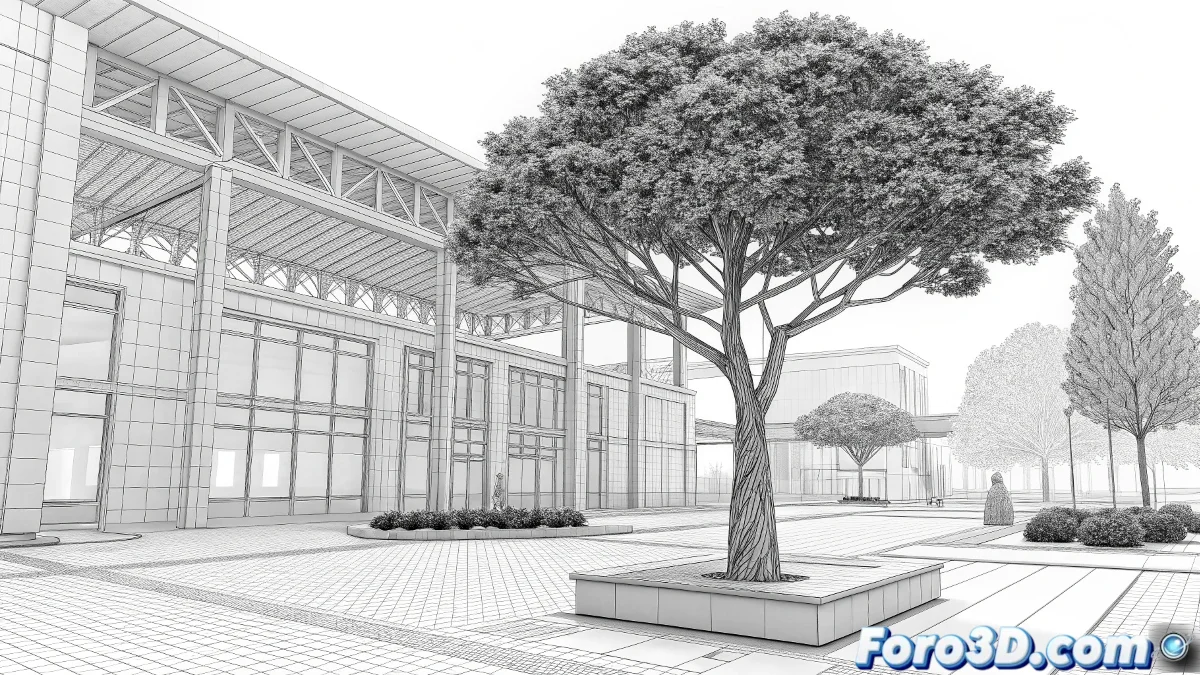
When Digital Trees Find Their Perfect Ecosystem
The integration of vegetation in 3ds Max represents one of those challenges where the technical choice directly impacts project viability. Where a poorly implemented tree can consume disproportionate resources, an intelligent vegetation strategy allows creating complete digital forests that breathe realism without strangling system performance. The evolution from traditional 3D models to specialized solutions like RPC and V-Ray Proxy marks the path toward an approach where every pixel of foliage earns its place by visual merit, not by technical accident.
The most fascinating aspect of this evolution is how it reflects our growing understanding of which elements truly contribute to the perception of realism. Where we once assumed that more geometry automatically equated to better quality, we now understand that the human eye prioritizes certain visual cues over others. A tree can be technically imperfect but visually convincing if it preserves the characteristics that our brain recognizes as real vegetation.
The best tree is not the most detailed, but the one that best fulfills its function in the composition
Methods According to Distance and Purpose
- Full 3D models for foreground and critical details
- Photographic RPC for midground and quick backgrounds
- V-Ray Proxy for massive vegetation and professional optimization
- Strategic combination for ideal balance
3D Models: The Luxury of Close-Up Detail
Traditional 3D models in formats like *.3ds or *.max represent the option of maximum geometric fidelity, with every leaf, branch, and trunk structure represented by real polygons. This approach is unbeatable for close shots and foregrounds where the camera explores the vegetation at distances that would reveal any technical shortcut. The ability to light these complex geometries with global illumination systems produces rich light interactions where light filters through the foliage and casts complex shadows that no 2D system can convincingly replicate.
The high computational cost of these models requires intelligent optimization strategies. Modifiers like Optimize and MultiRes allow creating Level of Detail (LOD) versions of the same tree, using the full geometry for close shots and progressively simplified versions for greater distances. This approach preserves quality where it matters while recovering precious resources where detail would be imperceptible.
RPC: The Elegance of the Photographic
- Extremely fast rendering with immediate visual impact
- Automatic camera orientation for visual consistency
- Extensive libraries of pre-produced plant species
- Perfect integration in architectural renders
RPC objects (Rich Photorealistic Content) operate under the principle that sometimes the best simulation of reality is reality itself. By using photographs of real trees cut out on planes that always face the camera, these elements offer instant realism that 3D geometry takes much longer to achieve. Their two-dimensional nature makes them remarkably efficient in terms of memory and render time, allowing extensive scenes to be populated with believable vegetation without significant performance penalties.
A well-chosen RPC can do in seconds what a 3D model takes minutes to render
V-Ray Proxy: The Power of Intelligent Loading
V-Ray Proxy (VRMesh) represents the most sophisticated solution for heavy geometry management in large-scale projects. By exporting complex vegetation as external .vrmesh files, the system keeps only a lightweight representation in the main scene during work, loading the full geometry exclusively during rendering. This intelligent separation between viewport and render radically transforms what is possible in terms of vegetation density, allowing the creation of extensive landscapes with thousands of individual trees that would be impossible to handle with native geometry.
Proxy export through V-Ray Mesh Export is a straightforward process that preserves all materials, mapping coordinates, and animations of the original model. Once exported, the proxy can be instanced multiple times with scale and rotation variations that break visual repetitiveness, creating the illusion of a diverse ecosystem from a limited set of base assets.
The Master Combination: Layered Strategy
- Foreground: full 3D models with maximum detail
- Midground: V-Ray Proxy for quality-performance balance
- Backgrounds and distances: RPC for maximum efficiency
- Transitions: progressive LODs for smooth changes
The strategic combination of methods is where the true art of vegetation in 3ds Max lies. Starting with detailed 3D models for foreground elements that justify the investment in geometry, transitioning to V-Ray Proxy for the main mass of vegetation that requires volume but not extreme detail, and finishing with intelligently placed RPC for backgrounds and distant elements, a quality gradient is created that maximizes visual impact while minimizing computational cost.
This layered approach replicates how we naturally perceive vegetation in the real world—with attention to close-up detail and acceptance of imprecision at a distance—creating renders that are not only technically efficient but psychologically convincing. Attention to transitions between different detail levels prevents that annoying visual "pop-in" that reveals abrupt LOD changes.
And while your scene finally displays that forest breathing realism from foreground to horizon, you understand that true mastery in 3D vegetation is not in choosing one method over others, but in orchestrating them harmoniously to create digital ecosystems that feel alive in every pixel 🌳