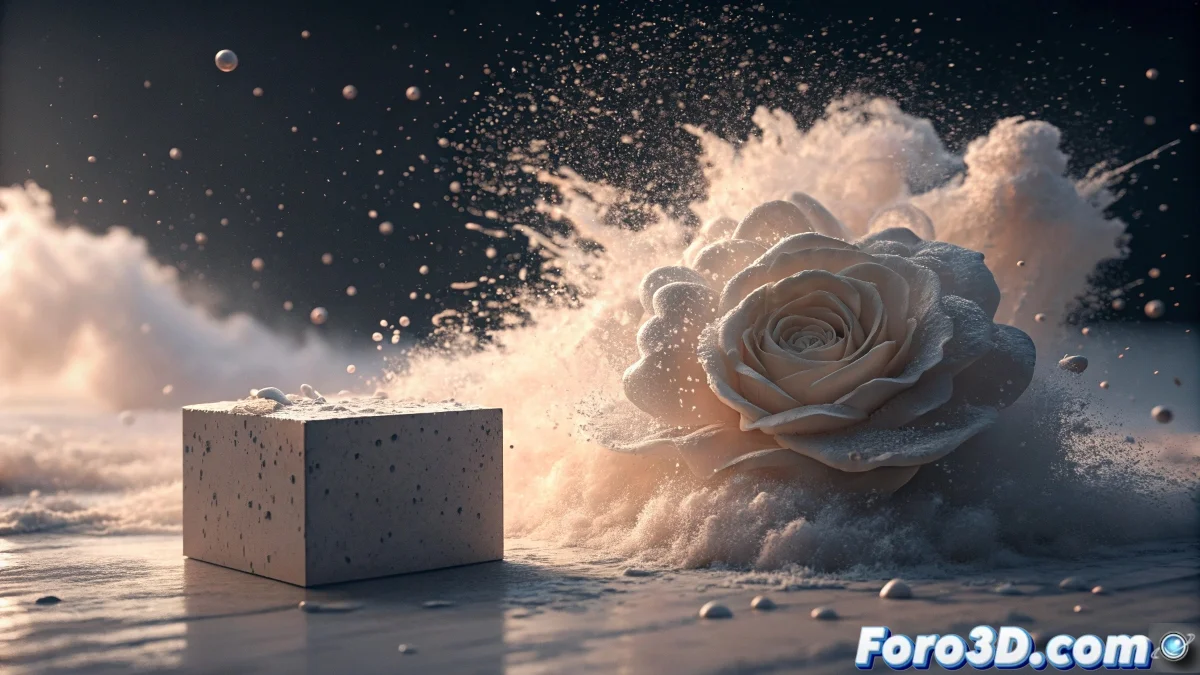
When Particles Decide to Change Shape
RealFlow presents that parallel universe where solid objects can melt, transform, and reconstitute into new shapes through the power of fluid particles. The transition between one object and another through this system is so magical that it almost makes one forget the complex mathematics happening behind the scenes. Whoever masters this technique can turn a torus into a dragon with the elegance of a digital magic trick.
The fundamental process involves using the initial object as a particle emitter that gradually forms the silhouette of the target object. What seems like a simple animation is actually a choreographed ballet of fluid dynamics, where each particle knows exactly where it should be at every moment.
Setting Up Transformer Emitters
The first step consists of creating an Object emitter that will use the initial geometry as a source of particles. The Resolution and Particle Size parameters determine how many soldiers our transforming army will have. Too many and the calculation drags on forever, too few and the result looks like Swiss cheese with volumetric aspirations.
- Select source geometry as particle emitter
- Adjust resolution according to object complexity
- Define emission rate to control transformation speed
- Set initial velocity for flow direction
In RealFlow, patience is the most powerful daemon of all
The Art of Directing Particles with Daemons
Daemons act as invisible orchestra conductors that guide the particles toward their new shape. The Attractor is essential for this type of transformation, using the target object as a magnet that attracts the particles to its surface. The attraction force must be carefully balanced to avoid particles arriving like bullets or like lazy snails.
For more organic transformations, combinations of Noise Field and Vortex add that controlled chaos that avoids unnatural mechanical movements. The activation time of each daemon creates choreographies where the particles first disperse and then converge toward the new object.
- Attractor to guide particles to the target object
- Noise Field to add natural variations
- Vortex to create elegant spiral movements
- Gravity to anchor the simulation to physical reality
From Particles to Visible Mesh
Particles alone are like invisible ghosts until the Meshing process is applied. The Particle Mesh node creates a continuous surface that connects the points into a solid geometry. The Radius and Filter settings determine how smooth or grainy the final transformation appears.
For perfect transitions, the original object's disappearance can be animated as the new particle mesh appears. Blend techniques between materials complete the illusion, making it so the viewer never detects the exact point where one object ends and the other begins.
- Apply Particle Mesh to create visible surface
- Animate opacity of source and target objects
- Adjust materials for smooth transition
- Use cache for quick preview
By mastering these techniques, any object can transform into any other with the fluidity of mercury and the magic of cinema. Because in RealFlow, even the most ordinary teapot can dream of becoming an art nouveau vase, as long as you have enough RAM and patience 😏