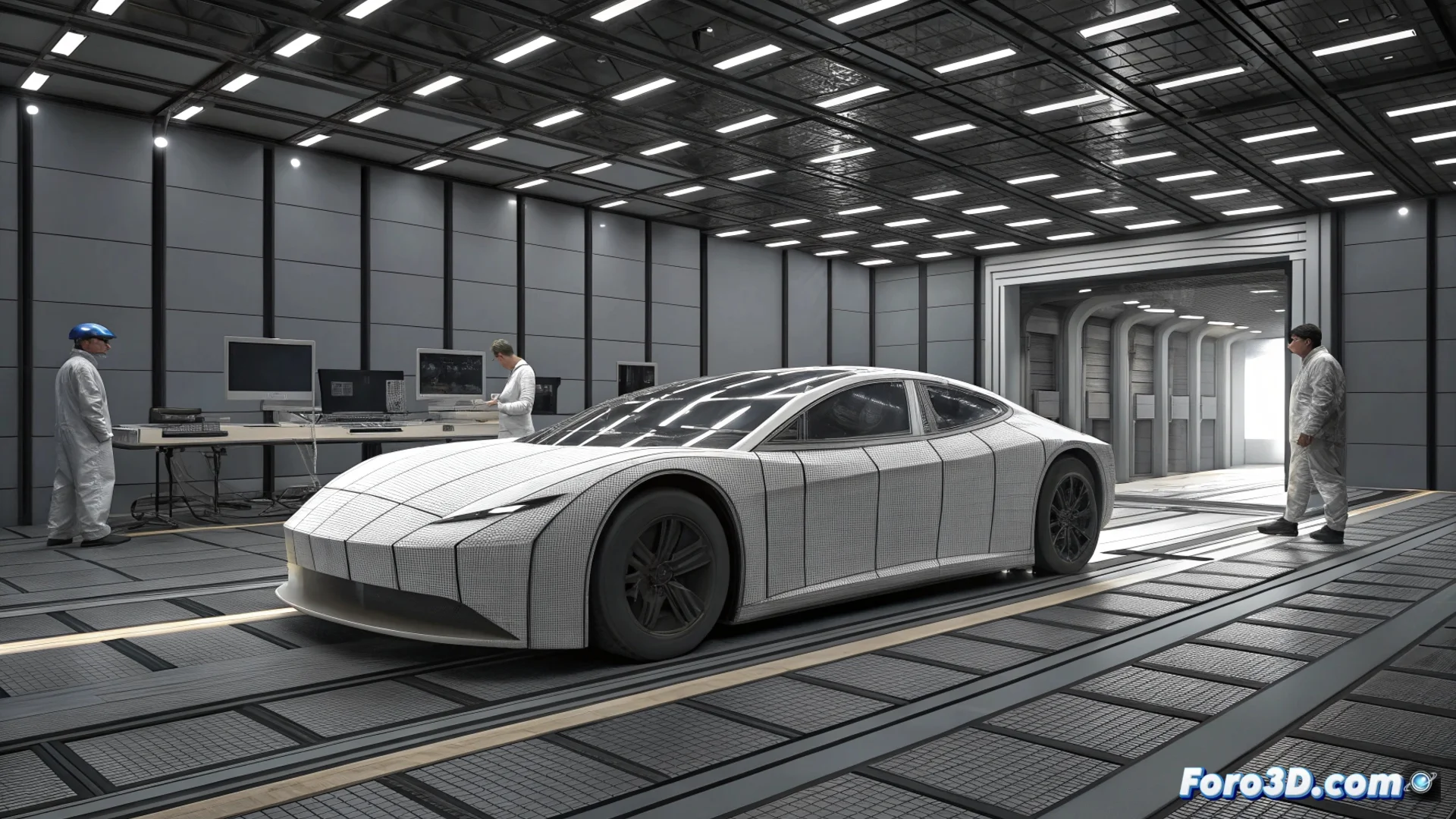
Lightyear Used 3D Printing to Develop Its First Solar Prototype
Before manufacturing its first production model, the Lightyear 0, the Dutch company Lightyear had to validate and perfect its design exhaustively. For this purpose, the team integrated 3D printing fundamentally into the development phase of the Lightyear One prototype, materializing body components and custom supports at an unprecedented speed. 🚗⚡
Additive Manufacturing Accelerated the Iterative Design Process
The main challenge was to achieve maximum energy efficiency, where aerodynamics plays a determining role. Any adjustment in the vehicle's shape could alter its drag coefficient. Instead of relying on traditional manufacturing techniques, which are slower and more expensive, they opted to 3D print hundreds of parts. This enabled testing new versions of panels, spoilers, and wings in a very short time, evaluating their performance in the wind tunnel, and continuously refining the design until achieving the ideal shape.
Key Advantages of Rapid Prototyping:- Iteration Speed: Produce physical components in hours or days, not weeks.
- Physical Validation: Test parts on full-scale models and in simulated conditions.
- Design Flexibility: Implement and test complex geometric changes agilely.
The process demonstrated that, to create a car of the future that hardly needs to be plugged in, you first have to print mountains of plastic.
Functional Prototypes to Validate Aerodynamic Performance
These elements manufactured with additive technology, although not the definitive parts for a road car, served to build complete and functional test models. These prototypes could undergo rigorous tests that replicated real driving situations. The ability to transform digital concepts into tangible objects quickly was a decisive factor in achieving the exceptionally low drag coefficient that defines Lightyear vehicles, an essential attribute for maximizing range with solar energy.
Results of the Adopted Approach:- Optimal Aerodynamic Efficiency: An extremely low drag coefficient was achieved.
- Compressed Development Cycle: The time between design and testing was significantly reduced.
- Reduction in Initial Costs: High investments in traditional molds were avoided in early phases.
A Fundamental Method for Sustainable Mobility
Lightyear's strategy underscores the value of 3D printing in the modern automotive industry, especially for projects seeking to break paradigms like solar mobility. This case demonstrates how an agile manufacturing technology can be the foundation for developing more efficient and sustainable transportation solutions, allowing for rapid and precise iteration until achieving a revolutionary product. 🌞🔧