LASED: the 3D printer that prints in the air… literally
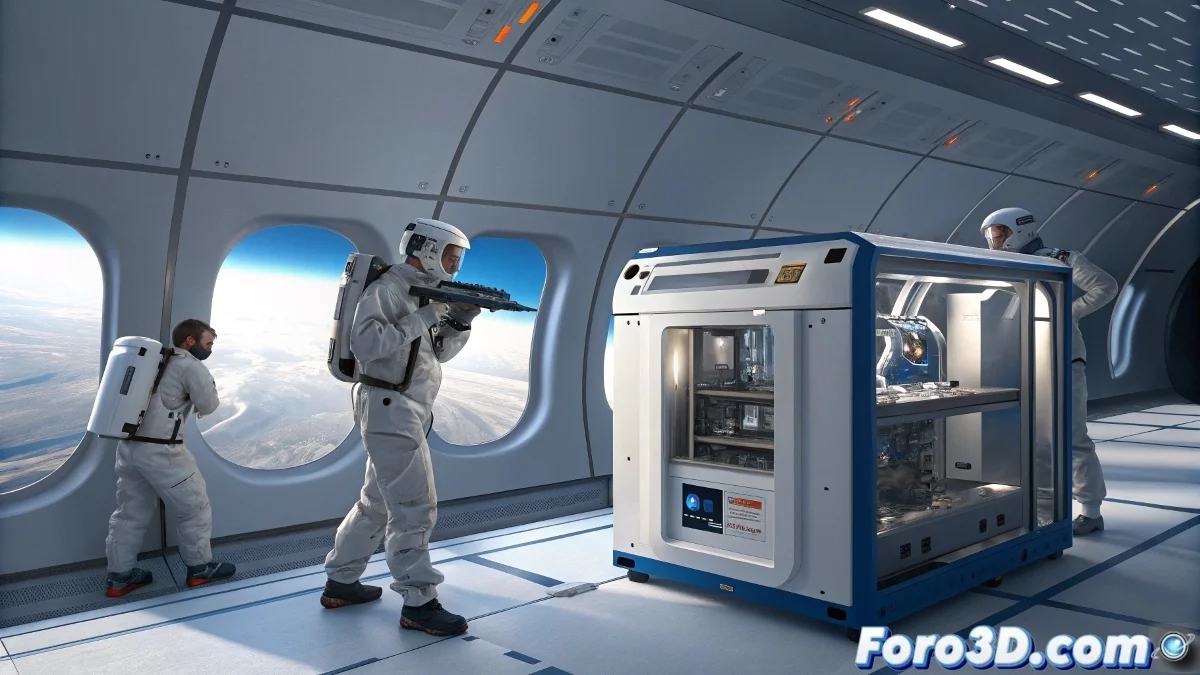
A team from Auburn University has taken a crucial step in space additive manufacturing. Their LASED printer (Laser-Assisted Sintering in Extreme Dimensions), only 60 cm in size, has successfully printed during parabolic flights that simulate weightlessness conditions.
What makes it different?
- Compact and efficient: Consumes less than 500W, ideal for long-duration missions.
- Multimaterial: Uses laser to sinter metal powders and deposit nanoparticles.
- Autonomous: Reduces the need to send parts from Earth.
During the flights, conducted in a modified Boeing 727, LASED was able to print during periods of 20 to 25 seconds of microgravity. Key properties such as mechanical strength, dimensional accuracy, and roughness were then analyzed.
What's next: printing on the ISS and beyond
The next step will be to test semiconductors in low-gravity environments in 2025, with an eye on future lunar missions and the International Space Station. The dream of having self-sufficient orbital factories no longer seems like science fiction.
While on Earth we continue to struggle with jammed filaments, LASED demonstrates that printing in space… might be easier.