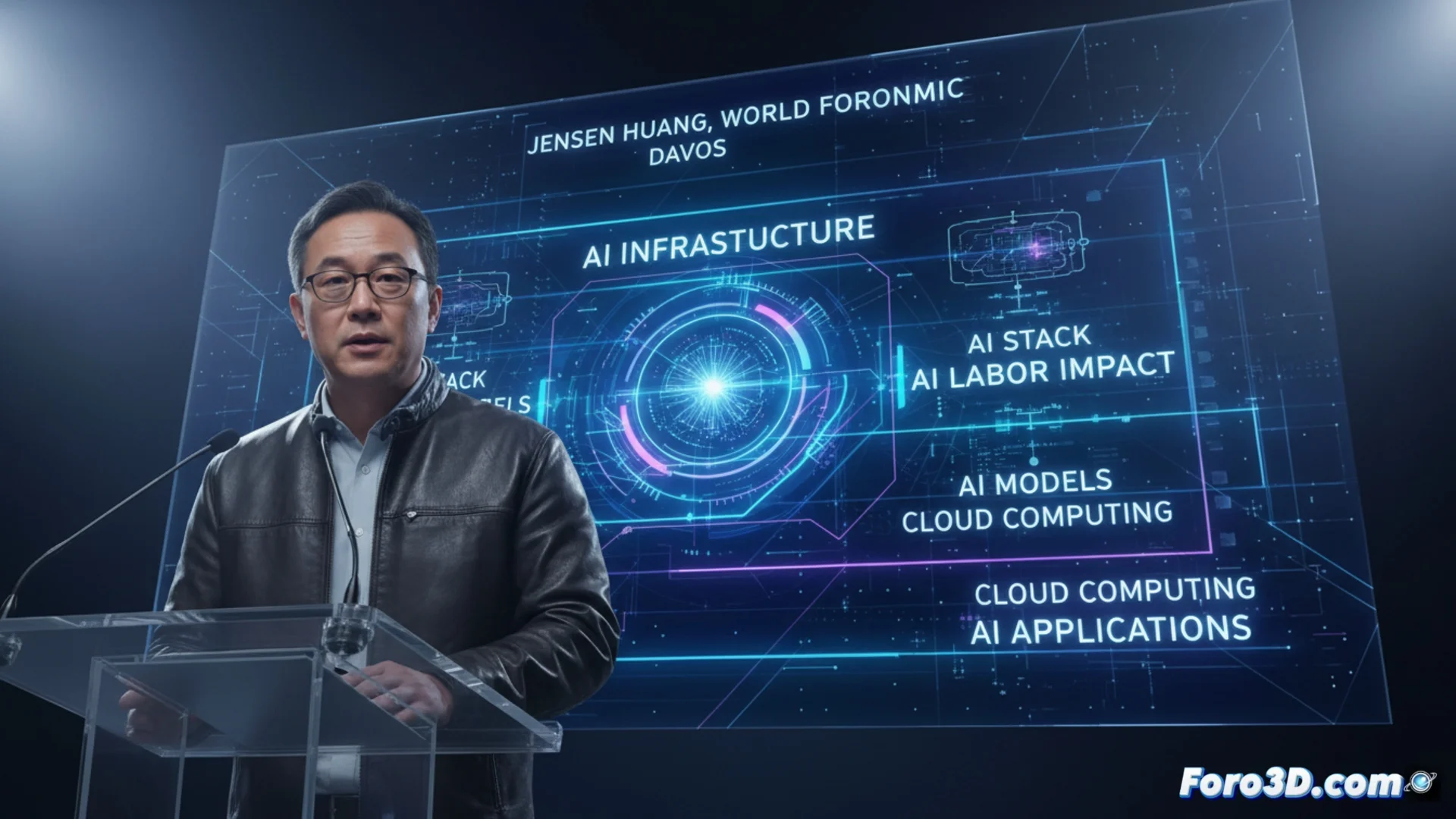
Jensen Huang at Davos: Artificial Intelligence as Stratified Infrastructure
During the World Economic Forum in Davos, Jensen Huang, the CEO of NVIDIA, defined artificial intelligence as the core of what he considers the largest infrastructure project ever attempted. His perspective goes beyond seeing it as an isolated tool, presenting it as a complex and layered system that acts as an economic engine for numerous sectors. 🏗️
The Layered Architecture of the AI Platform
Huang explained this infrastructure using the analogy of a five-tier cake. The fundamental base is the power supply. Upon it rests the layer of chips and computing hardware. The third level consists of cloud data centers, which serve as support for creating foundational AI models. The upper and most visible layer is that of applications, where the technology is integrated into specific areas.
The five strata of AI infrastructure:- Energy: The base that powers the entire system.
- Hardware: Chips and systems for processing data.
- Data Centers: Cloud infrastructure that hosts and runs.
- Base Models: The core algorithms that learn and reason.
- Applications: Specific solutions for finance, health, or manufacturing.
"Each of these layers needs to be built, operated, and maintained, driving a diverse demand for talent on a global scale." - Jensen Huang
Economic and Employment Consequences by Level
The NVIDIA leader highlighted that each stratum of this ecosystem generates its own demand for professionals. This phenomenon activates the entire economy, involving sectors from energy and construction to precision manufacturing, cloud operations, and software programming. Huang specified that the applications stratum is the one that produces tangible economic value, by enabling companies to reinvent how they work and what services they offer.
Sectors mobilized by AI infrastructure:- Energy and Construction: To build and maintain the physical base.
- Advanced Manufacturing: To produce specialized hardware.
- Cloud Operations: To manage data centers.
- Software Development: To create models and applications.
A Shift in the Narrative on Employment
It is paradoxical that, after years of warning that machines would replace humans, a technology is now being promoted by arguing that a lot of people will be needed to build and care for those same machines. Huang's vision closes a circle, positioning AI not as a replacement, but as a catalyst for a new era of construction and maintenance on a global scale. 🤖