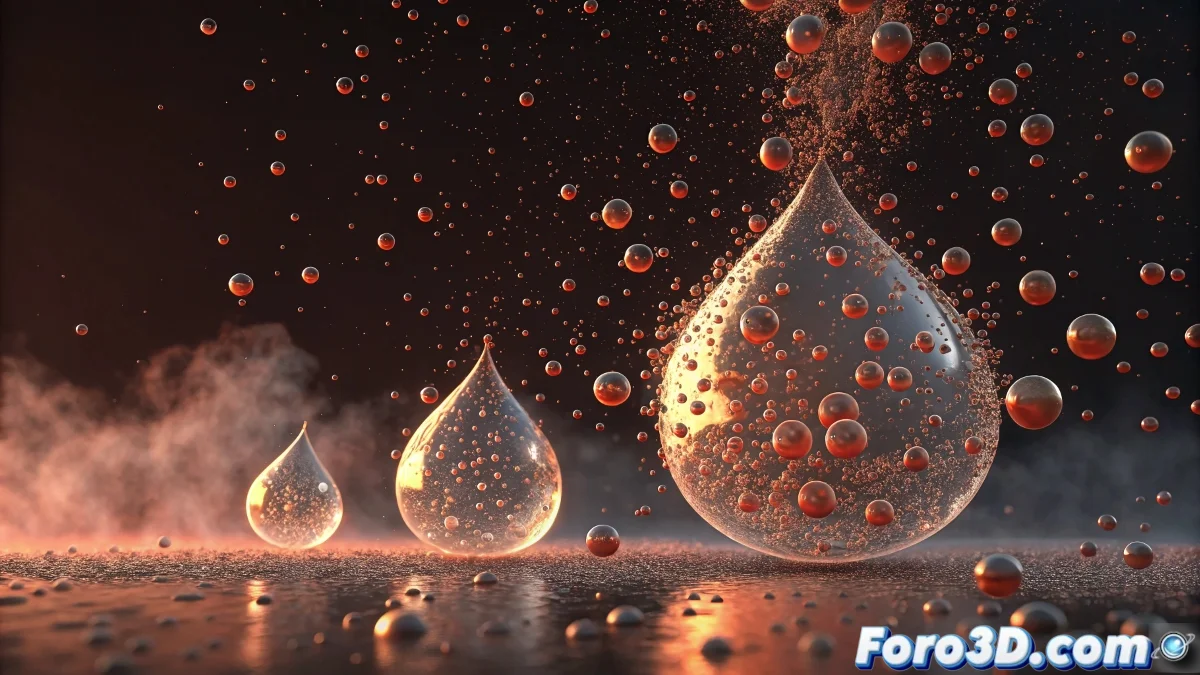
The Dilemma of Cannibal Drops in Particle Flow
What you're describing is one of those seemingly simple but surprisingly complex effects to achieve in Particle Flow. It's not just about the drops sliding across the surface, but about them acting as small liquid vacuums that absorb everything in their path. The static condensation should yield to the advance of the larger drops.
The challenge lies in creating a system where two types of particles interact intelligently: the moving drops as predators and the condensation particles as prey. Particle Flow can handle this, but it requires a specific setup of events and collisions.
In the world of particles, large drops are like sharks and small ones like plankton
Predator-Prey System Setup
You need to create two independent but communicating particle systems. One for the moving drops and another for the static condensation, with an event that manages the devouring particle by particle.
- Main drops system: large particles with gravity and surface collision
- Condensation system: small static particles adhered to the can
- Cross-collision event: connect both systems for contact detection
- Transfer action: delete small particles when touched by drops
Specific Events for Particle Consumption
The magic happens in the Collision Spawn event or a combination of Collision and Delete. When a drop detects a condensation particle in its path, an absorption mechanism must be triggered.
You can make the drops grow slightly when absorbing other particles, simulating that liquid accumulation effect. It's the particle life cycle 😊
- Collision test: detect contact between particle systems
- Spawn on collision: optional for absorption visual effects
- Scale increase: make the drop grow when consuming particles
- Speed inheritance: transfer some momentum if necessary
Parameters for Realism in Absorption
For the effect to be convincing, you need to carefully adjust how and when the transfer occurs. It's not about instant deletion, but a gradual process that respects the laws of physics.
The collision detection radius is crucial: too small and the drops will pass by, too large and they'll absorb particles from afar in an unrealistic way.
- Collision radius slightly larger than the visual radius
- Delay in deletion for gradual effect
- Random variation in the absorption process
- Proximity activation instead of exact contact
Practical Step-by-Step Solution
If you feel overwhelmed by the complexity, start with a simplified system. An inclined plane with static particles and a single moving drop will let you fine-tune the setup before applying it to the full can.
Remember that Particle Flow is like visual programming: each event is an if-then condition that dictates particle behavior.
- Create test system with simple geometry
- Set up basic collision detection first
- Add gradual growth effects later
- Transfer setup to the final scene
After mastering this technique, your drops won't just slide across the surface, but will grow and strengthen with every particle they encounter on their path... like little liquid ninjas on a cleaning mission 💦