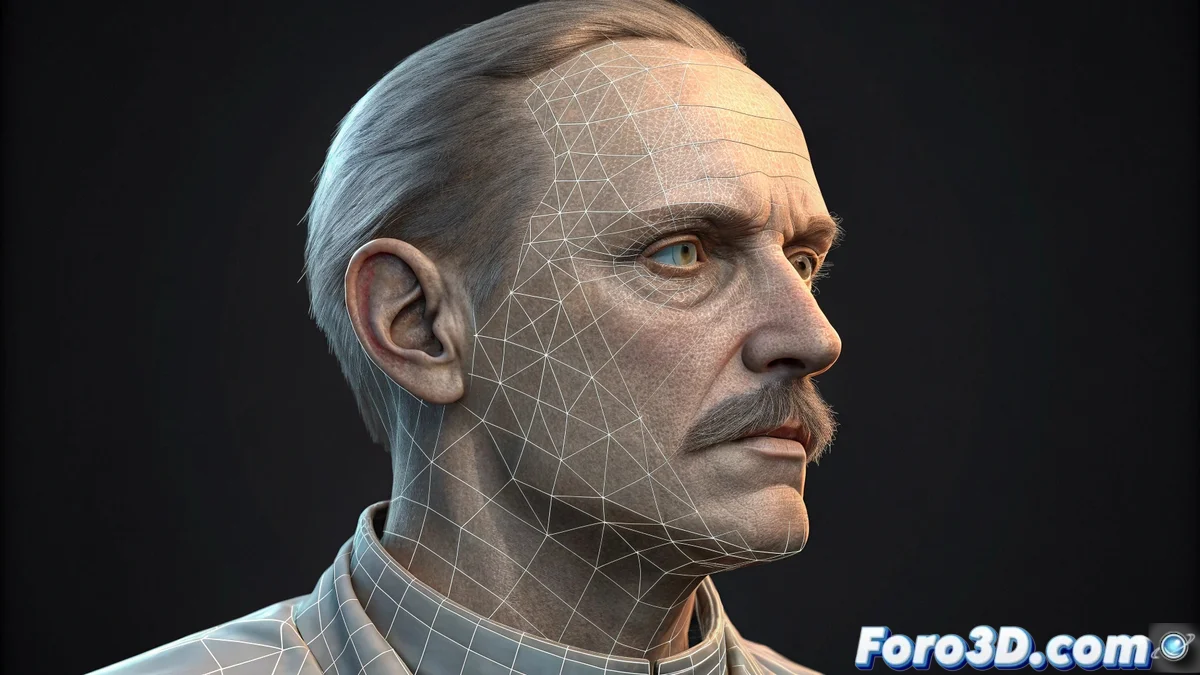
When the face changes, the hair must keep up
Animating a character with facial expressions using the Morpher modifier in 3ds Max is a common practice, but integrating elements like hair or mustache can become a headache. 😫 The classic mistake is to collapse or attach (attach) this additional geometry to the head mesh, which irreparably breaks the vertex correspondence with the morph targets. The solution is not to merge, but to create intelligent systems that communicate with each other without losing their individual properties.
The golden rule: maintain independence
The fundamental principle is clear: never collapse the geometry of the Morpher. The head mesh must remain intact and separate from any hair system. 💇 Instead, modifiers and techniques should be used that allow the hair to "ride" on the deformed surface. For head hair, the modern and efficient option is to use systems like Hair and Fur (integrated in 3ds Max) or more advanced plugins like Ornatrix, which dynamically adapt to changes in the base mesh shape.
The key is intelligent separation, not destructive fusion.
Specific techniques for mustaches and facial hair
For more localized elements, like a mustache or sideburns, there are elegant solutions. One of the most effective is the Skin Wrap modifier. 🎭 This modifier is applied to the mustache geometry (which can be a simple mesh or guide for a hair system) and is instructed to "wrap" or follow the deformation of the head that has the Morpher. This way, the mustache will copy all movements and expressions without altering the original structure of the head.
- Subobject linking: Some hair systems allow anchoring to a specific selection of face polygons.
- Auxiliary objects: Using dummies or helper objects linked to the head to guide the hair.
- Independent body: The morphed head is linked to the body via a skeleton (Skin) or constraints, not by joining it.
A robust workflow
The safest strategy is to work in layers. First, the facial animation is completed and fully tested with the Morpher on the head alone. Once it works correctly, hair systems are added as independent elements that reference the deformed head. 💡 This not only avoids technical problems but also facilitates iterations; the hairstyle can be adjusted without fear of ruining the expression animation.
The relationship between the Morpher and the hair is like that of two good roommates: each has their own living space, but they coordinate perfectly to move the furniture. 😉 That said, if one does an exaggerated morph, the other must be prepared to follow the movement without complaining.