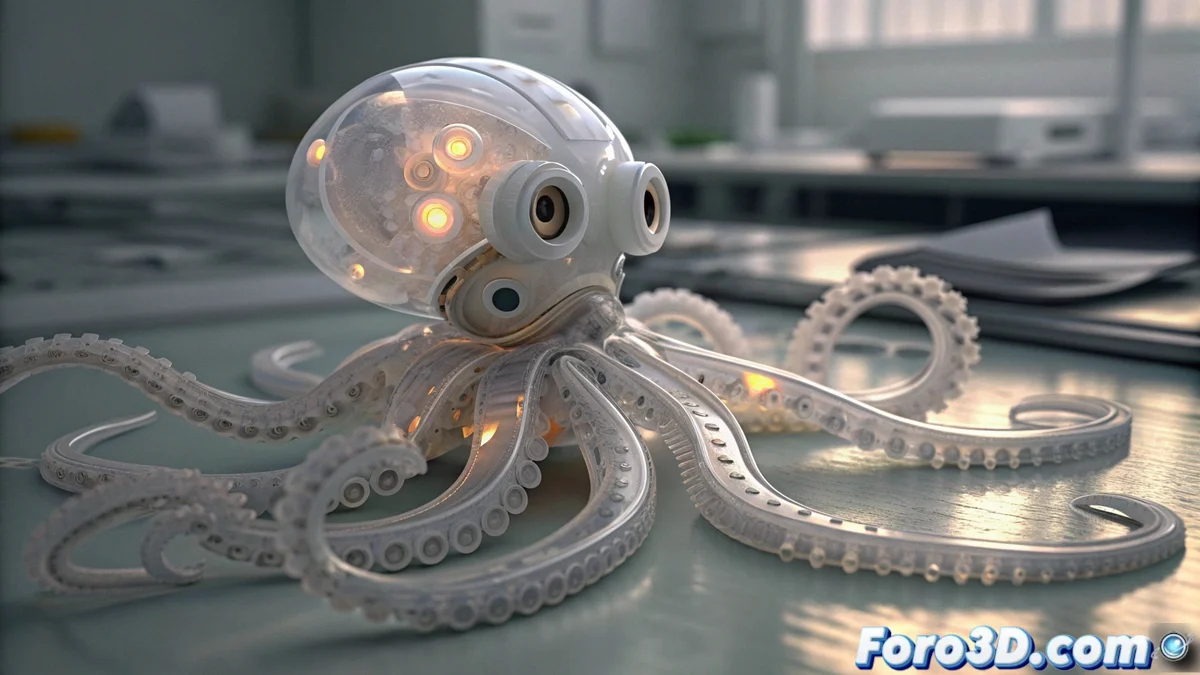
Harvard's Octobot: a Soft and Autonomous Robot
The Wyss Institute at Harvard University has presented a milestone in engineering: the Octobot. This device is the first completely soft robot that operates without relying on wires, batteries, or rigid electronic circuits. Its design, inspired by an octopus, dispenses with traditional components and opens a new path for building autonomous and flexible machines 🐙.
A Chemical Propulsion System Without Electronics
The key to its operation lies in a fluidic logic circuit that is integrated directly into the robot's silicone body. The researchers fabricate both the structure and this internal circuit using a 3D printer. Instead of electric motors, movement is generated by a controlled chemical reaction.
Octobot's Mechanism of Action:- A small amount of hydrogen peroxide decomposes inside the robot, producing gas.
- The microfluidic circuit directs and channels this gas precisely.
- The gas alternately inflates groups of tentacles, creating a pumping motion that propels the robot.
By not using traditional electronics, the robot can operate in environments where rigid systems might fail or be unsuitable.
Implications and Future of Soft Robotics
This innovative approach goes beyond the conceptual prototype. By creating robots that are inherently soft and safe, possibilities are unlocked for interacting with living organisms without the risk of harming them. The absence of metal parts or toxic batteries is fundamental for this purpose.
Possible Fields of Application:- Medical Applications: Devices that can navigate inside the human body for diagnostic tasks or drug delivery.
- Exploration in Confined Spaces: Accessing rubble, pipes, or complex environments where rigid robots would get stuck.
- Safe Interaction: Working alongside people in collaborative environments without the danger posed by hard parts.
The Path Ahead
Harvard's team continues researching to evolve this first Octobot. The next steps include incorporating basic sensors that allow the robot to perceive its environment and achieve more complex and directed movements. Although its appearance may seem playful, its technology represents a paradigm shift in how we design and build autonomous machines, paving the way for more integrated and adaptable robotics 🤖.